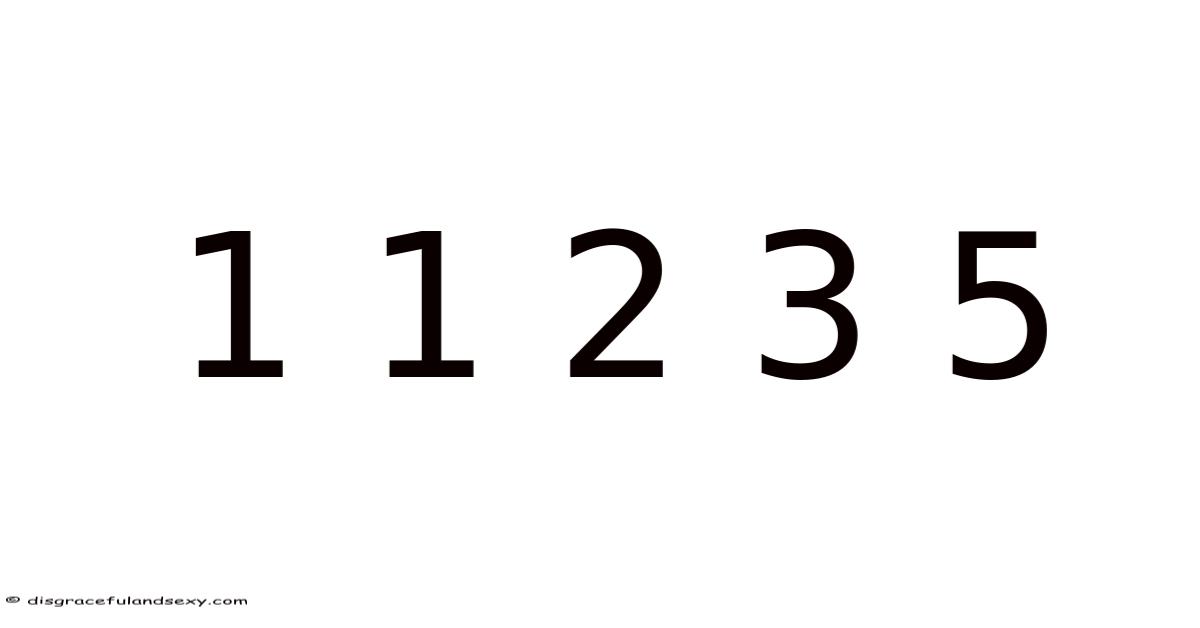
Unraveling the Mystery: The Fascinating World of the Fibonacci Sequence (1, 1, 2, 3, 5...)
The sequence 1, 1, 2, 3, 5... might seem unremarkable at first glance. That said, this seemingly simple series of numbers, known as the Fibonacci sequence, holds a profound significance in mathematics, nature, and even art. Understanding the Fibonacci sequence opens a window into the elegant patterns underlying seemingly chaotic systems. This article gets into the intricacies of the Fibonacci sequence, exploring its origins, mathematical properties, and surprising appearances throughout the natural world. We'll uncover its secrets and explore its lasting impact on various fields.
It sounds simple, but the gap is usually here.
Introduction: A Glimpse into the Golden Ratio
The Fibonacci sequence is a series where each number is the sum of the two preceding ones, usually starting with 0 and 1. That's why while the sequence is famously represented as 1, 1, 2, 3, 5, 8, 13, 21, and so on, it's crucial to understand that its mathematical underpinnings extend far beyond this initial sequence. As the Fibonacci sequence progresses, the ratio between consecutive numbers approaches the golden ratio, a proportion found throughout art, architecture, and nature. 618, often represented by the Greek letter phi (Φ). The sequence's significance lies in its close relationship to the golden ratio, approximately 1.This convergence on the golden ratio is a key to understanding the sequence's captivating properties And that's really what it comes down to..
Leonardo Pisano Bigollo (Fibonacci): The Man Behind the Sequence
The sequence is named after Leonardo Pisano Bigollo, better known as Fibonacci, a prominent Italian mathematician of the 13th century. In practice, he introduced the sequence to the Western world in his 1202 book, Liber Abaci. While the sequence wasn't entirely his discovery (earlier appearances exist in Indian mathematics), Fibonacci's work popularized it and laid the foundation for its subsequent exploration and applications. His introduction of the sequence wasn't presented as a profound mathematical concept but rather as a solution to a practical problem: rabbit population growth.
The Rabbit Problem: A Simple Explanation
Fibonacci's original context for the sequence involved a thought experiment about rabbit reproduction. He posited a scenario where a pair of rabbits produces a new pair every month, and each new pair takes one month to mature before producing their own offspring. By tracking the number of rabbit pairs each month, Fibonacci arrived at the sequence:
- Month 1: 1 pair
- Month 2: 1 pair (the original pair)
- Month 3: 2 pairs (the original plus one new pair)
- Month 4: 3 pairs (the previous month's 2 plus 1 new pair)
- Month 5: 5 pairs (3 + 2)
- Month 6: 8 pairs (5 + 3)
- And so on...
This seemingly simple rabbit problem illustrates the recursive nature of the Fibonacci sequence, where each term is defined in relation to the previous terms. This recursive definition is key to understanding its mathematical properties And it works..
Mathematical Properties: Beyond the Basics
The Fibonacci sequence boasts a rich array of mathematical properties, many of which are interwoven and interconnected:
-
Recursive Definition: As mentioned earlier, the core defining characteristic is its recursive nature: F(n) = F(n-1) + F(n-2), where F(n) represents the nth Fibonacci number. This simple rule generates the entire sequence.
-
Closed-Form Expression (Binet's Formula): While the recursive definition is intuitive, a closed-form expression allows direct calculation of any Fibonacci number without calculating all preceding numbers. Binet's formula, a remarkable result, provides this:
F(n) = (Φⁿ - ψⁿ) / √5
where Φ is the golden ratio ((1 + √5) / 2) and ψ is its conjugate ((1 - √5) / 2). Despite involving irrational numbers, this formula yields whole numbers for the Fibonacci sequence.
-
Golden Ratio Convergence: As mentioned previously, the ratio between consecutive Fibonacci numbers (F(n+1) / F(n)) approaches the golden ratio (Φ) as n approaches infinity. This convergence is a fundamental property that links the Fibonacci sequence to the golden ratio's ubiquitous presence in nature and art.
-
Summation Properties: Various elegant summation formulas exist for the Fibonacci sequence. Take this: the sum of the first n Fibonacci numbers is given by F(n+2) - 1. This demonstrates an inherent interconnectedness within the sequence itself.
-
Matrix Representation: The Fibonacci sequence can be elegantly represented using matrices, leading to efficient computational methods for generating large Fibonacci numbers That's the whole idea..
The Fibonacci Sequence in Nature: A Ubiquitous Pattern
The Fibonacci sequence's true fascination lies in its pervasive appearance throughout the natural world. This isn't a mere coincidence; it reflects fundamental principles of growth and optimization in biological systems And it works..
-
Phyllotaxis (Plant Arrangements): The arrangement of leaves, petals, and seeds in many plants follows Fibonacci numbers. As an example, the number of spirals in a sunflower head often corresponds to consecutive Fibonacci numbers. This arrangement optimizes sunlight capture and seed dispersal The details matter here..
-
Flower Petals: The number of petals in many flowers is a Fibonacci number (3, 5, 8, 13, etc.). Again, this is thought to be an evolutionary optimization for efficient space utilization and pollination.
-
Pinecones and Pine Needles: The spiral arrangement of scales on a pinecone often exhibits Fibonacci numbers. Similarly, the number of needles in a pine cluster is frequently a Fibonacci number Simple, but easy to overlook..
-
Seashells (Nautilus Shell): The spiral shape of a nautilus shell is often cited as an example of the golden spiral, a spiral whose growth factor is the golden ratio, closely related to the Fibonacci sequence And that's really what it comes down to..
-
Tree Branching: The branching patterns of many trees exhibit Fibonacci-like sequences. The main trunk branches into two, then each branch into two or more, and so on, creating a fractal-like structure.
-
Animal Anatomy: Fibonacci numbers can also be found in the bone structure of certain animals, and in the arrangement of scales and feathers.
The Fibonacci Sequence in Art and Architecture: Aesthetics and Proportion
About the Fi —bonacci sequence and the golden ratio have inspired artists and architects for centuries. The aesthetically pleasing proportions associated with the golden ratio are believed to create a sense of harmony and balance Not complicated — just consistent..
-
Classical Architecture: Many classical buildings incorporate proportions based on the golden ratio, creating a sense of visual harmony. The Parthenon in Greece is often cited as an example of such architectural design, although the degree to which it adheres strictly to golden ratio proportions is debated among scholars.
-
Renaissance Art: Renaissance artists, notably Leonardo da Vinci, utilized the golden ratio in their compositions, believing it to create visually pleasing and balanced works. Da Vinci's Vitruvian Man is a famous example of the application of these principles.
-
Modern Art and Design: The golden ratio and Fibonacci sequence continue to influence modern art, design, and photography. Artists and designers often incorporate these proportions to create visually appealing and harmonious compositions But it adds up..
The Fibonacci Sequence in Computer Science: Applications and Algorithms
Beyond its natural and artistic manifestations, the Fibonacci sequence plays a significant role in computer science. Its recursive nature and mathematical properties lend themselves to various algorithms and applications:
-
Algorithm Design: The recursive nature of the Fibonacci sequence is used in the design of recursive algorithms, which break down problems into smaller, self-similar subproblems.
-
Data Structures: Fibonacci heaps, a type of priority queue data structure, make use of Fibonacci numbers in their implementation to achieve efficient performance That's the whole idea..
-
Cryptography: Certain cryptographic techniques take advantage of the properties of the Fibonacci sequence for encryption and decryption processes It's one of those things that adds up. And it works..
Frequently Asked Questions (FAQ)
Q: Is the Fibonacci sequence infinite?
A: Yes, the Fibonacci sequence is infinite. The recursive definition allows for the generation of an unbounded sequence of numbers Small thing, real impact..
Q: Are all spirals in nature Fibonacci spirals?
A: While many spirals in nature closely approximate Fibonacci spirals (golden spirals), not all spirals strictly adhere to this pattern. That said, the Fibonacci spiral is a common and significant type of spiral found in nature That's the part that actually makes a difference..
Q: Is the golden ratio exactly 1.618?
A: The golden ratio (Φ) is an irrational number, approximately 1.It's an unending decimal, so 1.6180339887... 618 is simply a rounded approximation Worth knowing..
Q: How is the Fibonacci sequence related to the Golden Spiral?
A: The Golden Spiral is a logarithmic spiral whose growth factor is the golden ratio. The spiral's construction uses squares whose sides are Fibonacci numbers, providing a visual representation of the sequence's relationship to the golden ratio.
Conclusion: A Timeless Mathematical Beauty
The Fibonacci sequence, from its humble beginnings in a rabbit problem, has blossomed into a remarkable exploration of mathematical beauty and natural patterns. Its appearance across diverse fields, from the arrangement of sunflower seeds to the proportions of classical architecture, highlights its profound significance. And the sequence serves as a testament to the underlying mathematical elegance that governs many seemingly disparate aspects of the world around us. Its study not only provides insights into the natural world but also enriches our understanding of mathematics and its power to explain the involved patterns that shape our universe. The ongoing exploration of its properties continues to unveil new connections and applications, solidifying its position as a timeless mathematical marvel Nothing fancy..
People argue about this. Here's where I land on it.
