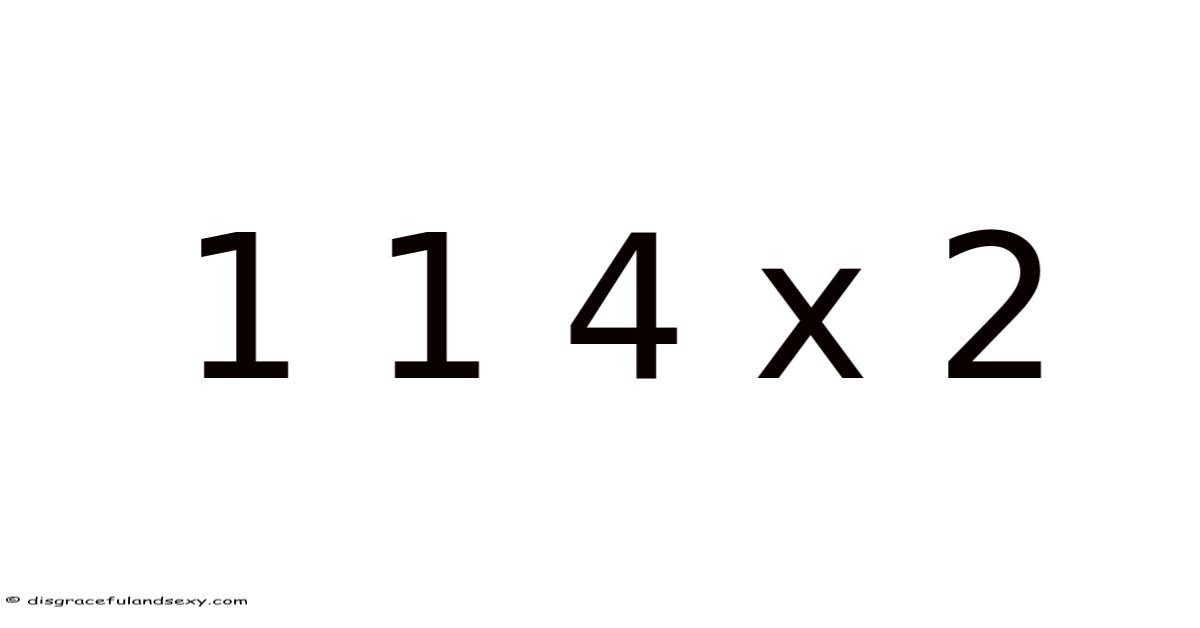
Decoding the Mystery: A Deep Dive into 1 1 4 x 2
This article explores the seemingly simple mathematical expression "1 1 4 x 2," delving into its various interpretations, potential ambiguities, and the underlying principles of mathematical notation and order of operations. We'll uncover why this seemingly straightforward problem can lead to different answers depending on how it's approached, highlighting the importance of clear communication and consistent application of mathematical rules. Understanding this seemingly simple problem unlocks a broader appreciation for the precision required in mathematics and its applications in various fields.
Introduction: The Importance of Precision in Mathematics
At first glance, "1 1 4 x 2" appears to be a basic arithmetic problem. Still, the lack of clearly defined operators between the numbers introduces ambiguity. Worth adding: this isn't just a matter of nitpicking; it's fundamental to ensuring accurate results in any field that relies on mathematical calculations, from engineering and finance to computer programming and scientific research. A slight change in how we interpret the spacing or the implied operations can dramatically alter the outcome. This ambiguity underscores a critical aspect of mathematics: the very important importance of precise notation. Misinterpretations can lead to significant errors, highlighting the necessity for clear, unambiguous communication Easy to understand, harder to ignore. Took long enough..
Interpreting the Expression: Potential Readings
The ambiguity arises from the absence of explicit operators (+, -, ×, ÷) between the numbers. Let's examine several possible interpretations:
1. Interpretation as a Concatenation of Numbers:
One way to interpret the expression is to treat the numbers as concatenated, creating a larger number before multiplication. This would mean reading it as "114 x 2". In this case, the calculation is straightforward:
114 x 2 = 228
This approach assumes that the spaces are simply separators for a single number, not representing mathematical operations.
2. Interpretation with Implicit Addition:
Another interpretation considers the spaces to represent implicit addition. This would read the expression as:
(1 + 1 + 4) x 2
Following the order of operations (PEMDAS/BODMAS – Parentheses/Brackets, Exponents/Orders, Multiplication and Division, Addition and Subtraction), we first perform the addition within the parentheses:
1 + 1 + 4 = 6
Then, we perform the multiplication:
6 x 2 = 12
This interpretation prioritizes addition before multiplication And that's really what it comes down to. And it works..
3. Interpretation with Mixed Operations:
A more complex interpretation could involve a mix of concatenation and addition:
(11 + 4) x 2 or (1 + 14) x 2 or even (1 + 1 + 4) x 2
Each of these yields a different result:
- (11 + 4) x 2 = 15 x 2 = 30
- (1 + 14) x 2 = 15 x 2 = 30
- (1 + 1 + 4) x 2 = 6 x 2 = 12 (same as interpretation 2)
This highlights the ambiguity inherent in the lack of clearly defined operators.
The Role of Order of Operations (PEMDAS/BODMAS)
The order of operations, often remembered by the acronyms PEMDAS (Parentheses, Exponents, Multiplication and Division, Addition and Subtraction) or BODMAS (Brackets, Orders, Division and Multiplication, Addition and Subtraction), is crucial in evaluating mathematical expressions. These rules dictate the sequence in which operations should be performed to ensure consistent and accurate results. On the flip side, even with the order of operations, the ambiguity in "1 1 4 x 2" remains unless we explicitly define how the numbers are grouped or what operations are implied between them Practical, not theoretical..
Why is Clear Notation Essential?
The ambiguity highlighted by "1 1 4 x 2" underscores the importance of clear and unambiguous mathematical notation. In professional settings, such as engineering, finance, or scientific research, imprecise notation can have severe consequences. A misinterpretation in a complex calculation could lead to structural failures in a building, inaccurate financial projections, or flawed scientific conclusions Took long enough..
Illustrative Examples from Real-World Applications:
Consider the following real-world examples where clear notation is essential:
- Computer Programming: Ambiguous expressions can lead to unexpected program behavior or errors. Programming languages require precise syntax to check that instructions are executed correctly.
- Engineering Design: In engineering calculations, even a small error due to unclear notation can have catastrophic consequences. Bridges, buildings, and other structures are designed using complex mathematical models that demand accuracy and precision.
- Financial Modeling: Financial models rely on complex calculations. Errors stemming from unclear notation can lead to incorrect financial projections and potentially significant losses.
Mathematical Notation Conventions
To avoid ambiguity, mathematicians have established conventions for writing mathematical expressions. These conventions confirm that expressions are interpreted consistently. These conventions include using:
- Parentheses/Brackets: To group terms and indicate the order of operations.
- Explicit Operators: Clearly stating the operations (+, -, ×, ÷) between numbers.
- Consistent Spacing: Using consistent spacing to avoid confusion between concatenated numbers and separate terms.
FAQ: Frequently Asked Questions
Q1: What is the correct answer to "1 1 4 x 2"?
A1: There isn't a single "correct" answer without clarifying the intended operations. But the answer depends entirely on how the expression is interpreted. Possible answers include 12, 228, and 30 It's one of those things that adds up. But it adds up..
Q2: How can I avoid this ambiguity in my own work?
A2: Always use clear and unambiguous notation. Explicitly state all operations using the appropriate symbols (+, -, ×, ÷). Use parentheses or brackets to group terms and specify the order of operations Turns out it matters..
Q3: What if the spaces are intentional?
A3: If the spaces are deliberately included, it suggests an intention to imply some kind of mathematical operation. On the flip side, without further information, it remains ambiguous. It could mean the user intended for the spaces to indicate addition or some other operation not explicitly stated Not complicated — just consistent..
Counterintuitive, but true And that's really what it comes down to..
Conclusion: The Power of Precision
The seemingly simple expression "1 1 4 x 2" serves as a potent reminder of the importance of precise and unambiguous mathematical notation. While seemingly trivial, this example highlights the potential for misinterpretations and the far-reaching consequences of unclear communication in any field that relies on mathematical calculations. The focus should always be on clarity, using established mathematical conventions to avoid ambiguity and ensure the accuracy of results. This simple problem provides a valuable lesson: precision is not just important; it’s fundamental to the reliability and integrity of mathematical work. This principle extends beyond simple arithmetic, permeating every aspect of applied mathematics in the modern world. Mastering clear communication in mathematics is crucial for avoiding errors and ensuring accurate and reliable results.
