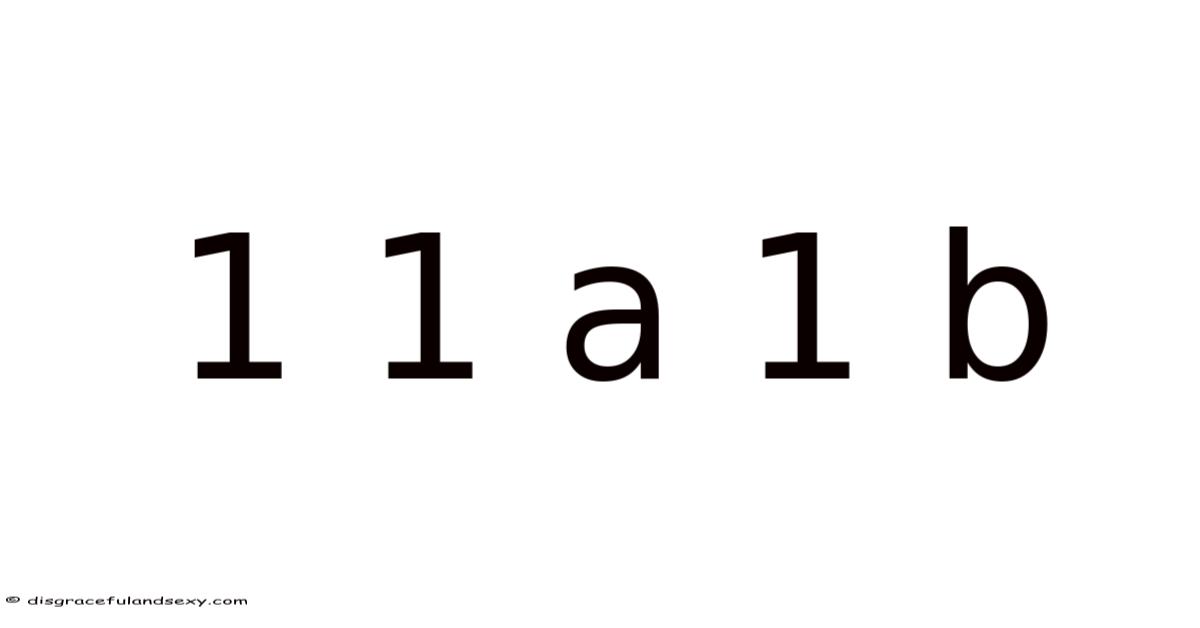
Decoding 1 1 a 1 b: A Deep Dive into Sequence, Pattern, and Problem-Solving
The seemingly simple sequence "1 1 a 1 b" might appear cryptic at first glance. Still, this seemingly innocuous string holds the key to understanding fundamental concepts in pattern recognition, logical reasoning, and problem-solving. But this article will explore various interpretations of this sequence, walk through the underlying mathematical and logical principles, and ultimately demonstrate how seemingly simple puzzles can get to complex cognitive skills. We'll explore different approaches, examining numerical, alphabetical, and even potential symbolic interpretations. This exploration will not only analyze the given sequence but also equip you with tools to tackle similar pattern-based problems.
Understanding the Challenge: Numerical and Alphabetical Perspectives
At its core, the sequence "1 1 a 1 b" presents a challenge in pattern identification. The immediate observation reveals a mix of numerical (1, 1) and alphabetical (a, b) elements. This immediately suggests that the solution might not rely solely on numerical progression or alphabetical order, but rather a combination or a more nuanced pattern That's the part that actually makes a difference..
It sounds simple, but the gap is usually here.
Several initial approaches might be considered:
-
Numerical Sequence: Is there a numerical pattern hidden within the '1's? While the immediate repetition of '1' might seem simple, we must look for hidden rules or underlying progressions. Perhaps the repetition is a clue itself, pointing towards a pattern that involves repetition or mirroring Worth keeping that in mind..
-
Alphabetical Sequence: The inclusion of 'a' and 'b' suggests a potential alphabetical progression. The sequence jumps from numbers to letters and back, so we can't directly apply standard alphabetical ordering. There must be a more complex rule or a relationship between the numerical and alphabetical parts.
-
Combined Sequence: The most likely interpretation involves analyzing the interplay between the numbers and letters. This might involve considering the position of the elements, their relative order, or the overall arrangement. We might need to identify a pattern that encompasses both numerical and alphabetical components Turns out it matters..
Exploring Potential Solutions: Step-by-Step Analysis
Let's explore several potential interpretations and solutions, keeping in mind the need for a logical and consistent pattern And that's really what it comes down to..
1. The Simplest Interpretation (Repetitive Pattern): A simple, albeit less engaging, solution might be to view the sequence as a repetitive pattern. The sequence "1 1 a 1 b" could simply repeat: "1 1 a 1 b 1 1 a 1 b 1 1 a 1 b..." This interpretation highlights repetition as a fundamental pattern, but it lacks depth and doesn't fully work with the combination of numbers and letters No workaround needed..
2. Alternating Number-Letter Sequence: A more sophisticated interpretation could involve an alternating sequence of numbers and letters. The sequence begins with two numbers, then alternates between a letter and a number:
- 1 (number)
- 1 (number)
- a (letter)
- 1 (number)
- b (letter)
Following this pattern, the next element should be a number. Even so, ), the next element would be '2'. If we assume a simple progression of numbers (1,2,3...This interpretation would generate a sequence like this: "1 1 a 1 b 2 c 2 d 3 e 3 f.. Simple, but easy to overlook..
3. Position-Based Pattern: Another approach involves assigning significance to the position of each element within the sequence. Let's number the positions:
- 1
- 1
- a
- 1
- b
Notice that 'a' appears in the third position, and 'b' in the fifth. This could suggest a pattern involving odd-numbered positions for letters and even-numbered positions for numbers. If we continue this, the next element would be a number in the sixth position, and it could be '1' again, or continue the previous numerical progression to ‘2’.
4. Pattern Based on Numerical and Alphabetical Relationships: A more layered solution might involve finding a numerical relationship that influences the alphabetical elements. Take this: the number '1' could correspond to the first letter of the alphabet ('a'). The subsequent '1' could then represent the next element using a rule. A simple rule could be that the value corresponds to the ordinal position of the alphabet. While such patterns are plausible, there needs to be a defined, consistent rule.
Expanding the Scope: Incorporating More Advanced Concepts
To further deepen our understanding, let’s consider more advanced approaches to analyze the sequence "1 1 a 1 b":
-
Mathematical Functions: Could a mathematical function generate this sequence? We could explore functions that alternate between numerical and alphabetical outputs, depending on the input. Even so, defining such a function requires a clear and consistent rule Small thing, real impact..
-
Modular Arithmetic: Modular arithmetic involves the remainder after division. We could explore whether the numbers relate to specific remainders when divided by a certain number, and if this relates to the alphabetical sequence. This approach could reveal a hidden structure involving remainders or cycles.
-
Symbolic Representation: Could "1 1 a 1 b" represent a more abstract symbolic system? Each element could carry a specific meaning or represent a concept within a larger system. This requires defining the meaning of each symbol and a set of rules governing their interaction Small thing, real impact..
-
Computer Science Applications: In computer science, this type of sequence might represent a specific data structure or algorithm. Exploring different data types and algorithms could reveal a connection or a way to generate similar sequences programmatically.
Beyond the Sequence: Developing Problem-Solving Skills
The seemingly simple sequence "1 1 a 1 b" serves as an excellent tool for illustrating the power of systematic thinking and pattern recognition. The key to solving such problems lies in the ability to:
- Identify Patterns: Accurately recognizing repeating elements or relationships between elements is crucial.
- Formulate Hypotheses: Developing and testing potential patterns and rules is essential.
- Evaluate Consistency: A successful solution must adhere to a consistent rule or pattern.
- Embrace Iteration: Trial and error is inherent in problem-solving. Refining our assumptions and trying new approaches is critical.
By exploring various interpretations and approaching the problem from different angles, we not only solve the immediate puzzle but also enhance our critical thinking and analytical skills. This process cultivates the ability to tackle more complex real-world problems requiring similar logical reasoning and pattern recognition.
Frequently Asked Questions (FAQs)
Q: Is there only one correct answer to this sequence?
A: No, there isn't necessarily one single "correct" answer. In practice, depending on the assumed underlying rules or system, multiple interpretations and solutions are possible. The key is to identify a consistent pattern that explains the sequence.
Q: How can I improve my ability to solve similar pattern-based problems?
A: Practice is crucial! Regularly work on pattern-recognition puzzles, logic games, and coding challenges. Start with simple sequences and gradually progress to more complex ones.
Q: What real-world applications exist for this type of pattern recognition?
A: Pattern recognition is fundamental to many fields, including:
- Data analysis: Identifying trends and anomalies in large datasets.
- Cryptography: Breaking codes and ensuring data security.
- Artificial intelligence: Building algorithms for machine learning and image recognition.
- Medical diagnosis: Recognizing patterns in medical images or patient data.
Conclusion: Unveiling the Power of Pattern Recognition
The seemingly simple sequence "1 1 a 1 b" has provided us with a fascinating exploration into the world of pattern recognition and problem-solving. By dissecting its various interpretations, we have demonstrated how a seemingly simple puzzle can engage complex cognitive skills. This exercise reinforces the idea that effective problem-solving often requires creativity, persistence, and the ability to approach a problem from multiple perspectives. The ability to recognize patterns and establish logical connections is not only a valuable skill for solving puzzles but also a crucial skill applicable across various disciplines and professions. The journey of deciphering this sequence should serve as a reminder that even the most seemingly simple challenge can lead to deeper insights and enhanced problem-solving capabilities It's one of those things that adds up. Worth knowing..
