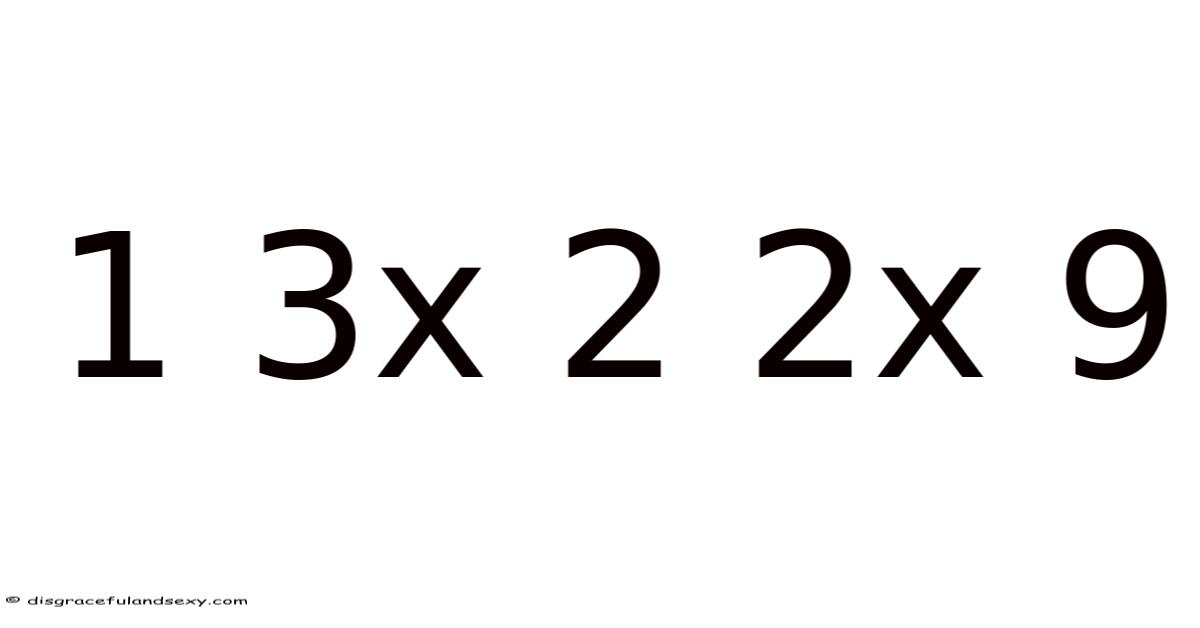
Decoding the Mystery: 1 3x 2 2x 9 – A Deep Dive into Mathematical Patterns and Problem-Solving
This article explores the seemingly simple numerical sequence "1 3x 2 2x 9". In practice, while initially appearing straightforward, this sequence presents an intriguing opportunity to look at various mathematical concepts, problem-solving strategies, and the beauty of pattern recognition. We'll unpack the potential interpretations, discuss the underlying logic, and explore different approaches to understanding and extending this sequence. This investigation will not only provide a solution but also enhance your understanding of mathematical thinking Took long enough..
Understanding the Problem: What We See and What We Don't
At first glance, "1 3x 2 2x 9" looks like a random arrangement of numbers and the multiplication symbol 'x'. Here's the thing — the lack of clear operational precedence (e. We need to consider various possibilities and apply logical reasoning to determine the most plausible interpretation. Is it hinting at a pattern requiring further numbers to become clear? g., parentheses) makes it ambiguous. Is it a single equation? Is it a series of operations? That said, this ambiguity is precisely what makes this sequence a fascinating puzzle. These are the questions we will address.
Not obvious, but once you see it — you'll see it everywhere.
Possible Interpretations and Solutions:
Several interpretations are possible, depending on how we choose to group the numbers and apply the multiplication operations. Let's explore some key possibilities:
1. A Sequence of Independent Operations:
One straightforward interpretation treats each part ("1 3x", "2 2x", "9") as separate, independent calculations.
- 1 3x: This could be interpreted as 1 multiplied by 3, resulting in 3.
- 2 2x: This would be 2 multiplied by 2, resulting in 4.
- 9: This remains 9.
This approach leaves us with the sequence 3, 4, 9. On the flip side, this solution lacks a unifying pattern or relationship between the resulting numbers, suggesting this might not be the intended interpretation.
2. A Single Equation with Implicit Operations:
A more challenging interpretation involves treating the entire sequence as a single mathematical expression. That's why we might need to infer missing operations, potentially leading to a hidden pattern. Here, creativity in interpreting the spaces and arrangement of numbers becomes crucial.
- Option A: (1 + 3) x (2 + 2) x 9: This interpretation adds numbers within parentheses before multiplication. This would be (4) x (4) x 9 = 144.
- Option B: 1 + (3 x 2) + (2 x 9): This interprets the 'x' as multiplication and involves prioritizing multiplication over addition according to standard order of operations (PEMDAS/BODMAS). This evaluates to 1 + 6 + 18 = 25.
- Option C: (1 x 3) x (2 x 2) x 9: This prioritizes multiplication from left to right, giving us 3 x 4 x 9 = 108.
- Option D: 13 x 22 x 9: This interpretation considers "1 3" as 13, "2 2" as 22. This yields a large result: 2574.
Each of these options produces a different numerical answer. This highlights the importance of explicitly defining mathematical operations to avoid ambiguity. None of these, however, immediately reveals an obvious pattern that could be extrapolated.
3. Seeking Underlying Patterns and Sequences:
Perhaps the sequence is part of a larger, yet-unrevealed pattern. To explore this, let’s consider possibilities:
- Fibonacci-like sequences: While the initial numbers don't directly fit known Fibonacci or Lucas sequences, further numbers might reveal a relationship based on adding or subtracting previous terms.
- Geometric progressions: Could the numbers represent elements of a geometric progression? This would require identifying a common ratio between terms. Still, the initial numbers don't suggest an obvious geometric pattern.
- Modular arithmetic: Is there a pattern involving remainders after division by a specific number? This requires exploring different moduli (the number we're dividing by) to see if a consistent pattern emerges.
Expanding the Possibilities: Adding Context
To solve this ambiguous sequence, additional context would be invaluable. Here’s how more information could tap into the solution:
- Source: Knowing the source of this sequence (a textbook, a puzzle, a coding challenge) could provide hints about the intended solution.
- Surrounding elements: If this sequence is part of a larger problem, the surrounding context might clarify the intended operations.
- Further numbers in the sequence: If additional numbers were provided, they could reveal a hidden pattern that currently eludes us.
The Importance of Clear Mathematical Notation
This puzzle highlights the critical importance of clear and unambiguous mathematical notation. On top of that, using parentheses, brackets, or other symbols to indicate the order of operations is essential to avoid confusion and check that everyone understands the intended meaning of an equation or sequence. The absence of such clarity makes this sequence challenging but also allows for creative problem-solving strategies.
A Deeper Dive: Mathematical Concepts in Play
This sequence, despite its apparent simplicity, touches on several significant mathematical concepts:
- Order of Operations (PEMDAS/BODMAS): This fundamental concept dictates the sequence in which mathematical operations should be performed (Parentheses/Brackets, Exponents/Orders, Multiplication and Division, Addition and Subtraction). The ambiguous nature of "1 3x 2 2x 9" forces us to consider the implications of different interpretations of the order of operations.
- Pattern Recognition: This is a critical skill in mathematics and many other fields. Identifying patterns helps us understand relationships between numbers and predict future values in a sequence. This sequence challenges us to develop our pattern recognition skills by exploring potential underlying patterns or relationships.
- Problem-Solving Strategies: Addressing this puzzle necessitates using various problem-solving techniques, including trial and error, systematic exploration of possibilities, and seeking hidden patterns.
- Ambiguity and Interpretation: The problem highlights how ambiguity in mathematical notation can lead to multiple valid interpretations. This underscores the importance of precise communication in mathematics and other quantitative fields.
Frequently Asked Questions (FAQ)
-
Q: Is there a single "correct" answer? A: Without additional context, there's no single definitively "correct" answer. The ambiguity allows for multiple valid interpretations, each leading to a different result Practical, not theoretical..
-
Q: What mathematical concepts are relevant to solving this? A: Order of operations (PEMDAS/BODMAS), pattern recognition, and problem-solving strategies are all critical Nothing fancy..
-
Q: How can I improve my ability to solve such puzzles? A: Practice with different types of mathematical puzzles and problems, focus on developing pattern recognition skills, and learn to approach problems systematically Nothing fancy..
Conclusion: The Enduring Appeal of Mathematical Puzzles
The "1 3x 2 2x 9" sequence, while seemingly simple, proves to be a fascinating exploration of mathematical interpretation and problem-solving. Even without a definitive answer, the process of exploring different solutions enhances our mathematical reasoning and problem-solving skills. This puzzle serves as a reminder that the beauty of mathematics often lies not just in finding the answer but in the journey of discovery itself. Now, it reveals the importance of clear notation and the richness of mathematical thinking, encouraging us to explore various possibilities and critically analyze the underlying logic. Worth adding: it invites us to engage in creative thinking and to appreciate the multifaceted nature of mathematical problems. The true value of this puzzle lies in the process of engaging with it, not necessarily in arriving at a specific numerical solution.
