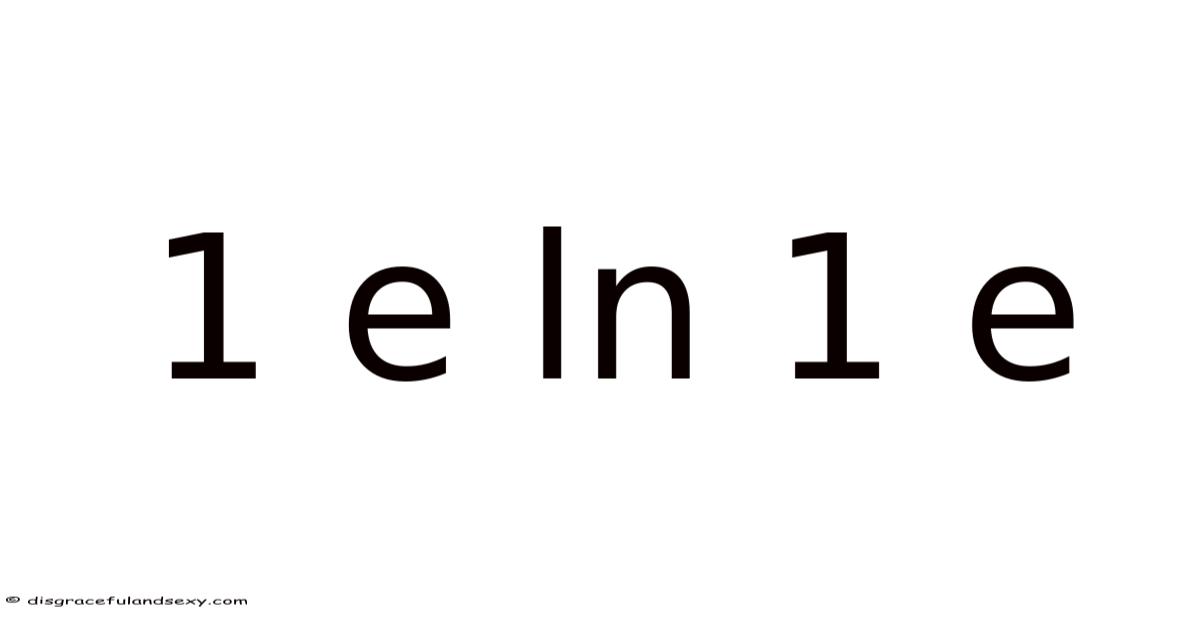
Decoding the Enigma: A Deep Dive into 1 * e^ln(1/e)
The expression 1 * e^ln(1/e) might seem daunting at first glance, a cryptic combination of mathematical constants and functions. Even so, understanding this seemingly complex expression reveals fundamental principles of logarithms and exponents, highlighting the elegant interconnectedness of mathematical concepts. In practice, this article will serve as a complete walkthrough, breaking down the expression step-by-step, exploring the underlying mathematical principles, and ultimately demonstrating its surprisingly simple solution. We'll journey from basic logarithmic and exponential rules to a complete understanding of this specific expression, making it accessible even to those with a limited mathematical background And that's really what it comes down to..
Understanding the Building Blocks: Logarithms and Exponents
Before we tackle the expression, let's establish a solid foundation in logarithms and exponents. These two concepts are intrinsically linked, operating as inverse functions of each other.
-
Exponentiation: Exponentiation represents repeated multiplication. Take this:
a^bmeans multiplying 'a' by itself 'b' times. The number 'a' is the base, and 'b' is the exponent Worth keeping that in mind.. -
Logarithms: A logarithm answers the question: "To what power must I raise the base to get a specific result?" The expression
logₐ(x)signifies the exponent to which 'a' (the base) must be raised to obtain 'x'. Take this:log₁₀(100) = 2because 10 raised to the power of 2 equals 100 That's the part that actually makes a difference..
A crucial relationship exists between exponents and logarithms: if a^b = x, then logₐ(x) = b. Consider this: this inverse relationship is key to simplifying our target expression. The most common logarithm bases are 10 (common logarithm) and e (natural logarithm). That's why e, Euler's number (approximately 2. On top of that, 71828), holds significant importance in calculus and many natural phenomena. The natural logarithm, denoted as ln(x), has the base e. That's why, ln(x) = logₑ(x).
Dissecting the Expression: 1 * e^ln(1/e)
Now, let's meticulously examine the expression 1 * e^ln(1/e):
- The Innermost Function: ln(1/e)
The innermost part of the expression is ln(1/e). Recall that 1/e can be written as e⁻¹. Which means, ln(1/e) = ln(e⁻¹) . Using the logarithmic property logₐ(a^x) = x, we can simplify this further: ln(e⁻¹) = -1.
- Substituting Back into the Expression:
Substituting -1 for ln(1/e), our expression becomes 1 * e⁻¹ It's one of those things that adds up. But it adds up..
- Simplifying the Exponent:
e⁻¹ is equivalent to 1/e. Because of this, the expression simplifies to 1 * (1/e).
- Final Simplification:
Finally, multiplying 1 by 1/e, we arrive at the solution: 1/e.
A Deeper Dive: Exploring the Mathematical Principles at Play
The solution's simplicity belies the profound mathematical principles at work. This example beautifully illustrates the power and elegance of logarithmic and exponential relationships. Let's delve further into the key concepts involved:
-
Inverse Functions: The core principle is the inverse relationship between the exponential function (e^x) and the natural logarithm (ln(x)). They essentially "undo" each other. Applying the exponential function to the natural logarithm of a number essentially cancels out the logarithmic operation, leaving the original number (provided the number is positive).
-
Logarithmic Properties: We used the logarithmic property
logₐ(a^x) = xwhich simplifies calculations significantly. This property is a direct consequence of the inverse relationship between logarithms and exponents. Other essential logarithmic properties, while not directly used in this specific calculation, are worth mentioning:logₐ(xy) = logₐ(x) + logₐ(y)logₐ(x/y) = logₐ(x) - logₐ(y)logₐ(x^y) = y * logₐ(x)
-
Euler's Number (e): The presence of e underscores the importance of this fundamental mathematical constant. e arises naturally in various mathematical contexts, including compound interest, exponential growth and decay, and many areas of calculus. Its unique properties make it an essential tool for modeling real-world phenomena.
Practical Applications and Further Exploration
While this specific expression might not have immediate practical applications in the same way as, for example, calculating compound interest or modeling population growth, it serves as an excellent exercise to solidify understanding of fundamental mathematical principles. The concepts demonstrated—the inverse relationship between exponential and logarithmic functions, the manipulation of logarithmic properties, and the significance of Euler's number—are crucial for more advanced mathematical studies, including calculus, differential equations, and probability theory Most people skip this — try not to. Worth knowing..
Frequently Asked Questions (FAQ)
-
Q: Can this be solved using a calculator? A: Yes, you can input the entire expression into a scientific calculator to obtain the numerical result (approximately 0.3679). Still, the value of working through the steps lies in understanding the underlying mathematical principles.
-
Q: What if the expression were different, say
e^ln(e^2)? A: Using the same principles, we'd havee^ln(e^2) = e^2because the exponential and logarithm cancel each other out. -
Q: Is there a graphical representation of this concept? A: Yes. Graphing the functions y = e^x and y = ln(x) will visually demonstrate their inverse relationship. Their graphs are reflections of each other across the line y = x Most people skip this — try not to..
-
Q: Are there any limitations to the application of these rules? A: The logarithmic properties are valid only for positive arguments (i.e., the number inside the logarithm must be greater than zero). The base of the logarithm must also be positive and not equal to 1 Small thing, real impact. Took long enough..
Conclusion
The seemingly complex expression 1 * e^ln(1/e) ultimately simplifies to the elegant and insightful result of 1/e. This journey through its solution not only provided a numerical answer but also offered a deep dive into the fundamental principles of logarithms and exponents, showcasing their interconnectedness and the power of Euler's number. Mastering these core concepts is key for success in further mathematical endeavors and for appreciating the underlying structure and beauty of mathematics. The journey of solving this expression serves as a microcosm of mathematical problem-solving, urging us to break down complex problems into smaller, manageable parts and applying fundamental principles to arrive at a clear, concise solution. This exercise reinforces the value of a strong mathematical foundation, highlighting the interconnectedness of seemingly disparate concepts.
