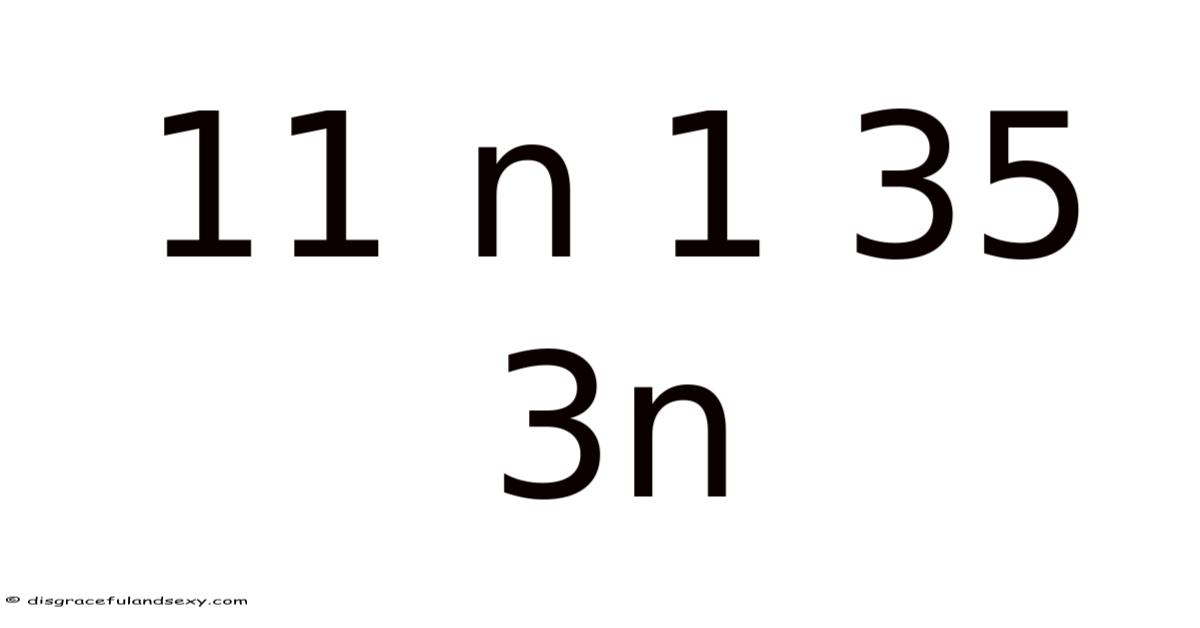
Decoding the Sequence: Unveiling the Patterns and Logic Behind "11 n 1 35 3n"
This article breaks down the intriguing numerical sequence "11 n 1 35 3n," exploring its potential underlying patterns and logical structures. This exploration will cover different possibilities, emphasizing the importance of clear notation and defined rules in mathematical sequences. While the sequence as presented is ambiguous, we will investigate various interpretations and mathematical approaches to understand what might be intended and how to solve similar puzzles. Understanding these principles is crucial not only for solving this specific sequence but also for tackling more complex mathematical puzzles and patterns Worth keeping that in mind..
Introduction: The Challenge of Ambiguity
The sequence "11 n 1 35 3n" presents an immediate challenge: the meaning of "n" is undefined. Is it a variable representing a specific number? To proceed, we need to consider possible scenarios and apply different mathematical approaches to identify potential solutions. Does it represent a mathematical operation? Worth adding: the lack of clear notation leaves the sequence open to multiple interpretations. This ambiguity highlights the importance of precise mathematical notation when defining sequences. A well-defined sequence avoids any confusion and allows for unique solutions.
Possible Interpretations and Approaches:
Let's consider several ways to interpret the sequence, assuming "n" represents different things:
1. "n" as a Placeholder for an Unknown Number:
If we assume "n" represents a single, unknown number, the sequence might be considered incomplete. Think about it: we could hypothesize that the sequence represents a pattern where the missing "n" values are related to the other numbers. Finding this relationship would require advanced mathematical techniques or trial and error. On the flip side, without more information or a defined rule, finding a unique solution is impossible.
- Example: We might attempt to fit the numbers to a polynomial function. Still, with only four data points (assuming "n" represents two distinct numbers), several different polynomials could fit this data, making it impossible to determine the "correct" solution without further constraints.
2. "n" as an Operator:
Another possibility is that "n" represents a mathematical operation. This could include addition, subtraction, multiplication, division, or a more complex operation. Let's explore some examples:
-
Addition/Subtraction: It's unlikely that simple addition or subtraction would create a consistent pattern.
-
Multiplication/Division: We might investigate whether multiplying or dividing specific numbers in the sequence by or with "n" leads to a pattern. Still, without defining "n" as a specific number or operation, this is again highly speculative Took long enough..
-
More Complex Operations: We might consider more sophisticated operations like modulo, exponentiation, or even combinations of operations. Still, without additional information or context, it becomes challenging to determine which operation or combination of operations should be applied That's the part that actually makes a difference..
3. "n" as Representing Multiple Unknown Numbers:
A third interpretation is that "n" represents a different numerical value in each instance. Worth adding: if this is the case, we'd need more information to decipher how these distinct sequences are related. This would imply that the sequence is comprised of multiple, distinct sequences interwoven. This could include additional terms in the sequence, a description of the pattern, or the specification of a generating function.
4. Considering the Sequence as a Code or Cipher:
Another intriguing possibility is that the sequence isn’t a simple mathematical progression but rather a code or cipher. The numbers and the "n" could represent letters or symbols based on a specific substitution. Without additional context or clues, however, deciphering such a code is virtually impossible Small thing, real impact. Practical, not theoretical..
The Importance of Well-Defined Sequences:
This exploration of the sequence "11 n 1 35 3n" highlights the critical importance of clearly defining mathematical sequences. Ambiguity leads to multiple interpretations, rendering a unique solution unattainable. A well-defined sequence must include:
-
Clear Notation: The symbols and operators used must be explicitly defined. This avoids any confusion about the intended meaning.
-
Explicit Rules: The rules governing the sequence must be stated clearly. This could be a recursive formula, an explicit formula, or a descriptive rule defining the relationship between consecutive terms.
-
Sufficient Data: A sufficient number of terms must be provided to establish a clear pattern and eliminate ambiguity. The more data points available, the more confident we can be in identifying the underlying rule.
Illustrative Example of a Well-Defined Sequence:
Let's compare the ambiguous sequence to a well-defined one:
So, the Fibonacci sequence is defined recursively: F(n) = F(n-1) + F(n-2), where F(0) = 0 and F(1) = 1. This clearly defines the sequence's rules and allows for the generation of an infinite number of terms.
Applying Mathematical Problem-Solving Techniques:
To solve problems involving numerical sequences, several mathematical tools and strategies can be employed:
-
Pattern Recognition: This is often the first step. Look for consistent differences, ratios, or other relationships between consecutive terms.
-
Difference Tables: Creating a difference table by calculating the differences between consecutive terms can reveal patterns that are not immediately apparent.
-
Polynomial Fitting: If the sequence appears to be polynomial in nature, techniques like polynomial interpolation can be used to find the equation that generates the sequence.
-
Recursive Relationships: Identifying a recursive relationship between terms can define the sequence elegantly and allow for the generation of further terms.
FAQ:
-
Q: Can this sequence be solved without additional information? A: No. The ambiguity of "n" prevents the determination of a unique solution.
-
Q: What kind of additional information would be helpful? A: Knowing the intended meaning of "n," additional terms in the sequence, or a description of the underlying rule would be crucial And that's really what it comes down to..
-
Q: Are there similar puzzles that are well-defined and solvable? A: Yes, many mathematical puzzles and sequences are well-defined and have unique solutions. Examples include the Fibonacci sequence, arithmetic progressions, geometric progressions, and various other types of sequences with clear rules.
Conclusion:
The sequence "11 n 1 35 3n" serves as a prime example of how poorly defined mathematical sequences can lead to ambiguity and the inability to find a unique solution. The exercise underscores the critical importance of clear notation, explicit rules, and sufficient data in defining mathematical sequences. Still, by learning from this ambiguous example, we can appreciate the power of well-defined sequences and the systematic approach required for solving mathematical puzzles. Further exploration of mathematical sequences should highlight the use of precise notation and a thorough understanding of the underlying principles to avoid the pitfalls of ambiguity. This understanding is not just helpful for solving puzzles but forms the bedrock of more advanced mathematical concepts.
