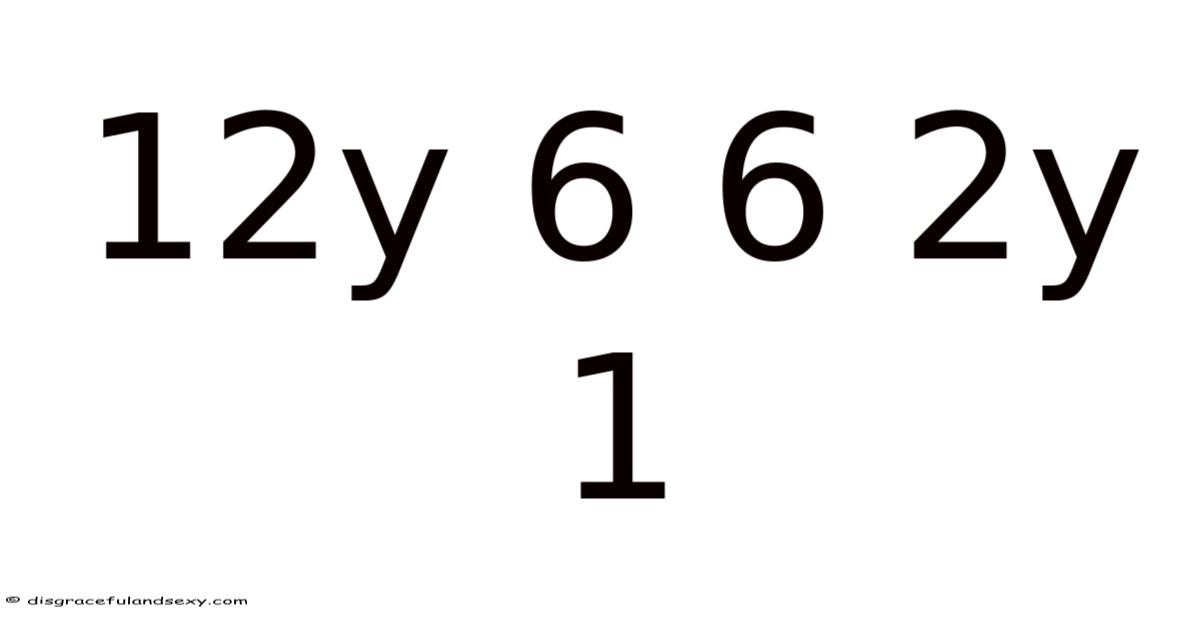
Decoding the Enigma: A Deep Dive into the Mathematical Expression "12y 6 6 2y 1"
This article explores the mathematical expression "12y 6 6 2y 1," delving into its potential interpretations, the underlying mathematical principles involved, and the possible solutions depending on the context. The seemingly simple expression hides a complexity that requires careful consideration of order of operations, potential symbolic representations, and the possibility of missing operators. We'll unravel the mystery, step-by-step, ensuring clarity and understanding for readers of all mathematical backgrounds.
Understanding the Challenges: Missing Operators and Ambiguity
The primary challenge in interpreting "12y 6 6 2y 1" lies in the absence of explicit operators between the numerical and alphabetical components. Still, standard mathematical notation requires operators (+, -, ×, ÷) to define the relationship between terms. The expression as presented is ambiguous and can lead to multiple interpretations unless further context is provided. We must consider the possibilities, treating the expression as a puzzle to solve rather than a straightforward equation Practical, not theoretical..
Possible Interpretations and Solutions
Let's explore several plausible interpretations, focusing on how the addition, subtraction, multiplication, and division operators might be implicitly represented or inferred:
1. Interpretation as a System of Equations:
One approach is to interpret the expression as representing a condensed system of equations. We might assume the spaces represent missing ‘=‘ signs. For instance:
- 12y = 6
- 6 = 2y
- 2y = 1
Solving this system, we find inconsistencies. Here's the thing — the first equation yields y = 1/2, the second yields y = 3, and the third also yields y = 1/2. This inconsistency suggests this interpretation is unlikely.
2. Interpretation Involving Implicit Multiplication:
We might assume juxtaposition (placing terms next to each other) implies multiplication. This interpretation transforms the expression into:
(12 × y) + 6 + 6 + (2 × y) + 1
This can be simplified by combining like terms:
14y + 13
This expression is now a linear equation in terms of 'y'. It does not have a single numerical solution without further information; it depends on the value assigned to ‘y’.
3. Interpretation as a Polynomial Expression:
If we consider 'y' as a variable and assume implicit addition, we could interpret this as a polynomial:
12y + 6 + 6 + 2y + 1
This simplifies to:
14y + 13
Again, this is a linear polynomial. Its value depends on the value of 'y'. It can be graphed as a straight line with a slope of 14 and a y-intercept of 13. This represents a function where the output (the value of the polynomial) is determined by the input (the value of y) It's one of those things that adds up..
4. Interpretation with Implicit Subtraction:
We could explore scenarios where subtraction is implied. As an example, it might be interpreted as:
12y - 6 - 6 - 2y - 1
Simplifying this results in:
10y - 13
This again is a linear equation. The solution depends entirely on the value of y Still holds up..
5. Considering Potential Errors or Missing Information:
It is also crucial to acknowledge the possibility of errors in the original expression. Perhaps an operator was omitted, or a typographical error occurred. Without additional context or clarification, any interpretation remains speculative Surprisingly effective..
The Importance of Mathematical Notation and Clarity
This exercise highlights the fundamental importance of precise and unambiguous mathematical notation. Practically speaking, the seemingly simple expression "12y 6 6 2y 1" exposes the pitfalls of ambiguity. In mathematics, clarity is essential. Missing operators can lead to multiple interpretations, rendering the expression unresolvable without further context.
Expanding on the Concept: Exploring Related Mathematical Ideas
To further enrich our understanding, let's touch on related mathematical concepts:
-
Order of Operations (PEMDAS/BODMAS): This rule dictates the sequence of calculations (Parentheses/Brackets, Exponents/Orders, Multiplication and Division, Addition and Subtraction). While this rule is vital for resolving complex expressions, its applicability is limited here due to the ambiguous nature of the original expression.
-
Linear Equations: The interpretations presented above predominantly lead to linear equations, which are equations of the form ax + b = c, where 'a', 'b', and 'c' are constants, and 'x' is the variable. Solving linear equations typically involves isolating the variable to find its value.
-
Polynomials: Our interpretations also involved polynomials, which are expressions consisting of variables and coefficients, combined using addition, subtraction, and multiplication. The degree of a polynomial is determined by the highest power of the variable. Our expressions were linear polynomials (degree 1).
-
Functions: The simplified expressions, like 14y + 13, can be considered functions. A function maps inputs (values of 'y') to outputs (the value of the expression). We can visualize this function graphically as a straight line.
Frequently Asked Questions (FAQ)
Q: What is the single correct answer to "12y 6 6 2y 1"?
A: There is no single correct answer without additional information or clarification of the missing operators. The expression is ambiguous and can lead to multiple valid interpretations, each producing a different result depending on the assumptions made That's the part that actually makes a difference..
Q: What are the different ways to interpret the expression?
A: We explored several interpretations, including treating it as a system of equations, assuming implicit multiplication, considering it a polynomial expression, and exploring the possibility of implicit subtraction. Each interpretation yielded a different mathematical result And that's really what it comes down to. Simple as that..
Q: Why is it important to use proper mathematical notation?
A: Precise mathematical notation is crucial for unambiguous communication. Missing operators, as demonstrated in this example, can create multiple interpretations, leading to confusion and incorrect results.
Q: Can this expression be solved without further information?
A: No. On top of that, without knowing the intended operators, the expression remains fundamentally unresolved. It can only be simplified into different expressions based on various interpretations, but none of them provides a definitive solution Not complicated — just consistent..
Conclusion: The Value of Ambiguity in Learning
While initially frustrating, the ambiguity of "12y 6 6 2y 1" provides a valuable learning opportunity. Practically speaking, it underscores the importance of clear communication and precise notation in mathematics. It also challenges us to think critically, explore multiple possibilities, and develop our problem-solving skills by considering different interpretations and their consequences. The expression serves as a reminder that seemingly simple problems can conceal hidden complexities and that a deep understanding of fundamental mathematical principles is crucial for navigating such ambiguities. On the flip side, the journey to unraveling this mathematical enigma highlights the importance of clarity, precision, and critical thinking in the world of mathematics. The exercise, ultimately, is not about finding a single "correct" answer, but about understanding the underlying principles and the different approaches to problem-solving that can be applied when faced with an ambiguous mathematical expression.
Counterintuitive, but true.
