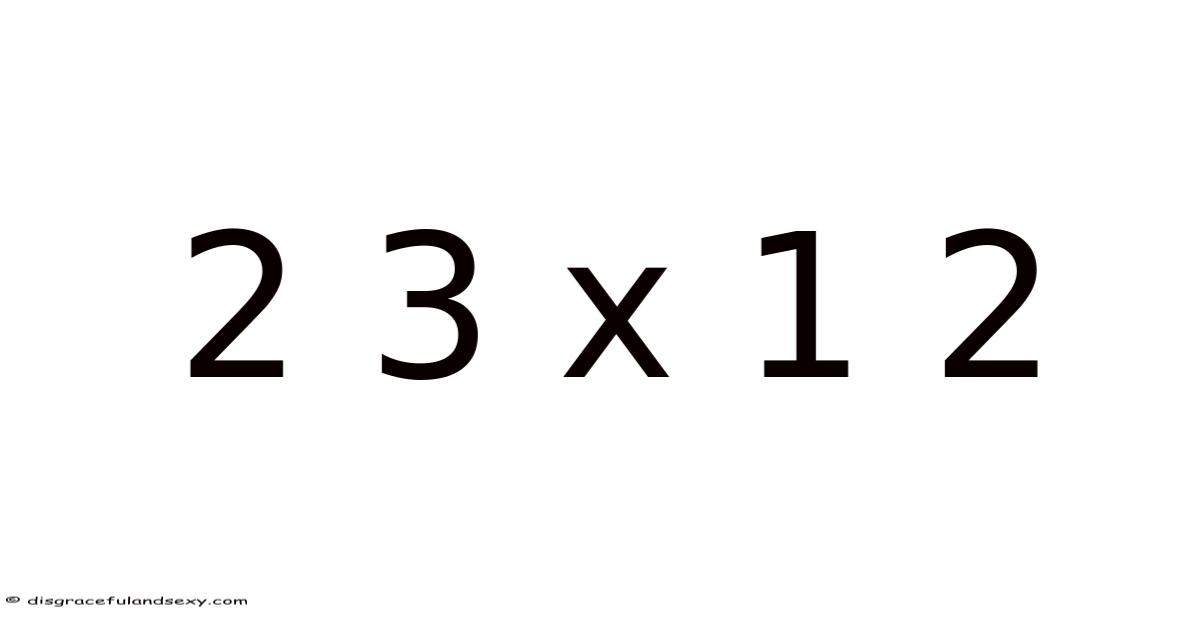
Decoding 2 x 3 x 1 x 2: A Deep Dive into Multiplication and its Applications
This article explores the seemingly simple mathematical expression "2 x 3 x 1 x 2," delving beyond the basic calculation to uncover the fundamental principles of multiplication, its diverse applications in various fields, and its significance in higher-level mathematics. Still, we'll examine the commutative and associative properties, explore practical examples across different disciplines, and address frequently asked questions to provide a comprehensive understanding of this foundational arithmetic operation. This will help you understand not just the answer, but the why behind it.
Understanding the Fundamentals: Multiplication as Repeated Addition
At its core, multiplication is a shortcut for repeated addition. The expression "2 x 3" means adding the number 2 three times: 2 + 2 + 2 = 6. Think about it: similarly, "3 x 2" represents adding the number 3 two times: 3 + 3 = 6. This foundational understanding is crucial for grasping more complex mathematical concepts That's the part that actually makes a difference..
Step-by-Step Calculation of 2 x 3 x 1 x 2
We can solve this equation in several ways, demonstrating the flexibility of multiplication:
Method 1: Sequential Calculation
- 2 x 3 = 6: We start by multiplying the first two numbers.
- 6 x 1 = 6: Next, we multiply the result by the third number.
- 6 x 2 = 12: Finally, we multiply the result by the last number.
Because of this, 2 x 3 x 1 x 2 = 12
Method 2: Commutative Property
The commutative property of multiplication states that the order of the numbers does not affect the product. This means 2 x 3 is the same as 3 x 2, and so on. We can rearrange the numbers to simplify the calculation:
This changes depending on context. Keep that in mind.
- Rearrange: We can rearrange the numbers to group them for easier calculation. To give you an idea, we can group the 2s together and the 3 and 1: (2 x 2) x (3 x 1)
- Calculate: 2 x 2 = 4 and 3 x 1 = 3
- Final Calculation: 4 x 3 = 12
This demonstrates the commutative property in action, showing that regardless of the order, the result remains 12.
Method 3: Associative Property
The associative property of multiplication allows us to group the numbers in different ways without changing the result. We can use parentheses to show how we group the numbers.
(2 x 3) x (1 x 2) = 6 x 2 = 12 or 2 x (3 x 1) x 2 = 2 x 3 x 2 = 12
Beyond the Calculation: Exploring the Properties of Multiplication
The seemingly simple equation, 2 x 3 x 1 x 2, offers a window into crucial mathematical properties:
-
Commutative Property: As demonstrated above, the order of numbers in a multiplication problem does not matter. This property simplifies calculations and allows for flexibility in problem-solving That's the part that actually makes a difference..
-
Associative Property: This property allows us to group numbers in any way we choose without changing the result. This is particularly helpful when dealing with larger multiplication problems And that's really what it comes down to..
-
Identity Property: The number 1 is the multiplicative identity. Any number multiplied by 1 remains unchanged. In our equation, multiplying by 1 doesn't alter the final product.
-
Distributive Property: While not directly demonstrated in this simple equation, the distributive property is crucial in more complex calculations. It states that multiplying a number by a sum is the same as multiplying the number by each term in the sum and then adding the results. For example: 2 x (3 + 1) = (2 x 3) + (2 x 1) = 8
Real-World Applications of Multiplication
Multiplication isn't confined to the classroom; it's fundamental to numerous real-world applications:
-
Everyday Finances: Calculating the total cost of multiple items, determining discounts, calculating taxes, and managing budgets all rely on multiplication. Take this: if you buy 2 items costing $3 each and 1 item costing $2, the total is (2 x $3) + (1 x $2) = $8 Surprisingly effective..
-
Measurement and Scaling: Scaling recipes, converting units (e.g., inches to centimeters), and calculating areas and volumes all involve multiplication. If a recipe calls for 2 cups of flour and you want to double the recipe, you'll need 2 x 2 = 4 cups of flour.
-
Engineering and Physics: Multiplication is essential in engineering calculations, such as determining forces, calculating distances, and designing structures. Physics relies heavily on multiplication in areas like mechanics, electromagnetism, and quantum mechanics.
-
Computer Science: Multiplication is a fundamental operation in computer programming, used in various algorithms and computations. From basic arithmetic to complex data manipulation, multiplication is indispensable No workaround needed..
-
Business and Economics: Calculating profits, losses, market shares, and economic growth all involve multiplication. Forecasting future revenues based on current sales requires multiplicative analysis.
-
Data Analysis and Statistics: Calculating averages, standard deviations, and correlations frequently involve multiplication. Understanding statistical significance often relies on calculations incorporating multiplication.
Multiplication in Higher Mathematics
The basic understanding of multiplication, exemplified by 2 x 3 x 1 x 2, forms the foundation for more advanced mathematical concepts:
-
Algebra: Multiplication is a core operation in algebraic equations, used to solve for unknowns and manipulate variables Which is the point..
-
Calculus: Derivatives and integrals, the cornerstones of calculus, involve multiplication and its inverse, division, extensively.
-
Linear Algebra: Matrix multiplication, a fundamental concept in linear algebra, is an extension of the basic multiplication principle Still holds up..
-
Number Theory: Prime factorization, a crucial aspect of number theory, relies on understanding the multiplicative relationships between numbers.
Frequently Asked Questions (FAQ)
Q: What is the importance of understanding the order of operations (PEMDAS/BODMAS)?
A: While the order of operations isn't directly relevant to this simple equation, it becomes crucial when dealing with more complex expressions involving multiple operations (parentheses/brackets, exponents/orders, multiplication and division, addition and subtraction). PEMDAS/BODMAS ensures consistent and accurate results.
Q: Can you explain the concept of zero in multiplication?
A: Any number multiplied by zero equals zero. This is known as the zero property of multiplication. If our equation were 2 x 3 x 1 x 0 x 2, the answer would be 0.
Q: How does multiplication relate to division?
A: Multiplication and division are inverse operations. Now, division "undoes" multiplication, and vice versa. Here's one way to look at it: 12 ÷ 2 = 6, and 6 x 2 = 12.
Q: How can I improve my multiplication skills?
A: Practice is key! Now, use flashcards, online games, and work through practice problems to build fluency and speed. Understanding the underlying principles, such as the commutative and associative properties, can also significantly enhance your skills.
Conclusion: The Enduring Significance of a Simple Equation
While seemingly straightforward, the equation 2 x 3 x 1 x 2 encapsulates fundamental principles of mathematics that extend far beyond its simple solution of 12. From everyday calculations to advanced scientific applications, multiplication remains an indispensable tool, highlighting the enduring significance of even the most basic mathematical concepts. Understanding these principles – the commutative and associative properties, the role of the multiplicative identity, and the relationship between multiplication and other mathematical operations – provides a solid foundation for further mathematical exploration. The ability to grasp and apply these concepts unlocks a deeper understanding of the world around us and empowers us to solve complex problems with confidence The details matter here. Simple as that..
