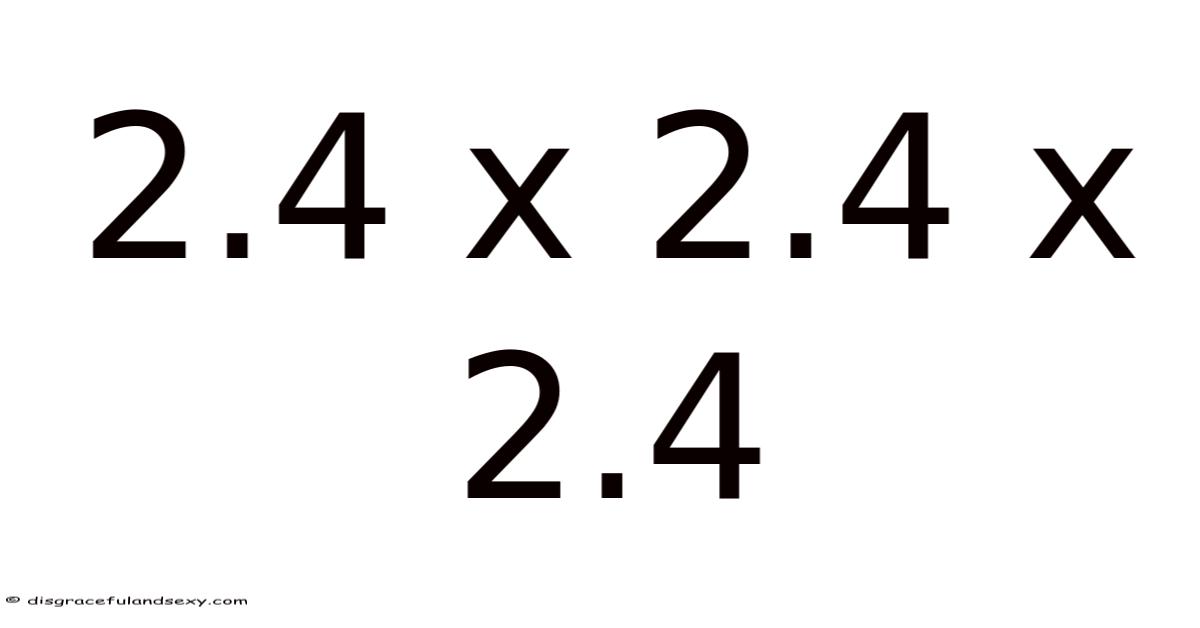
Decoding the Mystery of 2.4 x 2.4 x 2.4: Exploring Cubes, Volume, and Beyond
The seemingly simple expression "2.4 x 2.Day to day, 4 x 2. 4" might appear insignificant at first glance. Still, this seemingly mundane calculation opens a door to a world of mathematical concepts, practical applications, and even philosophical considerations. On the flip side, this article looks at the meaning behind this calculation, exploring its implications in geometry, physics, engineering, and even everyday life. We'll dissect the calculation, examine its real-world applications, and address common questions surrounding this seemingly simple equation.
Understanding the Fundamentals: Cubes and Volume
The expression 2.4 x 2.4 x 2.4 represents the calculation of the volume of a cube. Still, a cube is a three-dimensional solid object bounded by six square faces, facets or sides, with three meeting at each vertex. All of its sides are of equal length. Now, in our case, each side of the cube measures 2. On the flip side, 4 units (the units could be centimeters, meters, inches, feet, etc. – the units remain consistent throughout the calculation) The details matter here. Worth knowing..
The volume of a cube is determined by multiplying its length, width, and height. Since all three dimensions are equal in a cube, the calculation simplifies to side x side x side, or side³. So, 2.4 calculates the volume of a cube with sides of 2.Consider this: 4 x 2. 4 x 2.4 units.
Calculating the Volume: A Step-by-Step Guide
Let's break down the calculation:
-
First multiplication: 2.4 x 2.4 = 5.76. This gives us the area of one face of the cube.
-
Second multiplication: 5.76 x 2.4 = 13.824. This is the final volume of the cube.
Because of this, the volume of a cube with sides measuring 2.4 units is 13.824 cubic units.
Real-World Applications: Where 2.4 x 2.4 x 2.4 Matters
The calculation of the volume of a cube, even one with seemingly arbitrary dimensions like 2.4 x 2.4 x 2.
-
Engineering and Construction: Imagine calculating the volume of a concrete block, a storage container, or even a section of a building. Understanding cubic volume is crucial for material estimations, cost calculations, and efficient design. A 2.4 x 2.4 x 2.4 meter cube might represent a small storage unit, a section within a larger structure, or even a component in a piece of machinery. Accurate volume calculation ensures the appropriate amount of material is used and the structure is sound.
-
Packaging and Logistics: Businesses rely on accurate volume calculations for packaging goods, optimizing shipping containers, and determining transportation costs. Knowing the cubic volume of a product is essential for efficient storage and shipping. A cube of this size could represent the packaging of a particular item, necessitating precise calculations for efficient transportation and storage Took long enough..
-
Medicine and Pharmaceuticals: In the pharmaceutical industry, precise volume calculations are critical for drug dosages, solution preparation, and manufacturing processes. Cubic measurements play a role in determining the size of containers, ensuring accurate dispensing, and controlling the consistency of medications.
-
Scientific Research: In various scientific fields, the ability to precisely measure and calculate volumes is indispensable. This ranges from chemistry experiments requiring exact measurements of solutions to physics experiments involving cubic containers for reactions It's one of those things that adds up..
-
Everyday Life: While perhaps less obvious, understanding cubic volume applies even in everyday life. From estimating the amount of soil needed for a garden bed to calculating the amount of water in a fish tank, the principles remain the same.
Beyond the Calculation: Expanding the Understanding
The seemingly simple calculation of 2.In real terms, 4 x 2. 4 x 2.
-
Surface Area: The surface area of the cube is calculated by finding the area of each face (2.4 x 2.4 = 5.76 square units) and multiplying by 6 (the number of faces). This gives a total surface area of 34.56 square units. Understanding both volume and surface area is vital in numerous applications, such as determining the amount of paint needed to cover a surface or the heat transfer through a material.
-
Units of Measurement: The units used in the calculation are crucial. Whether the units are centimeters, meters, inches, or feet will drastically change the actual size and volume of the cube. Consistent use of units is essential for accurate calculations Not complicated — just consistent..
-
Dimensional Analysis: Understanding the units involved and how they interact during calculations is a core principle of dimensional analysis, a powerful tool for verifying the correctness of equations and preventing errors. This is particularly relevant in scientific and engineering applications.
-
Scaling and Proportionality: The concept of scaling and proportionality becomes clear when considering the implications of changing the side length of the cube. Increasing the side length increases both the volume and the surface area proportionally, but not at the same rate. This relationship is crucial in designing structures and systems that need to scale up or down in size while maintaining functionality That alone is useful..
Frequently Asked Questions (FAQs)
-
Q: Why is the result 13.824 and not a whole number?
- A: Because the side length of the cube (2.4 units) is not a whole number. Multiplying decimal numbers often results in decimal answers.
-
Q: What are the practical limitations of using this calculation?
- A: Practical limitations can include measurement inaccuracies, the assumption of perfectly regular cubic shapes (real-world objects might have slight imperfections), and the need to account for additional factors like material density or structural integrity.
-
Q: Can this calculation be used for objects that are not perfect cubes?
- A: No, this specific calculation (2.4 x 2.4 x 2.4) only applies to perfect cubes. For other shapes, different volume calculation methods must be used.
-
Q: What are some other ways to approach this calculation?
- A: You could use a calculator, perform the calculation manually using long multiplication, or employ a spreadsheet program to automate the process.
-
Q: What are the implications of rounding the result?
- A: Rounding the result to a whole number (e.g., 14 cubic units) introduces error. The degree of error depends on the application and the acceptable margin of error. In many situations, precision is crucial, and rounding could be unacceptable.
Conclusion: The Significance of Simple Calculations
The calculation 2.4 x 2.4 x 2.So 4, seemingly simple, reveals a wealth of mathematical and practical implications. Understanding cubic volume, its applications, and related concepts like surface area, scaling, and units of measurement is fundamental across numerous disciplines. Still, this calculation serves as a microcosm of the broader importance of precise mathematical understanding in our world. Which means from engineering marvels to everyday life, the principles demonstrated in this seemingly simple equation play a crucial role in our ability to design, build, understand, and interact with the world around us. The ability to perform such calculations is not merely an academic exercise; it's a vital skill with far-reaching consequences And that's really what it comes down to. Which is the point..
