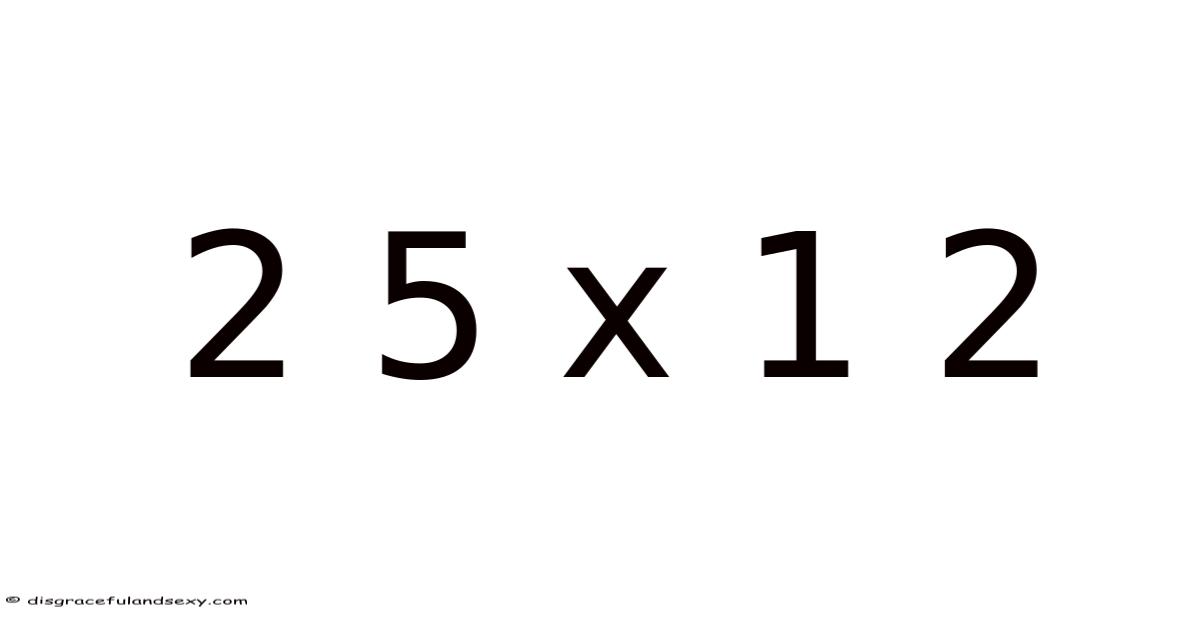
Decoding 2.5 x 1.2: A Deep Dive into Multiplication and its Applications
This article explores the seemingly simple calculation of 2.5 multiplied by 1.2, delving far beyond the immediate answer. We'll examine the underlying principles of decimal multiplication, explore various methods for solving this problem, and discuss real-world applications where this type of calculation is crucial. Understanding this seemingly basic operation lays the groundwork for more complex mathematical concepts and problem-solving skills. By the end, you'll not only know the answer but also understand why and how it's derived, broadening your mathematical understanding and confidence Simple, but easy to overlook..
Understanding Decimal Multiplication
Before we tackle 2.Now, 5 x 1. 2, let's refresh our understanding of decimal numbers and multiplication. Also, decimal numbers are numbers that contain a decimal point, separating the whole number part from the fractional part. Multiplying decimals involves the same fundamental principles as multiplying whole numbers, but with an added step for handling the decimal point.
The core concept remains the same: multiplication represents repeated addition. To give you an idea, 2.5 x 1.And 2 can be interpreted as adding 2. Practically speaking, 5 to itself 1. In real terms, 2 times. While this interpretation might seem unconventional, it highlights the fundamental relationship between addition and multiplication.
Method 1: Traditional Long Multiplication
This method is a classic approach taught in schools. It involves breaking down the numbers into their whole and fractional parts and performing a series of multiplications and additions.
-
Ignore the decimals: Initially, treat the numbers as whole numbers: 25 x 12.
-
Perform long multiplication:
25 x 12 ---- 50 (25 x 2) 250 (25 x 10) ---- 300 -
Place the decimal point: Count the total number of decimal places in the original numbers (2.5 has one decimal place, and 1.2 has one decimal place, totaling two). Place the decimal point in the result (300) two places from the right. This gives us 3.00, or simply 3.
That's why, 2.5 x 1.2 = 3
Method 2: Distributive Property
The distributive property states that a(b + c) = ab + ac. We can use this to break down the multiplication into simpler steps:
-
Rewrite the numbers: Rewrite 2.5 as 2 + 0.5 and 1.2 as 1 + 0.2.
-
Apply the distributive property:
2.5 x 1.2 = (2 + 0.5) x (1 + 0.2) = (2 x 1) + (2 x 0.2) + (0.5 x 1) + (0.5 x 0.2)
-
Perform the multiplications:
- 2 x 1 = 2
- 2 x 0.2 = 0.4
- 0.5 x 1 = 0.5
- 0.5 x 0.2 = 0.1
-
Add the results: 2 + 0.4 + 0.5 + 0.1 = 3
So, 2.5 x 1.2 = 3
Method 3: Converting to Fractions
Decimals can be expressed as fractions. This method involves converting the decimals into fractions, performing the multiplication, and then converting the result back to a decimal Took long enough..
-
Convert to fractions: 2.5 = 5/2 and 1.2 = 6/5
-
Multiply the fractions: (5/2) x (6/5) = (5 x 6) / (2 x 5) = 30/10
-
Simplify the fraction: 30/10 = 3
-
Convert back to decimal: 3 = 3.0
Which means, 2.5 x 1.2 = 3
Method 4: Using a Calculator
The simplest and often quickest method is to use a calculator. Simply input "2.Think about it: 2" and the calculator will provide the answer: 3. 5 x 1.While convenient, understanding the underlying mathematical principles is crucial for problem-solving and avoiding errors.
Real-World Applications of Decimal Multiplication
The seemingly simple calculation of 2.5 x 1.2 has numerous real-world applications across various fields:
- Shopping: Calculating the total cost of 2.5 kg of apples at $1.20 per kg.
- Construction: Determining the area of a rectangular space measuring 2.5 meters by 1.2 meters.
- Finance: Computing interest earned on a principal amount or calculating discounts.
- Cooking: Scaling recipes – if a recipe calls for 1.2 cups of flour, and you want to make 2.5 times the recipe, you need 2.5 x 1.2 = 3 cups.
- Science: In many scientific calculations, measurements often involve decimal numbers, requiring multiplication for various computations.
- Engineering: Calculations related to dimensions, materials, and forces frequently involve decimal multiplication.
Beyond the Calculation: Understanding the Significance
While the answer to 2.5 x 1.2 is straightforward, the process of arriving at the answer provides valuable insights into several key mathematical concepts:
- Decimal Place Value: Understanding the value of each digit based on its position relative to the decimal point is crucial for accurate calculations.
- Distributive Property: This fundamental property underpins many algebraic manipulations and simplifications.
- Fraction Equivalence: The ability to convert between decimals and fractions demonstrates a deeper understanding of number systems.
- Order of Operations: While not explicitly highlighted in this calculation, understanding the order of operations (PEMDAS/BODMAS) is essential for more complex problems involving multiple operations.
Frequently Asked Questions (FAQ)
-
What if one of the numbers was negative? If either 2.5 or 1.2 were negative, the result would be negative. To give you an idea, -2.5 x 1.2 = -3.
-
Can I use a different method to solve this? Yes, there are many approaches to decimal multiplication, each with its own advantages and disadvantages. The best method depends on individual preference, the complexity of the problem, and the available tools.
-
Why is understanding the methods important, beyond just getting the answer? Understanding the underlying mathematical principles provides a stronger foundation for tackling more complex problems and fosters a deeper appreciation for mathematics. It helps build critical thinking and problem-solving skills applicable far beyond this specific calculation It's one of those things that adds up..
-
Are there any shortcuts for multiplying decimals? While calculators provide the quickest method, understanding the methods discussed allows for mental estimations and quicker manual calculation in certain situations.
Conclusion
The seemingly simple calculation of 2.In real terms, 5 x 1. 2 provides a valuable opportunity to walk through the fundamentals of decimal multiplication. Also, by exploring various methods – long multiplication, the distributive property, fraction conversion, and calculator use – we've not only obtained the answer (3) but also gained a deeper appreciation for the underlying mathematical principles. Here's the thing — this understanding extends beyond the immediate calculation, equipping you with stronger problem-solving skills applicable in numerous real-world scenarios. That's why remember, grasping the how is just as important as knowing the what in mathematics. This exploration reinforces the importance of understanding the "why" behind the calculations, leading to a more solid and confident approach to mathematics Not complicated — just consistent. And it works..
