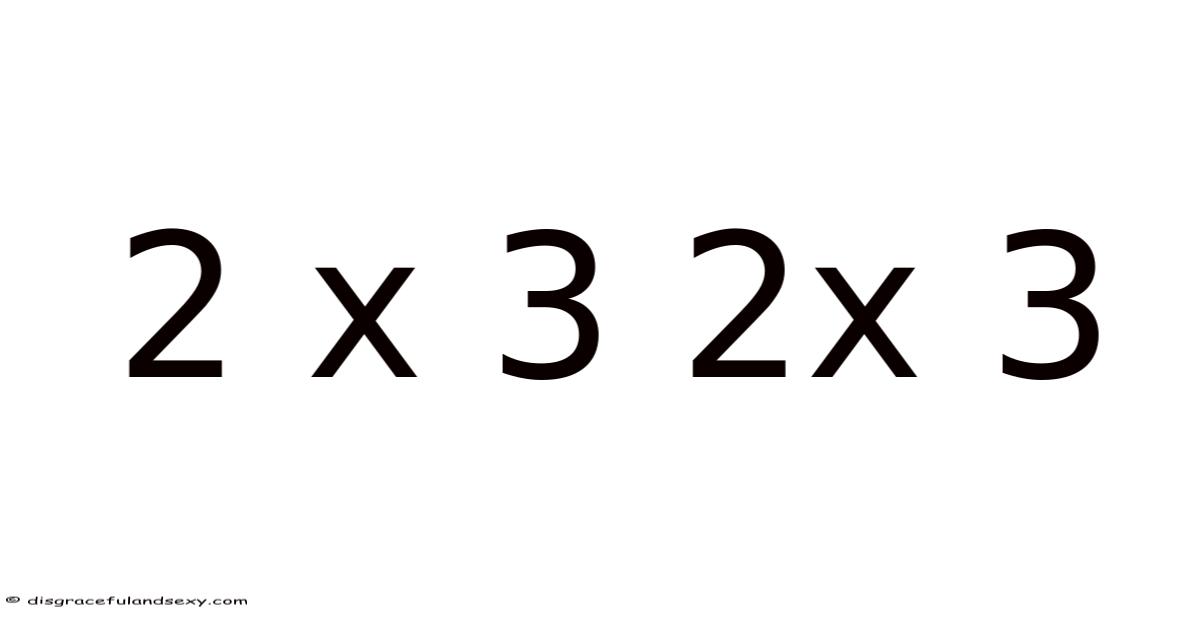
Decoding the Mystery of "2 x 3 2x3": Exploring Multiplication, Dimensionality, and Beyond
The seemingly simple expression "2 x 3 2x3" presents a fascinating challenge for interpretation. Also, at first glance, it might appear straightforward, but a deeper dive reveals a multitude of potential meanings, depending on the context. This article will explore the various interpretations of this expression, delving into the fundamentals of multiplication, discussing potential interpretations in different fields like geometry and programming, and finally examining its ambiguous nature and the importance of clear communication in mathematics and beyond No workaround needed..
Understanding the Basics: Multiplication
Before we unravel the mystery of "2 x 3 2x3," let's solidify our understanding of the core concept: multiplication. Also, multiplication is a fundamental arithmetic operation that represents repeated addition. This is a simple, yet crucial foundation for understanding more complex mathematical concepts. Here's a good example: 2 x 3 signifies adding the number 2 three times (2 + 2 + 2), resulting in 6. This core concept of repeated addition is crucial for understanding how we might interpret "2 x 3 2x3" Not complicated — just consistent..
Interpretation 1: Simple Multiplication – 2 x 3 x 2 x 3
The most straightforward interpretation treats "2 x 3 2x3" as a series of multiplications. We can rewrite it as 2 x 3 x 2 x 3. Following the order of operations (multiplication from left to right), we have:
- 2 x 3 = 6
- 6 x 2 = 12
- 12 x 3 = 36
So, under this interpretation, "2 x 3 2x3" equals 36. This is the most likely interpretation if the expression is encountered without additional context.
Interpretation 2: Exploring Dimensionality – A 2x3 Matrix or Rectangle
Stepping beyond simple arithmetic, "2 x 3 2x3" can represent dimensionality. In the context of geometry or computer science, "2 x 3" frequently describes a matrix or a rectangle with 2 rows and 3 columns That's the part that actually makes a difference..
If we interpret "2 x 3 2x3" as two separate 2x3 matrices, we're dealing with two distinct entities, each with its own characteristics. Visualizing this:
- Matrix 1: A 2x3 matrix could be represented as:
[a  b  c]
[d  e  f]
- Matrix 2: A second, independent 2x3 matrix could be represented as:
[g  h  i]
[j  k  l]
Here, a, b, c, d, e, f, g, h, i, j, k, and l represent any numerical values. This interpretation moves beyond a single numerical answer and digs into the realm of data structures.
Interpretation 3: Cartesian Coordinates and Points in Space
Expanding on dimensionality, we could interpret "2 x 3 2x3" within a Cartesian coordinate system. Still, this requires a more formalized understanding of how to represent coordinates. It might be interpreted as implying separate sets of coordinates: (2,3) and (2,3), representing two identical points in a 2-dimensional space. Again, the interpretation depends heavily on the context No workaround needed..
And yeah — that's actually more nuanced than it sounds.
Interpretation 4: Repeated Operations in Programming
In programming, "2 x 3 2x3" could represent a sequence of operations. Worth adding: imagine a loop that repeats a calculation (2 x 3) twice. This approach opens up avenues for exploring programming logic and iterative processes. The result would still be 36 (6 from the first loop and 6 from the second), but the focus shifts from a static calculation to a dynamic process It's one of those things that adds up..
The Importance of Context and Clear Communication
The ambiguity of "2 x 3 2x3" highlights the crucial role of context in mathematical interpretation. That's why this is why precise mathematical notation is essential for avoiding misunderstandings. But the same sequence of symbols can have different meanings depending on the environment it is presented in. The proper use of parentheses, brackets, and other mathematical symbols is critical for clarity.
Take this: the lack of operators between the two instances of "2 x 3" leads to ambiguity. If we wanted to clearly express the idea of multiplying 2 x 3 by itself, we'd write (2 x 3)² or (2 x 3) * (2 x 3). This eliminates the possibility of misinterpretation That's the part that actually makes a difference..
Expanding on the Concept: Order of Operations (PEMDAS/BODMAS)
The Order of Operations, often remembered by acronyms like PEMDAS (Parentheses, Exponents, Multiplication and Division, Addition and Subtraction) or BODMAS (Brackets, Orders, Division and Multiplication, Addition and Subtraction), provides a framework for evaluating mathematical expressions with multiple operations. In the case of "2 x 3 2x3" interpreted as a series of multiplications, we simply follow the order from left to right as multiplication and division have equal precedence.
Addressing Potential Misinterpretations
It is crucial to recognize that "2 x 3 2x3" lacks the formality and clarity expected in mathematical notation. While we have explored various interpretations, a well-defined mathematical expression would clearly specify the relationship between the numerical components. So misinterpretations arise due to the ambiguous spacing and lack of explicit operators. Such ambiguity makes it unsuitable for formal mathematical contexts.
The official docs gloss over this. That's a mistake.
Beyond the Numbers: The Broader Implications
The ambiguity inherent in "2 x 3 2x3" extends beyond just mathematics. It touches upon the importance of clear communication in all areas of life. Think about it: whether we are writing code, designing buildings, or explaining a concept, precise language and unambiguous notation are very important to conveying our ideas effectively. The lessons learned from interpreting this simple expression extend to the broader field of communication and problem-solving.
Practical Applications and Real-World Examples
While "2 x 3 2x3" itself might not have direct real-world applications in its raw form, the underlying concepts it touches upon—multiplication, dimensionality, and the importance of clear communication—are vital in various fields Worth keeping that in mind. That's the whole idea..
- Engineering: Calculations involving dimensions and quantities often rely on precise mathematical expressions.
- Computer Science: Data structures, matrix operations, and algorithms all require unambiguous notation.
- Finance: Calculations involving interest rates, investments, and budgeting are critically dependent on accurate arithmetic.
Conclusion: The Value of Precision
The seemingly simple expression "2 x 3 2x3" has revealed a surprisingly rich landscape of interpretations. From basic arithmetic to matrix representation and even programming logic, the expression demonstrates the power of context and the importance of clear communication. While the most straightforward interpretation leads to an answer of 36, the exploration of alternative interpretations highlights the need for precise mathematical notation and the broader implications of unambiguous communication in diverse fields. The lesson learned is that precision in expressing mathematical ideas is critical to effective problem-solving and communication. The ambiguity of the expression serves as a valuable reminder that even in the world of seemingly simple numbers, clarity is key And that's really what it comes down to..
