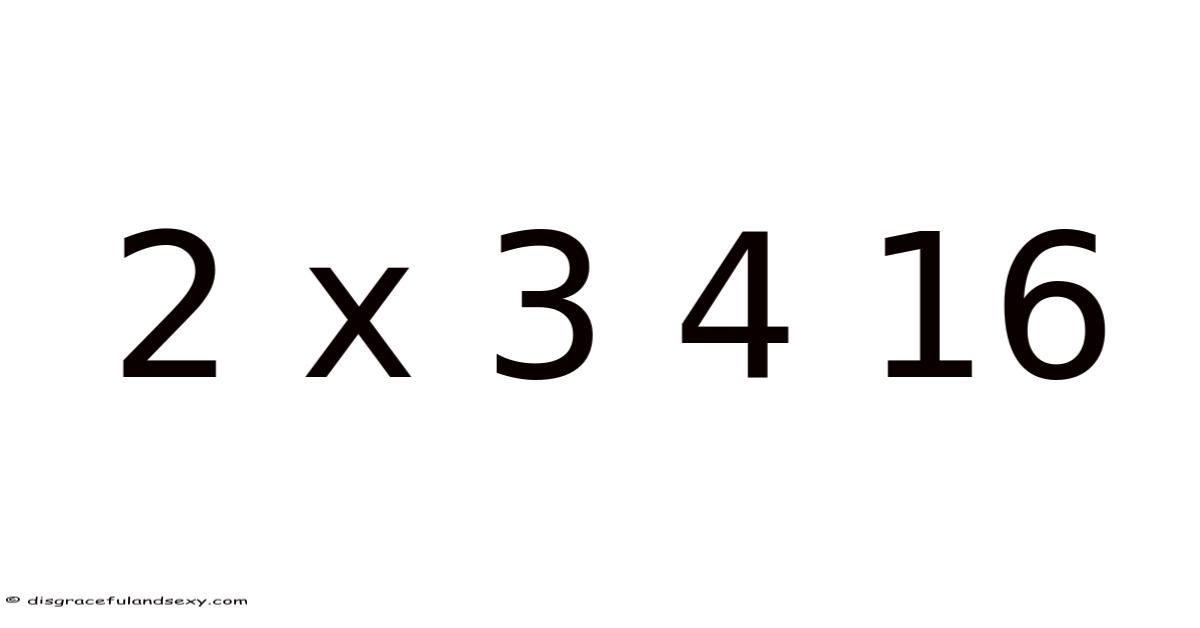
Decoding the Sequence: Unraveling the Mystery of 2 x 3 4 16
The sequence "2 x 3 4 16" might initially seem like a random collection of numbers. That said, a closer look reveals a hidden pattern, sparking curiosity and challenging our logical reasoning skills. This article delves deep into this intriguing sequence, exploring various potential mathematical relationships and ultimately unveiling the underlying logic. We'll examine different approaches to problem-solving, emphasizing the importance of critical thinking and pattern recognition. This exploration will not only explain the sequence but also enhance your understanding of mathematical sequences and logical deduction.
Understanding the Challenge: More Than Just a Simple Sequence
At first glance, the sequence "2 x 3 4 16" appears deceptively simple. The presence of the multiplication sign "x" between the 2 and 3 suggests a potential mathematical operation. Even so, the subsequent numbers, 4 and 16, don't immediately seem to follow a straightforward arithmetic progression or geometric progression. This ambiguity is precisely what makes the sequence so fascinating. Because of that, it forces us to consider multiple possibilities and employ different problem-solving strategies. We must move beyond basic arithmetic and break down the realm of pattern recognition and logical deduction Which is the point..
Potential Interpretations and Mathematical Approaches
Several approaches can be applied to decipher the logic behind this intriguing sequence. Let's explore some of the most plausible interpretations:
1. A Combination of Operations: Beyond Simple Multiplication
The inclusion of "x" doesn't necessarily dictate that only multiplication is involved. The sequence might involve a combination of arithmetic operations. As an example, we could consider the following:
- 2 x 3 = 6: This is straightforward multiplication.
- 6 + 4 = 10: This adds the next number in the sequence. That said, this approach does not produce the 16.
Alternatively, we can analyze a different pattern. Day to day, perhaps the 'x' isn't a standard multiplication sign but a placeholder for a more complex relationship. This leads us to another promising interpretation.
2. A Pattern Based on a Quadratic Relationship
It's possible that the sequence is defined by a quadratic equation. In this case, we might try to find a function f(x) that satisfies the following:
- f(1) = 2
- f(2) = 3
- f(3) = 4
- f(4) = 16
Finding such a function requires solving a system of equations, a more advanced mathematical technique. This is a more challenging approach, requiring a deeper understanding of algebraic functions. Still, one might explore using interpolation methods or polynomial curve fitting techniques to determine the underlying function. While a precise quadratic function might not perfectly fit, it underscores the importance of exploring various mathematical models to solve this kind of problem Not complicated — just consistent..
3. Introducing a Hidden Operation: Exploiting Implicit Relationships
Instead of searching for an explicit mathematical formula, we can analyze the sequence for implicit relationships. Let's examine the numbers individually:
- 2: A prime number.
- 3: A prime number.
- 4: 2 squared (2²)
- 16: 4 squared (4²) or 2 to the power of 4 (2⁴)
This pattern reveals a possible hierarchical relationship. On the flip side, we start with prime numbers and then the next number is obtained by squaring the previous one. This interpretation requires the 'x' to serve as a separator of different operations rather than a direct multiplication Practical, not theoretical..
4. The Role of the "x": Redefining the Symbol's Function
The "x" may not represent standard multiplication. Instead, it could be a symbolic separator, indicating a shift in the pattern or the introduction of a new operation. Simply put, the 'x' could simply act as a visual delimiter that breaks down the sequence into two parts which follow different logical structures:
- The first part: 2, 3 - these numbers are consecutive prime numbers.
- The second part: 4, 16 - these numbers are consecutive powers of 2; specifically, 2², 2⁴
Under this interpretation, there isn't a continuous mathematical operation linking all four numbers. Instead, the sequence is a combination of two separate but related patterns That's the part that actually makes a difference..
The Most Plausible Explanation: A Combined Pattern Approach
While various interpretations are possible, the most satisfying explanation is a combined pattern approach. This approach accepts that the 'x' acts as a delimiter. We can see two distinct sequences embedded within the overall sequence:
- A sequence of consecutive prime numbers (2 and 3): This represents the initial part of the sequence.
- A sequence of consecutive powers of 2 (4 and 16): This represents the second part of the sequence, starting with 4 which is 2².
This explanation satisfies the given data and avoids the need for overly complex mathematical functions. It highlights the importance of recognizing different patterns and considering the potential for non-linear relationships between numbers.
Expanding the Sequence: Predicting Future Numbers
If we accept the combined pattern approach as the correct interpretation, we can attempt to predict the next numbers in the sequence. On the flip side, it helps to note that this prediction relies on continuing the established patterns. There's no guarantee that the patterns will continue indefinitely Worth knowing..
Following the established pattern:
- Next prime numbers: The next two prime numbers after 3 are 5 and 7.
- Next powers of 2: The next power of 2 after 16 is 32 (2⁵), followed by 64 (2⁶), and so on.
Thus, based on this interpretation, a possible continuation of the sequence could be: 2 x 3 4 16 5 7 32 64…
This prediction highlights the fact that different interpretations might generate different extensions of the sequence. The beauty of such number puzzles lies in the creativity and multiple solutions they allow.
Applying the Concepts: Problem-Solving Strategies
This seemingly simple sequence showcases various important problem-solving strategies:
- Pattern recognition: Identifying recurring patterns or relationships between numbers is crucial.
- Critical thinking: Questioning assumptions and exploring multiple interpretations is essential.
- Mathematical modeling: Employing various mathematical concepts and techniques (like quadratic equations) to model the sequence.
- Logical deduction: Using logic and reasoning to eliminate impossible interpretations and arrive at the most plausible explanation.
- Creative thinking: Considering unconventional approaches and redefining the meaning of symbols (like the "x" in this case).
These strategies are not only valuable in solving mathematical puzzles but are also transferable skills applicable to various fields and real-life situations.
Frequently Asked Questions (FAQ)
Q: Is there only one correct answer to this sequence puzzle?
A: While the combined pattern approach presents a compelling and likely solution, there might be other equally valid interpretations, depending on the assumptions made about the nature of the sequence and the role of the "x". The ambiguity highlights the richness and complexity of pattern recognition Small thing, real impact..
Q: How can I improve my skills in solving similar number puzzles?
A: Practice is key! Engage with various number puzzles and sequence problems of different complexities. Focus on developing your pattern recognition skills, learning different mathematical techniques, and honing your critical thinking abilities.
Q: Are these types of problems relevant to real-world applications?
A: While this specific sequence might not have direct real-world applications, the underlying problem-solving skills are highly relevant. Pattern recognition, logical deduction, and creative problem-solving are valuable tools in many fields, including computer science, data analysis, and scientific research Turns out it matters..
Conclusion: The Power of Pattern Recognition and Logical Deduction
The sequence "2 x 3 4 16" serves as a captivating example of how a simple collection of numbers can spark intellectual curiosity and challenge our problem-solving skills. The most likely explanation reveals a combined pattern of consecutive prime numbers and powers of 2, highlighting the importance of recognizing multiple patterns and considering the contextual role of symbols. So beyond the specific solution, this exploration underscores the power of pattern recognition, critical thinking, and logical deduction – skills crucial for success in various academic and professional pursuits. Through this deeper understanding, we not only solve the puzzle but also enhance our analytical abilities, fostering a more profound appreciation for the beauty and complexity of mathematics.
