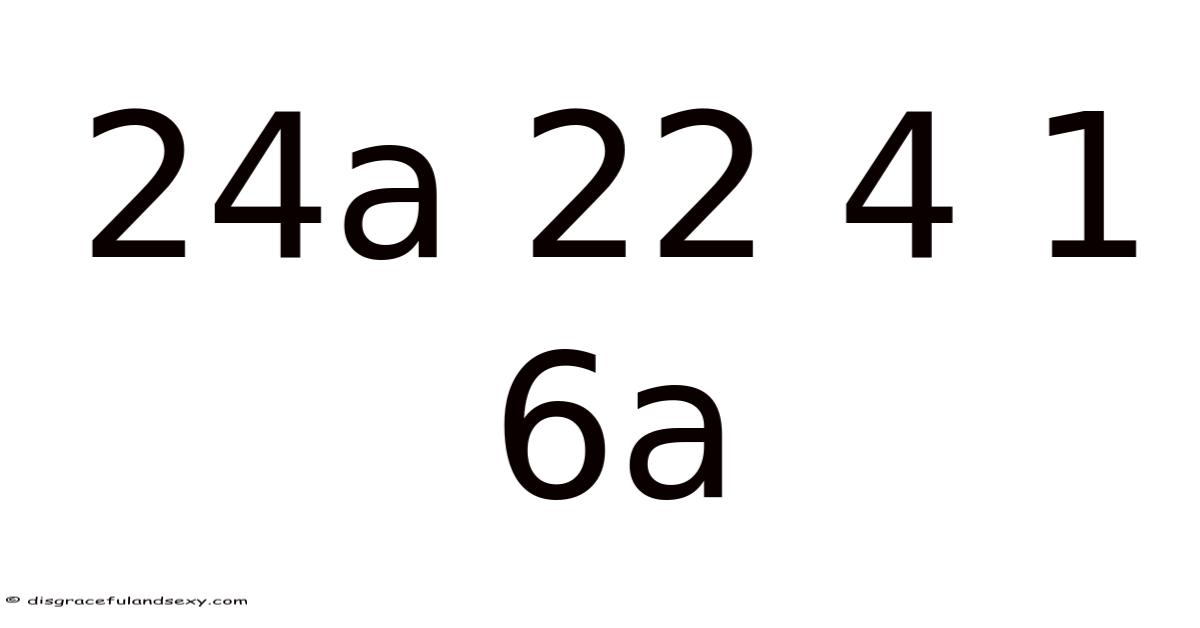
Decoding the Enigma: Unveiling the Meaning Behind "24a 22 4 1 6a"
This article looks at the mystery surrounding the seemingly random sequence "24a 22 4 1 6a". And while there's no single, universally accepted meaning, we will explore various possibilities, focusing on potential interpretations within different contexts, including cryptography, numerology, and even artistic expression. Understanding the context in which this sequence appears is crucial to deciphering its intended meaning. This exploration will provide a framework for analyzing similar cryptic sequences and highlight the importance of contextual clues in deciphering hidden messages Which is the point..
Quick note before moving on And that's really what it comes down to..
Understanding the Components: Numbers and Letters
The sequence "24a 22 4 1 6a" combines numbers and lowercase letters. This immediately suggests a level of complexity beyond simple numerical sequences. The presence of the letters "a" introduces ambiguity, broadening the possibilities of interpretation.
-
Numbers: The numbers (24, 22, 4, 1, 6) could represent various things depending on the context. They could be:
- Dates: Potentially representing days, months, or years. The presence of a number like '1' makes a date interpretation less likely, but it can’t be completely disregarded.
- Coordinates: In a geographical or grid-based system.
- Measurements: Units of length, weight, time, etc.
- Codes: Parts of a more extensive code or cipher.
- Numerical Values in a Formula or Equation: Potentially acting as variables or constants.
-
Letters: The lowercase "a" adds another layer of complexity. Its meaning is highly dependent on the context. It could:
- Represent a Variable: In a mathematical or programming context.
- Indicate a Unit of Measurement: Such as 'a' for amperes (electrical current) or 'a' for acres (area).
- Be Part of an Alphabetic Cipher: Where letters are used to represent numbers or words.
- Simply Be a Separator or Marker: Distinguishing groups of numbers within the sequence.
Potential Interpretations and Contexts
The interpretation of "24a 22 4 1 6a" hinges on understanding the context in which it appeared. Here are some potential scenarios:
1. Cryptographic Context
The sequence could represent a simple substitution cipher. Each number could stand for a letter of the alphabet, with "a" acting as a marker or possibly representing a specific letter or symbol. That said, without a key or more information, cracking such a cipher is extremely difficult. More complex ciphers are also possible, possibly involving multiple layers of encryption.
The seemingly random nature of the numbers might mislead. The sequence may follow a specific pattern that is not immediately apparent, such as a modulo operation, or a more complex mathematical algorithm.
2. Numerical Systems and Bases
The numbers could be interpreted in different numerical bases (like binary, ternary, octal, hexadecimal, etc.Also, ). Converting the numbers to different bases might reveal a hidden pattern or a meaningful message. Now, the use of different bases is common in computer science and cryptography. The presence of 'a' could signify a transition or a change in base within the sequence itself Not complicated — just consistent..
3. Artistic and Symbolic Interpretations
In an artistic context, the sequence could represent abstract concepts, emotions, or elements of a narrative. The numbers might symbolize specific events or characters. Now, the artist's intent would be crucial to interpreting the meaning. The seemingly random nature of the numbers could be intentional, representing chaos, unpredictability, or the subconscious.
4. Geographical or Cartographic Context
If the numbers represent coordinates, they could point to a specific location on a map or grid. Even so, without specifying the coordinate system (latitude/longitude, UTM, etc.Consider this: ), determining a precise location is impossible. The letter "a" could signify a specific zone or region within a larger coordinate system.
5. Algorithmic or Programming Context
The sequence could be an instruction set for a computer program or part of an algorithm. The letters and numbers could represent variables, operators, or memory addresses. Deciphering this would require knowledge of the specific programming language or algorithm used Simple as that..
6. Numerology
In numerology, numbers hold symbolic meanings. Here's the thing — the numbers in the sequence could be reduced to single digits and then interpreted based on numerological principles. The letter "a" could be assigned a numerical value based on its position in the alphabet. That said, numerological interpretations are largely subjective and lack scientific basis Worth keeping that in mind..
The Importance of Context: A Case Study Approach
To illustrate the importance of context, let's consider a hypothetical scenario:
Imagine the sequence "24a 22 4 1 6a" is found etched onto an ancient artifact. That said, if we discover alongside the artifact a written language or a series of symbols, this additional information could provide crucial clues for interpreting the sequence. Without any additional information, deciphering the sequence is extremely challenging. The artifact's location, its age, and the culture associated with it could also offer valuable insights Nothing fancy..
Another scenario: suppose the sequence appears in a contemporary art installation. In this case, the artist's statement or any accompanying documentation could open up the intended meaning. The sequence might not be meant to be literally deciphered but could represent a concept, a feeling, or a process of creation.
Methodological Approaches to Deciphering Similar Sequences
When confronted with cryptic sequences similar to "24a 22 4 1 6a," a systematic approach is crucial. This approach involves:
- Contextual Analysis: Carefully examine the circumstances surrounding the sequence's discovery. Consider the source, the date, and any accompanying information.
- Frequency Analysis: If the sequence is part of a larger body of text or data, analyze the frequency of each number and letter. This can reveal patterns and help identify potential ciphers.
- Pattern Recognition: Look for patterns within the sequence. Are there recurring numbers or letters? Are the numbers increasing or decreasing in a systematic way?
- Mathematical Analysis: Explore mathematical operations that could transform the sequence into a more meaningful form. Consider different numerical bases and mathematical functions.
- Trial and Error: Experiment with different cipher methods and decryption techniques. Keep track of your attempts and eliminate those that don't yield promising results.
- Consultation with Experts: If necessary, consult experts in cryptography, linguistics, or other relevant fields.
Frequently Asked Questions (FAQ)
-
Q: Is there a definitive meaning to "24a 22 4 1 6a"?
- A: No, without additional context, there is no single definitive meaning. The interpretation depends entirely on the context in which the sequence appears.
-
Q: Could this be a code related to a specific organization or group?
- A: It's possible, but highly improbable without further evidence. Codes used by organizations are usually more complex and secure than this sequence appears to be.
-
Q: What is the role of the lowercase "a"?
- A: The role of "a" is ambiguous and depends entirely on the context. It could be a separator, a variable, part of an alphabetic cipher, or have another meaning entirely.
-
Q: Can you provide a guaranteed method to decipher this sequence?
- A: No, there is no guaranteed method without additional information. The deciphering process relies heavily on contextual clues and educated guesswork.
Conclusion
The sequence "24a 22 4 1 6a" remains an enigma without sufficient context. On the flip side, by examining the various potential interpretations and considering the importance of context, we have gained valuable insight into the complexity of deciphering cryptic sequences. While a definitive solution may remain elusive without additional information, the process of attempting to decipher the sequence itself provides a valuable exercise in critical thinking and problem-solving. Think about it: this exploration highlights the need for a systematic approach, involving meticulous observation, contextual analysis, and the exploration of various interpretive frameworks. The journey of decoding such a mystery underscores the detailed relationship between symbols, numbers, and the human quest for meaning.
