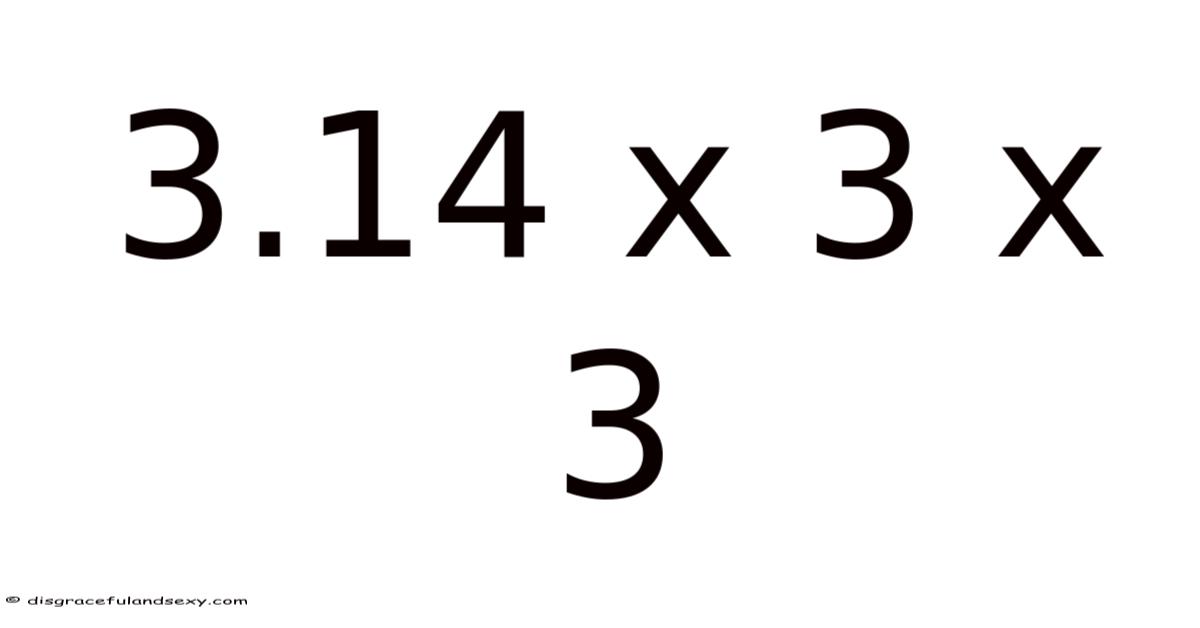
Unraveling the Mystery of 3.14 x 3 x 3: Exploring Pi, Circles, and Cubic Dimensions
The seemingly simple calculation, 3.Consider this: 14 x 3 x 3, holds a fascinating gateway to understanding fundamental mathematical concepts. That's why at first glance, it appears to be a straightforward multiplication problem, yielding the answer 28. Worth adding: 26. Even so, delving deeper reveals its connections to the intriguing world of geometry, specifically involving the constant π (pi) and the calculation of the volume of a cylinder. This article will explore the significance of each element in this calculation, examining its geometrical implications, and extending the understanding to related concepts. This exploration will go beyond a simple numerical answer, providing a comprehensive understanding of the underlying mathematical principles.
Understanding the Components: Pi (π), Radius, and Cubed Dimensions
Before diving into the calculation itself, let's break down its components:
-
3.14 (π or Pi): This is an approximation of the mathematical constant pi, a ratio representing the circumference of a circle to its diameter. Pi is an irrational number, meaning its decimal representation goes on forever without repeating. While we often use 3.14 as a simplification, the actual value of pi is far more complex, extending infinitely. Its universality is a cornerstone of mathematics and physics, appearing in various formulas related to circles, spheres, and oscillations.
-
3: This number represents a length, typically the radius of a circle or cylinder. The radius is the distance from the center of a circle to any point on its circumference. In the context of our calculation, 3 could represent a radius of 3 units (inches, centimeters, meters, etc.) And that's really what it comes down to..
-
3 (Cubed): The number 3 appears twice. The second '3' is cubed (3³), which means 3 multiplied by itself three times (3 x 3 x 3 = 27). Cubing a number relates to three-dimensional space. In geometry, cubing a length signifies volume.
The Calculation: 3.14 x 3 x 3 and its Geometrical Significance
Now, let's consider the calculation 3.14 x 3 x 3 in its geometrical context. The calculation represents a simplified formula for the volume of a cylinder:
Volume of a Cylinder = πr²h
Where:
- π (pi) ≈ 3.14
- r = radius of the cylinder's base
- h = height of the cylinder
In our calculation, 3.14 represents π, 3 represents the radius (r), and 3 cubed (27) implicitly represents the height (h) if we were considering a cylinder with a base radius of 3 units and a height of 9 units. This would make the calculation as following:
3.14 x 3² x 3 = 3.14 x 9 x 3 = 84.78
However if the '3 cubed' refers to a height of just 3 units, then the volume of the cylinder could be calculated as:
3.14 x 3² x 3 = 3.14 x 9 x 3 = 84.78 cubic units
Therefore 3.26 cannot directly represent a cylinder volume using the standard formula. Which means 14 x 3 x 3 = 28. It's crucial to understand the context and the units involved. In this case, the given numbers might represent an approximation or a simplified scenario.
Expanding the Understanding: Related Geometric Concepts
Let's explore some related geometric concepts to gain a deeper understanding of the implications of our calculation:
-
Area of a Circle: The area of a circle is given by the formula A = πr². If our radius is 3, the area would be approximately 3.14 x 3² = 28.26 square units. This is coincidentally equal to the result of our initial calculation 3.14 x 3 x 3 = 28.26. This suggests that the initial calculation could represent the area of a circle with a radius of 3 units. This should be understood as a coincidence.
-
Volume of a Sphere: The volume of a sphere is given by the formula V = (4/3)πr³. If the radius is 3, the volume would be approximately (4/3) x 3.14 x 3³ = 113.04 cubic units. This highlights the difference between the volume of a cylinder and a sphere, even with the same radius.
-
Surface Area of a Cylinder: The surface area of a cylinder involves the area of the circular bases and the lateral surface area. The formula is more complex and is not directly related to our initial calculation But it adds up..
-
Three-Dimensional Geometry: Our calculation touches upon the fundamental concept of three-dimensional space. Cubing a length (as in 3³) represents the volume occupied by a cube with sides of that length. This concept extends to other three-dimensional shapes like cylinders, spheres, and cones No workaround needed..
Beyond the Numbers: Practical Applications
Understanding calculations involving π and three-dimensional shapes has numerous practical applications:
-
Engineering: Calculating volumes is crucial in civil engineering (e.g., determining the amount of concrete needed for a cylindrical pillar), mechanical engineering (designing cylindrical parts), and many other engineering disciplines.
-
Architecture: Architects need to calculate volumes for various purposes, such as determining the space within a cylindrical tower or the amount of material needed for construction Less friction, more output..
-
Manufacturing: Industries manufacturing cylindrical containers or components rely on accurate volume calculations for efficient production and material usage.
-
Physics: Calculations involving π and volumes are fundamental in various physics problems involving fluid dynamics, gravitational fields, and more.
Frequently Asked Questions (FAQ)
Q: Is 3.14 x 3 x 3 an exact calculation?
A: No, it's an approximation. So naturally, the actual value of π is irrational and extends infinitely. Because of this, any calculation using 3.The use of 3.That's why 14 for π is a rounded value. 14 for π will be an approximation It's one of those things that adds up..
Q: What units are used in this calculation?
A: The units depend on the context. In practice, if the radius (3) is in centimeters, then the result (28. 26) would represent square centimeters. If the calculation relates to volume, the units would be cubic units.
Q: What other formulas use π?
A: Many formulas in mathematics and physics involve π, including those related to circles, spheres, ellipses, cylinders, cones, and trigonometric functions.
Q: Can this calculation be applied to other shapes?
A: No, directly. The specific calculation 3.Now, 14 x 3 x 3 doesn't have a direct application to other shapes except potentially coincidental relation to the area of a circle with radius 3 units. Each shape has its own specific volume and area formulas.
Q: Why is Pi so important?
A: Pi's importance stems from its fundamental relationship to circles and their properties. This relationship extends to various applications in mathematics, science, and engineering because circular and spherical shapes appear extensively in the natural world and human-made objects That's the part that actually makes a difference. Took long enough..
Conclusion: More Than Just a Number
The calculation 3.Here's the thing — while the calculation itself might not directly represent the volume of a standard cylinder, it highlights the relationship between pi, radius, and the concept of area or volume. The seemingly simple act of multiplication unveils a wealth of knowledge about the fundamental building blocks of geometry and their role in our understanding of the world around us. Even so, this exploration extends beyond a simple numerical answer, encouraging a deeper understanding of the fundamental concepts behind geometrical calculations and their widespread applications in various fields. Plus, 14 x 3 x 3, while seemingly simple, provides a window into the fascinating world of geometry and the importance of the mathematical constant π. Remember to always carefully consider the context and units involved in any mathematical calculation to ensure accurate interpretation of the results.
