Unraveling the Mystery of 3 x 4 x 5: A Deep Dive into Multiplication and its Applications
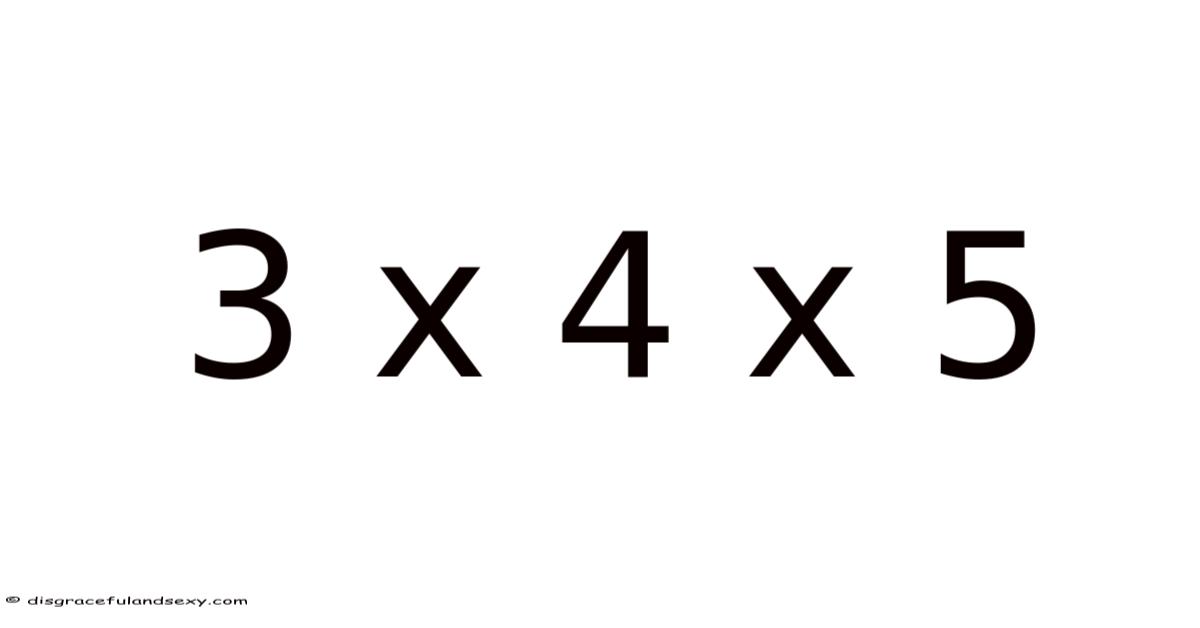
The seemingly simple calculation, 3 x 4 x 5, offers a gateway to exploring fundamental mathematical concepts and their far-reaching applications. This article will walk through the intricacies of this multiplication problem, examining its solution, exploring its underlying principles, and demonstrating its relevance in various fields. We'll move beyond simply stating the answer (60) and uncover the rich mathematical tapestry woven within this seemingly straightforward equation Not complicated — just consistent..
Easier said than done, but still worth knowing.
Understanding the Fundamentals: Multiplication as Repeated Addition
At its core, multiplication is a shorthand method for repeated addition. 3 x 4 x 5 can be understood as:
- 3 x 4: Adding the number 3 four times (3 + 3 + 3 + 3 = 12)
- (3 x 4) x 5: Then, adding the result (12) five times (12 + 12 + 12 + 12 + 12 = 60)
This foundational understanding is crucial for grasping the concept of multiplication, especially for younger learners. Visual aids, such as arrays of objects or blocks, can significantly enhance comprehension. Practically speaking, imagine arranging 3 rows of 4 blocks each; then, imagine stacking 5 of these arrays on top of each other. The total number of blocks represents the final product: 60 Worth knowing..
The Commutative and Associative Properties: Flexibility in Calculation
Multiplication boasts two significant properties that provide flexibility in how we approach calculations:
-
Commutative Property: The order of the numbers doesn't affect the result. 3 x 4 x 5 is the same as 4 x 3 x 5, 5 x 3 x 4, and any other permutation. This property simplifies calculations, allowing us to choose the order that seems most efficient.
-
Associative Property: The grouping of numbers doesn't change the outcome. (3 x 4) x 5 = 3 x (4 x 5). We can perform the multiplication in stages, choosing whichever pairing simplifies the process. Take this case: calculating 4 x 5 first (20) and then multiplying by 3 (60) can be easier than the initial (3 x 4) x 5 approach for some individuals.
These properties underscore the beauty and elegance of mathematical operations, highlighting the inherent structure and consistency within the system.
Beyond the Basics: Exploring Prime Factorization
The number 60, the result of 3 x 4 x 5, can be further analyzed through prime factorization. Prime factorization breaks down a number into its prime factors – numbers divisible only by 1 and themselves. Let's break down 60:
- 4 can be factored as 2 x 2
- 5 is already a prime number.
- 3 is also a prime number.
Which means, the prime factorization of 60 is 2 x 2 x 3 x 5 (or 2² x 3 x 5). This decomposition provides a deeper understanding of the number's structure and allows for simpler calculations in various mathematical contexts, like finding the greatest common divisor (GCD) or the least common multiple (LCM) Not complicated — just consistent..
Real-World Applications: Where 3 x 4 x 5 Shows Up
The seemingly abstract calculation of 3 x 4 x 5 has myriad real-world applications:
-
Geometry: Imagine a rectangular prism (like a box) with dimensions of 3 units, 4 units, and 5 units. The calculation 3 x 4 x 5 gives the volume of this prism in cubic units. This concept extends to calculating the volume of various shapes in architecture, engineering, and manufacturing.
-
Everyday Counting: Consider a scenario where you have 3 boxes, each containing 4 bags of apples, and each bag holds 5 apples. To find the total number of apples, you would use 3 x 4 x 5 = 60. This simple example highlights the practicality of multiplication in everyday life.
-
Data Analysis: Imagine a dataset organized into a 3 x 4 matrix (3 rows, 4 columns). If each cell contains 5 data points, calculating the total number of data points involves 3 x 4 x 5. This illustrates the utility of multiplication in data organization and analysis across numerous fields.
-
Business and Finance: Imagine a company producing 3 types of products, with each type having 4 variations and each variation having 5 different colors. The total number of distinct product combinations is 3 x 4 x 5 = 60. This type of calculation is crucial in inventory management, production planning, and market analysis The details matter here. Practical, not theoretical..
These examples demonstrate that the seemingly simple calculation 3 x 4 x 5 is a building block for solving complex problems across a wide range of disciplines That alone is useful..
Expanding the Concept: Beyond Simple Multiplication
While we've focused on 3 x 4 x 5, the principles extend to more complex scenarios. Consider:
-
Larger Numbers: The same fundamental principles apply when dealing with larger numbers. The commutative and associative properties remain relevant, allowing for strategic simplification of calculations. Prime factorization becomes even more valuable in managing and understanding larger numbers.
-
Decimals and Fractions: The concept of multiplication expands easily to include decimals and fractions. The underlying principles remain consistent, although the process might require additional steps and careful consideration of decimal places or fractional components.
-
Algebra: In algebra, the concept of multiplication is fundamental. Variables replace specific numbers, allowing for generalized calculations and the exploration of relationships between quantities. The properties discussed earlier remain equally important in algebraic manipulations Small thing, real impact..
Addressing Common Questions (FAQ)
Q: What if the order of numbers in the multiplication is changed? Does the answer change?
A: No, the answer does not change. The commutative property of multiplication ensures that the order of the numbers does not affect the final product. 3 x 4 x 5 = 5 x 3 x 4 = 4 x 5 x 3, and so on.
Q: Can I use a calculator to solve 3 x 4 x 5?
A: Absolutely! Calculators are efficient tools for performing multiplication, especially with larger numbers or more complex calculations. On the flip side, understanding the underlying principles remains essential, even when using technological aids No workaround needed..
Q: Is there a fastest way to solve 3 x 4 x 5 mentally?
A: The most efficient mental approach depends on individual preference. Some might prefer (3 x 4) x 5, others might choose 3 x (4 x 5). Practice helps develop fluency and efficiency in mental arithmetic.
Q: How does this relate to more advanced mathematical concepts?
A: The fundamental principles of multiplication, including the commutative and associative properties and prime factorization, lay the groundwork for more advanced mathematical concepts like algebra, calculus, and linear algebra. Understanding these basic concepts is crucial for progressing to higher levels of mathematical study.
Conclusion: The Enduring Significance of 3 x 4 x 5
While seemingly elementary, the calculation 3 x 4 x 5 offers a rich tapestry of mathematical insights and practical applications. Consider this: from the fundamental principles of repeated addition to the powerful properties of commutativity and associativity, this seemingly simple equation unveils the elegance and utility of multiplication. Its relevance extends far beyond the classroom, finding its place in everyday life, scientific endeavors, and various professional fields. By exploring this simple calculation, we gain a deeper appreciation for the fundamental building blocks of mathematics and their far-reaching impact on our understanding of the world. The seemingly simple 60 is, in fact, a gateway to a vast and fascinating mathematical landscape And it works..
