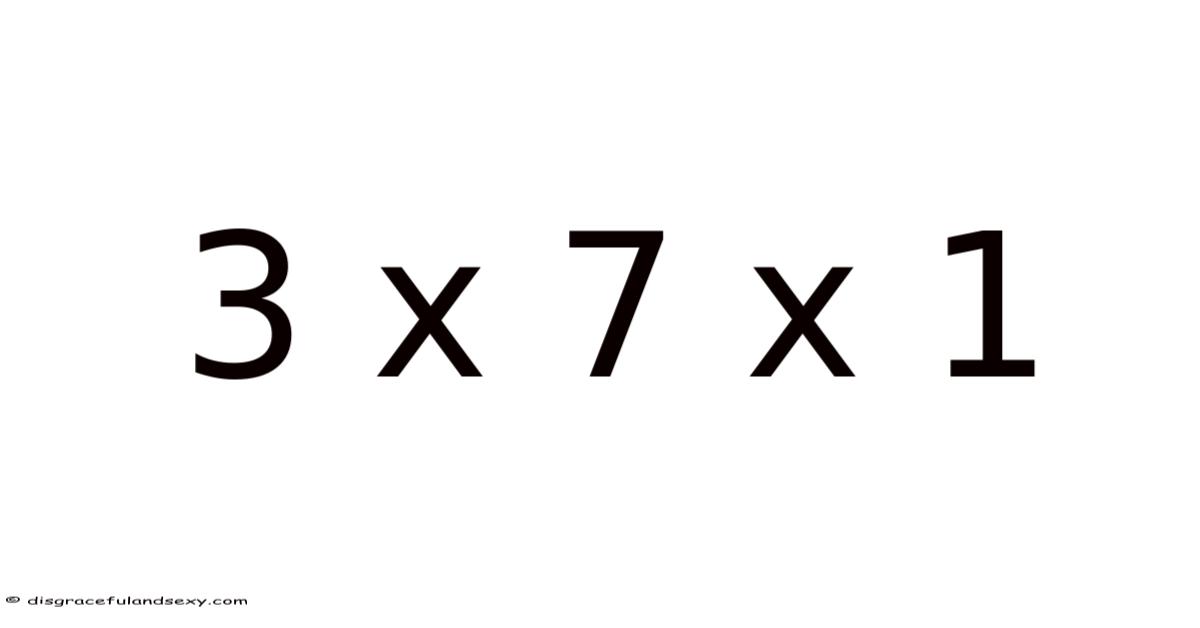
Unpacking the Seemingly Simple: A Deep Dive into 3 x 7 x 1
The seemingly simple equation, 3 x 7 x 1, offers a surprising depth of exploration when viewed through various mathematical and conceptual lenses. While the answer – 21 – is readily apparent, the journey to understanding its implications unveils fascinating connections within mathematics, and even hints at broader philosophical considerations. This article breaks down the intricacies of this basic multiplication problem, exploring its foundational principles, practical applications, and unexpected connections to more complex mathematical concepts.
Introduction: More Than Just Multiplication
At first glance, 3 x 7 x 1 appears trivial. That said, this seemingly simple equation serves as a perfect gateway to understand fundamental mathematical principles. We'll explore the properties of multiplication, the significance of the number 1 (the multiplicative identity), and how this simple equation can be a stepping stone to more complex calculations and concepts. It's basic arithmetic, suitable for primary school students. We'll even touch on how such seemingly simple problems build the foundation for advanced mathematical thought.
Understanding the Fundamentals: Multiplication and its Properties
Before delving into the specifics of 3 x 7 x 1, let's solidify our understanding of multiplication itself. Multiplication is essentially repeated addition. 3 x 7 means adding three sevens together (7 + 7 + 7 = 21). This understanding is crucial for grasping the concept at its core.
Several key properties govern multiplication:
-
Commutative Property: The order of the numbers doesn't affect the result. 3 x 7 x 1 is the same as 7 x 3 x 1, 1 x 3 x 7, and so on. This is because multiplication is commutative.
-
Associative Property: The grouping of numbers doesn't affect the result. (3 x 7) x 1 is the same as 3 x (7 x 1). We can perform the multiplication in any order we choose, achieving the same answer Nothing fancy..
-
Distributive Property: This property relates multiplication and addition. Here's one way to look at it: 3 x (7 + 1) = (3 x 7) + (3 x 1). While not directly relevant to 3 x 7 x 1 alone, it highlights the interconnectedness of arithmetic operations Worth knowing..
-
Identity Property of Multiplication: This is where the '1' in our equation becomes significant. Any number multiplied by 1 remains unchanged. This property is crucial for our equation because multiplying by 1 doesn't alter the product of 3 and 7.
The Significance of '1': The Multiplicative Identity
The number 1 holds a unique position in mathematics. But in our equation, 3 x 7 x 1 = 21, the '1' doesn't change the outcome. On top of that, this means that multiplying any number by 1 results in the same number. It's the multiplicative identity. On the flip side, understanding its role is essential Took long enough..
Imagine a scenario where we are calculating the area of a rectangle. Still, if the length is 3 units and the width is 7 units, the area is 3 x 7 = 21 square units. Now, imagine we introduce a scaling factor of 1. This means we're not changing the size of the rectangle. So the area remains 21 square units (3 x 7 x 1 = 21). So the '1' represents a scaling factor of no change. This illustrates the practical implications of the multiplicative identity in various applications.
Beyond the Basics: Applications and Extensions
While 3 x 7 x 1 seems simple, its underlying principles have far-reaching applications:
-
Unit Conversions: Consider converting meters to centimeters. There are 100 centimeters in a meter. If you have 3 meters, you'd multiply by 100 to get 300 centimeters. The equation could be represented as 3 x 100 x 1 (assuming a scaling factor of 1) Small thing, real impact..
-
Scaling and Proportion: In many fields like architecture, engineering, and cooking, scaling is critical. Imagine enlarging a recipe. If a recipe calls for 7 units of an ingredient, and you want to triple the recipe, you multiply by 3. Again, a scaling factor of 1 could be implicitly included, representing no further changes to the scaled recipe.
-
Algebraic Expressions: This simple equation can be a building block for understanding more complex algebraic expressions. It helps in grasping the order of operations and the manipulation of variables. Take this case: if we replace 7 with 'x', we get 3 * x * 1 = 3x, a basic algebraic expression.
-
Probability and Statistics: The concept of probability often involves multiplying probabilities of independent events. The multiplicative identity can play a crucial role in scenarios where one event has a probability of 1 (certainty) Surprisingly effective..
A Deeper Dive: Connecting to Advanced Concepts
The simplicity of 3 x 7 x 1 belies its potential to illuminate more advanced mathematical concepts:
-
Matrices and Linear Algebra: In linear algebra, matrices are multiplied. The concept of the multiplicative identity extends to matrices; there exists an identity matrix that, when multiplied by another matrix, leaves the other matrix unchanged. This is analogous to the role of '1' in our simple equation.
-
Abstract Algebra: Abstract algebra digs into more generalized mathematical structures. The concept of the multiplicative identity is a fundamental axiom in many algebraic structures like groups and rings. Our simple equation provides a concrete example of this abstract concept.
-
Number Theory: Number theory explores the properties of numbers. The prime factorization of 21 (3 x 7) is relevant to many number-theoretic concepts, such as divisibility rules and modular arithmetic.
Frequently Asked Questions (FAQ)
-
Q: What is the only number that, when multiplied by itself, equals itself? A: 1 and 0 And that's really what it comes down to. Which is the point..
-
Q: Is there any significance to the specific numbers 3 and 7 in this equation? A: Not inherently, other than they are integers and their product with 1 is 21. The significance lies in the principles of multiplication and the multiplicative identity.
-
Q: Can this equation be applied to negative numbers? A: Absolutely. 3 x (-7) x 1 = -21. The principles remain the same, even with negative numbers.
-
Q: What if the '1' were replaced with another number? A: The result would change proportionally. To give you an idea, 3 x 7 x 2 = 42. The '1' acted as a scaling factor; changing it changes the scale.
Conclusion: The Power of Simplicity
The equation 3 x 7 x 1, while seemingly basic, provides a rich foundation for understanding core mathematical concepts. From the fundamental properties of multiplication to the significance of the multiplicative identity and its applications in various fields, this equation serves as a powerful illustration of how seemingly simple ideas can underpin complex mathematical structures and real-world applications. That's why its simplicity allows for easy comprehension, yet its implications stretch far beyond the immediate calculation, highlighting the beauty and interconnectedness of mathematics. By exploring this simple equation, we gain a deeper appreciation for the elegance and power inherent in the foundational principles of arithmetic and their far-reaching consequences. The journey from a simple calculation to a profound understanding of mathematical principles is a testament to the beauty and depth of the mathematical world Worth keeping that in mind..
