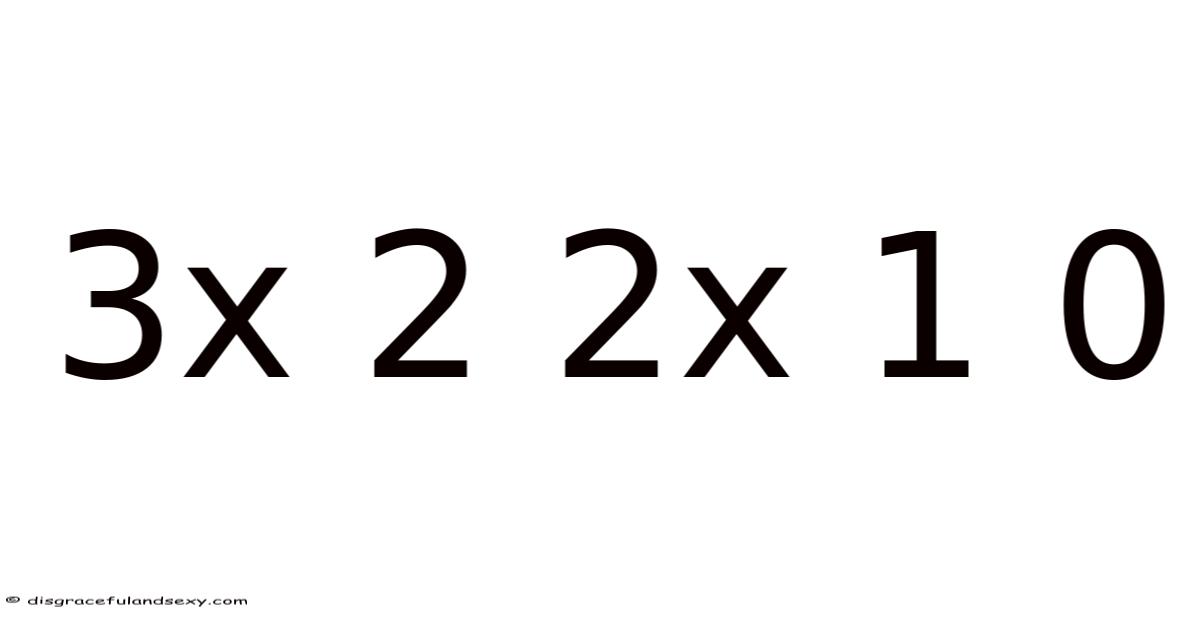
Decoding the Mysterious Sequence: 3x2, 2x1, 0 – A Deep Dive into Mathematical Patterns and Logical Reasoning
This article explores the seemingly simple sequence "3x2, 2x1, 0," delving into its potential interpretations, underlying mathematical principles, and the broader context of pattern recognition and logical reasoning. We'll examine various approaches to understanding this sequence, from basic arithmetic operations to more abstract concepts, encouraging critical thinking and problem-solving skills. Understanding sequences like this is crucial for developing strong analytical abilities applicable in various fields, from mathematics and computer science to data analysis and even everyday decision-making And that's really what it comes down to..
Understanding the Sequence: Initial Observations
The sequence "3x2, 2x1, 0" initially appears straightforward. It involves multiplication and then a seemingly abrupt drop to zero. Still, the simplicity belies a potential for multiple interpretations. The key to unlocking its meaning lies in identifying the pattern or rule governing its progression. Is it an arithmetic progression, a geometric progression, or something more complex? Does it involve a hidden function or relationship between the numbers?
Approach 1: Arithmetic and Geometric Progression Analysis
Let's initially explore the possibility of simple arithmetic or geometric progressions. An arithmetic progression involves a constant difference between consecutive terms. Still, the differences between the terms in our sequence (3x2 - 2x1 = 4, and 2x1 - 0 = 2) are not constant, ruling out this possibility.
A geometric progression involves a constant ratio between consecutive terms. In real terms, again, the ratios ( (3x2)/(2x1) = 3 and (2x1)/0 = undefined) are not constant, excluding this possibility as well. That's why, we need to explore more nuanced approaches.
Approach 2: Pattern Recognition and Identifying the Rule
The sequence might follow a more complex rule. Let's analyze the structure more closely. Notice that each element in the sequence can be represented as a multiplication followed by a potential implicit operation.
- 3 x 2: This is a simple multiplication resulting in 6.
- 2 x 1: This is also a simple multiplication resulting in 2.
- 0: This is the result of an operation that is yet to be defined.
To find the rule, let's consider the numbers involved in the multiplications. On the flip side, one possible rule could be: "Multiply the decreasing sequence of numbers (3, 2, 1, ... Plus, ) with a parallel decreasing sequence of numbers (2, 1, 0, ... We observe a decreasing pattern in the first operand (3, 2) and the second operand (2, 1). ).
This rule generates:
- 3 x 2 = 6
- 2 x 1 = 2
- 1 x 0 = 0
This provides a consistent and logical explanation for the sequence. The apparent jump to zero is not arbitrary but a result of the pattern's inherent progression. This pattern recognition approach highlights the importance of looking beyond superficial appearances and analyzing underlying structures.
Approach 3: Exploring Functional Relationships
We can also approach this problem from a functional perspective. But can we define a function f(x) that generates this sequence? While multiple functions could potentially work, one simple approach is to consider a piecewise function.
Let's define x as the position of the term in the sequence (1, 2, 3). We can define the function as follows:
f(x) = (4-x) * (3-x) for x = 1, 2*
This function would generate:
- f(1) = (4-1) * (3-1) = 6 (equivalent to 3 x 2)
- f(2) = (4-2) * (3-2) = 2 (equivalent to 2 x 1)
- f(3) = (4-3) * (3-3) = 0
This demonstrates that a functional relationship can also explain the sequence. This approach highlights the power of mathematical functions in modeling patterns and predicting future elements in a sequence.
Expanding the Sequence: Predictions and Extrapolation
Understanding the underlying rule allows us to predict subsequent elements in the sequence. Think about it: following the rule "Multiply the decreasing sequence of numbers (3, 2, 1, ... ) with a parallel decreasing sequence of numbers (2, 1, 0, .. Surprisingly effective..
- 3 x 2 = 6
- 2 x 1 = 2
- 1 x 0 = 0
- 0 x -1 = 0
- -1 x -2 = 2
- ...and so on.
Similarly, using the functional approach, we could calculate f(4), f(5), and so on, to predict further terms The details matter here..
The Importance of Context and Ambiguity
It's crucial to acknowledge the potential ambiguity inherent in interpreting short sequences. Consider this: the "best" explanation is often the one that is simplest, most elegant, and can most easily be generalized to explain further terms. Without more data points, multiple rules might fit the given sequence. This highlights the importance of considering different perspectives and multiple potential solutions.
Applying Logical Reasoning and Problem-Solving Skills
Analyzing the sequence "3x2, 2x1, 0" goes beyond simple arithmetic. It demonstrates the application of crucial problem-solving skills:
- Pattern Recognition: Identifying underlying patterns and relationships within seemingly random data is essential.
- Deductive Reasoning: Drawing logical conclusions based on observed patterns and established rules.
- Abstract Thinking: Moving beyond concrete numbers to understand abstract relationships and concepts.
- Creative Problem-Solving: Exploring multiple potential solutions and approaches.
These skills are highly transferable and applicable in various fields, reinforcing the importance of engaging with such mathematical puzzles Simple, but easy to overlook..
Beyond the Numbers: Real-world Applications
While seemingly abstract, the ability to identify patterns and relationships is crucial in numerous real-world applications:
- Data Analysis: Identifying trends and insights from large datasets.
- Computer Science: Designing algorithms and predicting system behavior.
- Financial Modeling: Forecasting market trends and managing risk.
- Scientific Research: Identifying patterns in experimental data and formulating hypotheses.
Mastering these skills, even through seemingly simple exercises like deciphering the sequence "3x2, 2x1, 0," equips individuals with valuable tools for problem-solving in various aspects of life Nothing fancy..
Frequently Asked Questions (FAQ)
Q: Is there only one correct answer to this sequence?
A: While the rule we presented provides a logical and consistent explanation, other interpretations might exist. Consider this: the limited number of terms in the sequence allows for multiple potential patterns. The most plausible solution is often the simplest and most easily generalizable Not complicated — just consistent..
Q: What mathematical concepts are relevant to solving this type of problem?
A: This problem touches upon several key mathematical concepts, including arithmetic and geometric progressions, function definition, pattern recognition, and deductive reasoning.
Q: How can I improve my ability to solve similar pattern recognition problems?
A: Practice is key. Engage with more sequence puzzles and mathematical problems. Focus on developing your ability to identify patterns, analyze relationships, and think abstractly But it adds up..
Conclusion: The Power of Pattern Recognition
The seemingly simple sequence "3x2, 2x1, 0" provides a valuable learning opportunity. It demonstrates that critical thinking, logical reasoning, and pattern recognition are essential skills applicable far beyond the realm of mathematics. Now, by exploring different approaches and considering multiple interpretations, we've not only deciphered the sequence but also gained valuable insights into the power of analytical thinking and its wide-ranging applications in the real world. The ability to identify and interpret patterns is a fundamental skill that underpins much of our understanding of the world around us, and practice in deciphering sequences like this can significantly enhance this critical ability.
