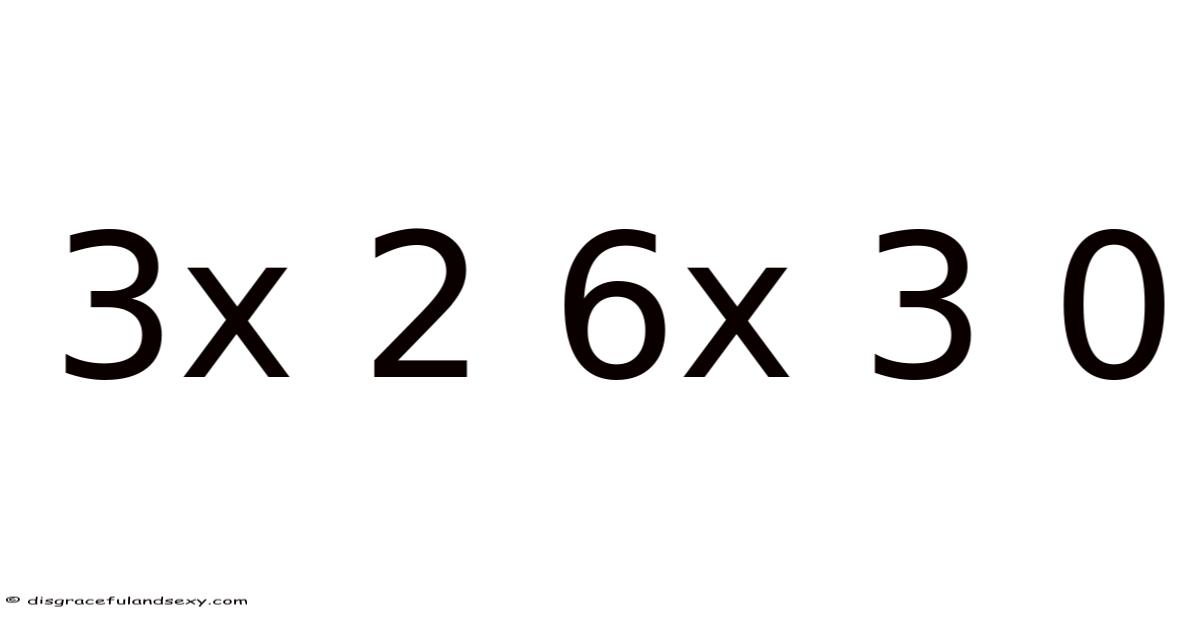
Decoding the Mystery: Exploring the Pattern in "3 x 2, 6 x 3, 0"
This seemingly simple sequence, "3 x 2, 6 x 3, 0," presents a fascinating puzzle. At first glance, it appears random, but a closer examination reveals underlying mathematical patterns and potential interpretations. This article will delve deep into the possible meanings, exploring various mathematical concepts and logical reasoning to uncover the hidden structure within this intriguing numerical arrangement. We'll examine different perspectives, discuss potential ambiguities, and ultimately aim to provide a comprehensive understanding of the various possibilities Small thing, real impact..
Introduction: Unveiling the Intrigue
The sequence "3 x 2, 6 x 3, 0" is deceptively simple. Its brevity invites speculation and multiple interpretations. Is it a simple arithmetic progression, a coded message, or something more complex? The absence of a clear continuation makes it even more challenging. Worth adding: this article will systematically explore different approaches to understanding this sequence, from basic arithmetic operations to more advanced mathematical concepts. Here's the thing — we will consider the possibility of missing elements, hidden rules, and different mathematical frameworks that could explain the pattern. In the long run, the goal is to provide a comprehensive analysis, highlighting both the possibilities and limitations of interpreting such a short sequence Simple, but easy to overlook..
Analyzing the Arithmetic Progression:
The most straightforward approach is to examine the arithmetic operations within the sequence. We see a pattern of multiplication:
- 3 x 2 = 6: This is a simple multiplication operation, resulting in 6.
- 6 x 3 = 18: This is also a multiplication, resulting in 18. That said, the sequence shows "6 x 3, 0," which creates a discrepancy.
This discrepancy is the key to unlocking the potential meanings. Practically speaking, the simple arithmetic progression doesn't hold consistently. The "0" at the end suggests a break in the pattern or the introduction of a different rule That's the part that actually makes a difference..
Exploring Potential Interpretations of the "0":
The presence of "0" requires careful consideration. Here are some possible interpretations:
-
Zero as a Termination Point: The "0" could signify the end of the sequence. Perhaps the pattern is intentionally left incomplete, requiring further information or context to continue. This interpretation suggests that the sequence is not meant to follow a strictly mathematical pattern, but rather to serve a different purpose, potentially as a symbol or a part of a larger code.
-
Zero as a Result of a Hidden Operation: The "0" might be the result of a hidden mathematical operation involving the previous results. Take this: is there an operation that transforms 18 into 0? Possible scenarios include:
- Modulo Operation: If we consider a modulo operation (finding the remainder after division), 18 mod 18 = 0. This might suggest a cyclical pattern where the result is always reduced to 0 after a specific operation.
- Subtraction or Other Operations: More complex operations involving subtraction, division, or a combination of operations could potentially result in 0. On the flip side, without further context or numbers in the sequence, this remains purely speculative.
-
Zero as an Independent Element: The "0" could be completely unrelated to the preceding multiplication operations. It could be a marker, a placeholder, or part of a larger system with rules beyond simple arithmetic. In this case, the sequence doesn't necessarily represent a continuous mathematical progression but a collection of independent elements Simple, but easy to overlook..
Expanding the Sequence: Hypothetical Continuations:
While the initial sequence is incomplete, we can hypothesize possible continuations based on different interpretations:
-
If "0" signifies termination: The sequence ends with 0, offering no clear basis for further calculations And that's really what it comes down to. Turns out it matters..
-
If "0" is a result of a modulo operation (mod 18): The next operation might be 0 x 4 = 0, resulting in 0 (mod 18). This creates a constant cycle, always returning to 0.
-
If a different mathematical pattern is at play: There could be various hidden rules determining the next numbers. Without further information or a defined rule, it is impossible to reliably predict the continuation of the sequence Easy to understand, harder to ignore..
Introducing Higher-Level Mathematical Concepts:
While the simple arithmetic approach offers some insights, it's essential to consider more advanced mathematical concepts. The sequence could represent:
-
Elements of a Matrix or Vector: The numbers could be components of a larger mathematical structure like a matrix or vector. The sequence could be a subset of a more complex equation or system. Without the broader context, this interpretation is purely speculative.
-
A Coding System: The sequence could be a simplified representation of a more complex code. Each number could be a key or an index in a larger system, with the "0" indicating the end of a message or a specific instruction No workaround needed..
-
A Symbolic Representation: The numbers might not represent purely numerical values but could hold symbolic meaning within a specific system or context.
Frequently Asked Questions (FAQ):
-
Q: Is there a definitive answer to the pattern? A: No, without more context or information, there's no single definitive answer. The limited nature of the sequence allows for multiple valid interpretations.
-
Q: What are the most likely interpretations? A: The most likely interpretations involve either the "0" acting as a termination point or as the result of a modulo operation. More complex scenarios involving hidden rules or coding systems are also possible but require additional data for verification.
-
Q: Can this sequence be used in a real-world application? A: While the sequence itself is short and seemingly simplistic, the principles of pattern recognition and mathematical problem-solving that we apply here are valuable in various fields, including cryptography, data analysis, and programming.
Conclusion: The Importance of Context and Further Investigation
The sequence "3 x 2, 6 x 3, 0" highlights the importance of context in mathematical interpretation. A seemingly simple sequence can lead to numerous possibilities. While simple arithmetic offers some clues, the ambiguous "0" opens the door to more complex scenarios. Because of that, without further context or a clearer definition of the rules governing the sequence, it remains open to various interpretations. The exercise of exploring this sequence underscores the value of logical reasoning, pattern recognition, and the consideration of different mathematical frameworks in problem-solving. Here's the thing — the mystery, however, is what makes this sequence so engaging, prompting us to explore the boundaries of our mathematical understanding and the potential for hidden meaning within even the simplest of numerical arrangements. The lack of a definitive answer allows for further exploration and discussion, emphasizing the beauty and complexity inherent in mathematical thinking. Perhaps the true value lies not in finding a single solution, but in the process of investigation and discovery itself Small thing, real impact. Simple as that..
