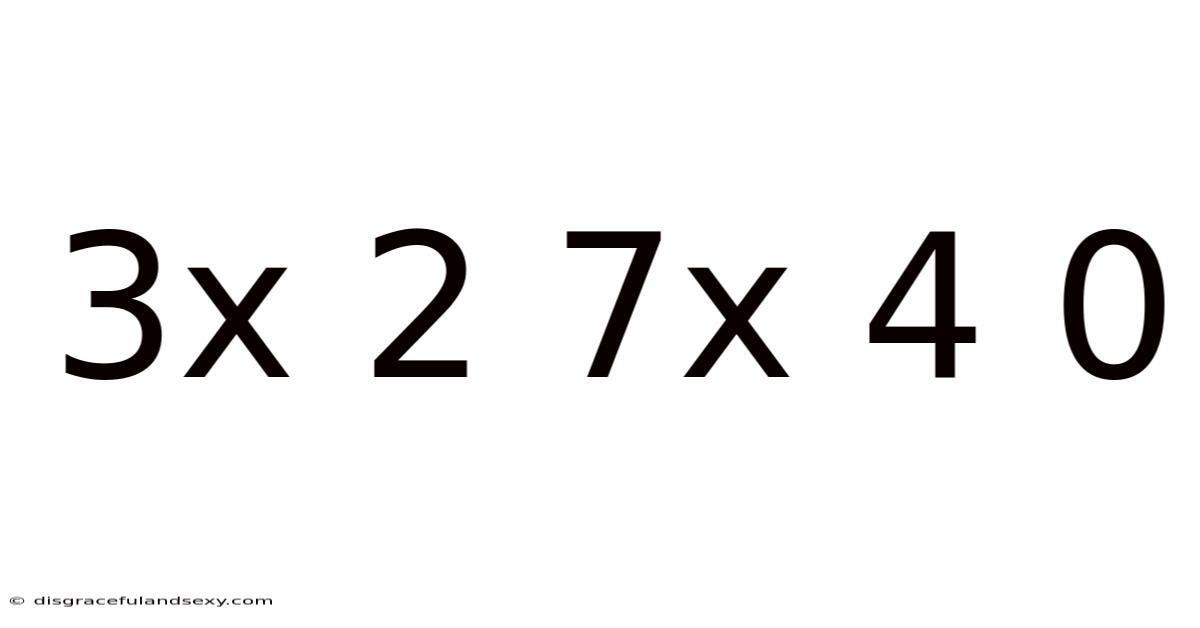
Decoding the Mystery: Exploring the Sequence 3x 2 7x 4 0
This article looks at the fascinating, albeit seemingly simple, numerical sequence: 3x 2 7x 4 0. At first glance, it appears random. This analysis will cover different mathematical perspectives, focusing on pattern recognition, algebraic manipulation, and the potential for hidden codes. On the flip side, a deeper exploration reveals potential patterns, mathematical relationships, and even possibilities for cryptographic interpretation. Day to day, we'll dissect this sequence, exploring various approaches to understanding its underlying structure and potential meanings. Let's tap into the secrets hidden within this intriguing number sequence And it works..
Introduction: The Allure of Numerical Patterns
Humanity has long been captivated by patterns. Its seemingly random arrangement invites us to investigate, analyze, and potentially uncover a hidden system. From the Fibonacci sequence in nature to the nuanced designs of fractals, numerical patterns offer a glimpse into the underlying order of the universe. The sequence 3x 2 7x 4 0 presents a microcosm of this fascination. In practice, understanding this sequence requires us to move beyond simple observation and engage in critical thinking and mathematical problem-solving. This analysis will demonstrate multiple potential interpretations, highlighting the multifaceted nature of mathematical investigation.
Methodological Approaches: Unraveling the Sequence
Several approaches can be employed to decipher the meaning behind 3x 2 7x 4 0. These methods include:
- Pattern Recognition: Looking for repeating numbers, incremental differences, or other recurring elements within the sequence.
- Algebraic Manipulation: Exploring potential algebraic expressions or equations that could generate the sequence.
- Cryptographic Analysis: Considering the possibility that the sequence represents a coded message or key.
- Statistical Analysis: Examining the frequency of numbers and other statistical properties of the sequence to look for anomalies or significant features.
Pattern Recognition: Finding Order in Apparent Chaos
Let's start with the most intuitive approach: pattern recognition. The sequence 3x 2 7x 4 0 doesn't immediately reveal an obvious, repeating pattern. Even so, we can explore various possibilities:
- Alternating Patterns: Notice how the "x" separates the numbers into pairs: (3, 2), (7, 4), (0). There's no immediately apparent relationship between the numbers in each pair. 3 and 2 differ by 1, while 7 and 4 differ by 3. The last element, 0, disrupts any easily discernible pattern.
- Differences: Calculating the differences between consecutive numbers yields irregular results. This lack of a consistent difference suggests a more complex underlying structure.
- Prime Numbers & Composites: Examining prime vs. composite numbers offers another angle. 3 and 7 are prime, while 2 and 4 are composite. The 0, being neither prime nor composite, further complicates any clear pattern based on this classification.
- Modular Arithmetic: Exploring modular arithmetic, where numbers are considered within a specific modulus (e.g., modulo 10), could potentially reveal hidden patterns. Still, initial exploration in this area doesn't readily yield conclusive results.
The lack of a readily apparent pattern suggests that a more sophisticated approach is needed.
Algebraic Manipulation: Searching for Underlying Equations
Could an algebraic expression generate this sequence? We could attempt to fit the sequence to various polynomial equations or other mathematical functions. Still, multiple equations could potentially generate this specific sequence. It's possible, but requires a degree of creativity and educated guesswork. On the flip side, the limited number of elements makes finding a unique solution challenging. This highlights the importance of additional data or context to constrain the possibilities.
Worth pausing on this one.
To give you an idea, we could hypothetically construct a piecewise function to generate the sequence. That said, without further information or constraints, any such function would be somewhat arbitrary and lack predictive power.
Cryptographic Analysis: A Coded Message?
Another intriguing possibility is that 3x 2 7x 4 0 represents a coded message or a cryptographic key. The "x" could be a separator, indicating that the numbers could represent letters, symbols, or parts of a more complex code.
- Simple Substitution: If "x" is a separator and each number represents a letter (e.g., 1=A, 2=B, etc.), the result is nonsensical. This suggests a more complex code.
- More Advanced Codes: More sophisticated cryptographic techniques, like substitution ciphers, transposition ciphers, or even more complex algorithms, could be employed. On the flip side, without a key or more context about the potential coding scheme, deciphering this sequence as a code remains highly speculative.
To effectively analyze the sequence from a cryptographic standpoint, we would need more data or a "key" to break the potential code.
Statistical Analysis: Exploring Frequencies and Distributions
Statistical analysis can be used to identify any anomalies or significant features in the sequence. We can look at the frequency of each number, its distribution, and other statistical properties. Because of that, in this case, a simple statistical analysis doesn't reveal any significant patterns or distributions that would clarify the sequence's meaning. The limited sample size also hinders any meaningful statistical conclusions.
Expanding the Possibilities: Considering Context
The interpretation of 3x 2 7x 4 0 heavily relies on context. Because of that, where did this sequence originate? What was the source material? Knowing the context could significantly influence our interpretation No workaround needed..
- Mathematical Problem: It might be part of a larger mathematical puzzle or equation. The sequence could represent intermediate results, coordinates, or indices within a broader problem.
- Real-world Data: It might be derived from real-world measurements, observations, or experimental results. In such a case, understanding the context of the experiment or measurement would be crucial for interpretation.
- Artistic Representation: It might even be a purely artistic or symbolic representation, with meaning determined by the artist or creator's intention.
Without knowing the context, all our analytical efforts are limited to speculation.
Conclusion: The Enduring Mystery of 3x 2 7x 4 0
The numerical sequence 3x 2 7x 4 0 presents a captivating enigma. Practically speaking, while we've explored several approaches—pattern recognition, algebraic manipulation, cryptographic analysis, and statistical analysis—none definitively reveals a single, conclusive meaning. The lack of an obvious pattern and the limited length of the sequence significantly challenge our efforts to decipher its potential significance.
This investigation highlights the importance of context in mathematical analysis. Without additional information regarding the sequence's source and the intention behind its creation, the possibilities remain open-ended and require further information for a definitive conclusion. In real terms, the ambiguity, however, is itself an intriguing aspect of the puzzle. The exercise serves as a reminder of the complex interplay between data, interpretation, and context in mathematical problem-solving. Perhaps, future discoveries or the unveiling of related sequences will shed more light on the mysterious 3x 2 7x 4 0 And that's really what it comes down to..
Not the most exciting part, but easily the most useful Simple, but easy to overlook..
Frequently Asked Questions (FAQ)
Q: Is there a single, definitive answer to the meaning of this sequence?
A: No. Day to day, based solely on the sequence 3x 2 7x 4 0, there's no single, definitive answer. The lack of context and the limited number of elements allow for multiple interpretations, all equally plausible without additional information.
Q: Could this be a code?
A: It's possible, but highly speculative without more information. This leads to to determine if it's a code, we need additional context or a key to decipher it. A more extensive sequence or further clues would be necessary to assess the possibility of a hidden cryptographic meaning Took long enough..
Q: What are the limitations of the analyses performed?
A: The main limitation is the lack of context and the short length of the sequence. Think about it: this limits the effectiveness of pattern recognition, statistical analysis, and restricts the certainty of any algebraic or cryptographic interpretation. More data would considerably enhance our ability to draw conclusive findings Not complicated — just consistent. That alone is useful..
Q: What further steps could be taken to understand this sequence?
A: Seeking the source of the sequence is the most crucial step. And knowing the origin, context, and the purpose behind the sequence could significantly influence our interpretation. Finding a related sequence or pattern might also offer clues about the underlying structure of 3x 2 7x 4 0.
