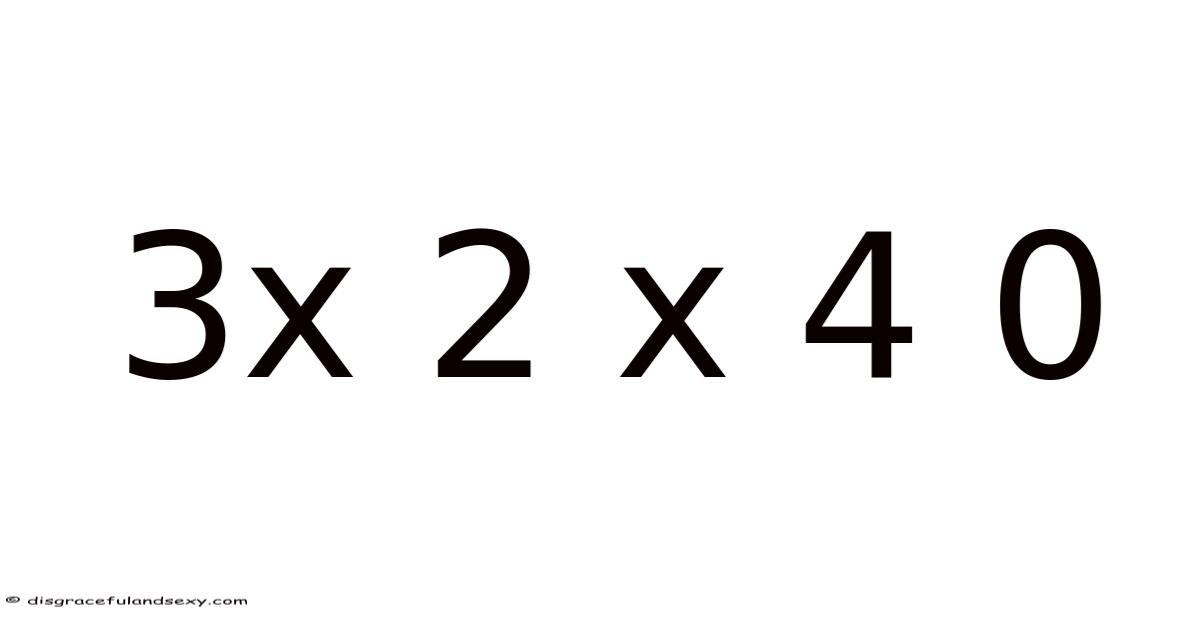
Decoding the Mystery: Exploring the Significance of "3 x 2 x 4 = 0"
The seemingly simple equation "3 x 2 x 4 = 0" is not a mathematically accurate statement. Instead, it presents an intriguing puzzle that opens the door to exploring several mathematical concepts, logical thinking, and even creative problem-solving. This article looks at the potential interpretations and hidden meanings behind this seemingly nonsensical equation, examining its implications within different mathematical frameworks and encouraging a deeper understanding of mathematical reasoning. We’ll explore various possibilities, from simple errors to more complex interpretations involving modulo arithmetic and abstract algebra.
Understanding the Mathematical Inaccuracy
Before delving into alternative interpretations, it's crucial to acknowledge the fundamental mathematical inaccuracy of the statement "3 x 2 x 4 = 0". Here's the thing — basic arithmetic dictates that 3 multiplied by 2 equals 6, and 6 multiplied by 4 equals 24. Because of this, the equation is fundamentally incorrect within the standard framework of arithmetic. This inaccuracy, however, opens up opportunities to explore scenarios where the equation might hold true under specific, non-standard conditions.
Not the most exciting part, but easily the most useful Not complicated — just consistent..
Potential Interpretations and Explanations
Several scenarios could lead to an interpretation where "3 x 2 x 4 = 0" might seem plausible, though not within the realm of traditional arithmetic. Let's examine some of these possibilities:
1. The Error Approach:
The most straightforward explanation is that the equation represents a simple mathematical error. Someone might have made a mistake in their calculation, leading to the incorrect result of 0. Think about it: this underscores the importance of careful calculation and verification in mathematics. Even seasoned mathematicians double-check their work to prevent such errors.
2. The Modulo Arithmetic Approach:
Modulo arithmetic (also known as clock arithmetic) provides a more intriguing interpretation. In modulo arithmetic, we're concerned with the remainder after division by a specific number, called the modulus. Here's a good example: in modulo 12 (like the numbers on a clock), 15 ≡ 3 (mod 12) because 15 divided by 12 leaves a remainder of 3.
Let's consider the equation "3 x 2 x 4 = 0" within the context of modulo arithmetic. If we choose a modulus of 24, then the equation holds true: 3 x 2 x 4 = 24 ≡ 0 (mod 24). Think about it: the remainder when 24 is divided by 24 is 0. This shows how the same equation can yield a different result under different mathematical systems.
3. The Boolean Algebra Approach:
Boolean algebra deals with binary values, typically 0 and 1, representing true and false respectively. While not directly applicable to the given equation's numerical values, the concept of a result being 0 in Boolean algebra might represent a "false" condition. And in a hypothetical scenario where the numbers represent conditions within a Boolean logic system, the equation's result of 0 could have a logical interpretation. This would require a complex system of conditions to be defined for each number Which is the point..
Honestly, this part trips people up more than it should.
4. The Abstract Algebra Approach:
Abstract algebra introduces the concept of groups, rings, and fields, where operations might not follow the familiar rules of standard arithmetic. This leads to in certain algebraic structures, it might be possible to define operations that result in the equation "3 x 2 x 4 = 0" being true. This would necessitate a highly specialized and abstract mathematical framework, far beyond the scope of elementary arithmetic. Such systems usually involve defining a unique set of rules for how these operations interact Worth keeping that in mind. Surprisingly effective..
5. The Contextual Approach:
Sometimes, a seemingly illogical equation can be meaningful within a specific context. Consider this: consider a scenario where the numbers represent quantities of resources. Worth adding: perhaps 3 units of resource A, 2 units of resource B, and 4 units of resource C are combined, and the result is a net zero effect due to some process that cancels out all resources (e. g.In practice, , a chemical reaction where reactants fully neutralize each other). This context would provide a non-mathematical, real-world interpretation of the equation Worth keeping that in mind..
Deeper Dive into Modulo Arithmetic
The modulo arithmetic interpretation provides a compelling way to make sense of the equation. Let's delve deeper into its mechanics:
-
The Modulus: The choice of modulus is crucial. As demonstrated earlier, using a modulus of 24 makes the equation true. Still, other moduli wouldn't yield a result of 0. Take this case: with a modulus of 10, 3 x 2 x 4 = 24 ≡ 4 (mod 10). The modulus defines the arithmetic system we are working within Most people skip this — try not to..
-
Applications of Modulo Arithmetic: Modulo arithmetic finds numerous applications in computer science, cryptography, and other fields. To give you an idea, it's used in:
- Hashing algorithms: To generate unique identifiers for data.
- Cryptography: To ensure data security and privacy.
- Clock arithmetic: Representing time in a cyclical manner.
-
Exploring Different Moduli: Experimenting with various moduli helps demonstrate the flexibility and power of modulo arithmetic. Try different moduli and see how the result changes. This exercise enhances understanding of how the system works and its dependency on the chosen modulus.
Frequently Asked Questions (FAQs)
Q: Is "3 x 2 x 4 = 0" a valid mathematical statement?
A: No, within the standard framework of arithmetic, it's incorrect. Even so, it can be true under specific circumstances, such as using modulo arithmetic with a modulus of 24.
Q: What are the real-world applications of this type of problem-solving?
A: Analyzing seemingly incorrect equations helps in developing critical thinking skills and problem-solving abilities. This process is transferable to various fields, including programming, engineering, and scientific research. Understanding different mathematical systems like modulo arithmetic is essential for working with computer systems and digital data.
Q: How can I learn more about modulo arithmetic?
A: Consult textbooks or online resources that cover number theory and abstract algebra. Many introductory courses on discrete mathematics include a section on modulo arithmetic Simple, but easy to overlook..
Q: Can this equation be solved in any other mathematical system besides modulo arithmetic?
A: While modulo arithmetic provides a clear explanation, other abstract algebraic structures could theoretically define operations where this equation holds true. Still, these would be highly specialized systems far removed from standard arithmetic Simple, but easy to overlook..
Conclusion: Beyond the Numbers
The equation "3 x 2 x 4 = 0" initially appears to be a simple mathematical error. It encourages critical thinking, pushing us to question assumptions and explore alternative perspectives within the broader world of mathematical possibilities. That said, its exploration leads to a deeper understanding of mathematical concepts beyond basic arithmetic. And the exercise highlights the importance of considering different mathematical frameworks and the power of creative problem-solving in interpreting seemingly illogical statements. Also, the investigation allows for an appreciation of modulo arithmetic and its diverse applications. Which means ultimately, this seemingly simple equation serves as a gateway to exploring the multifaceted nature of mathematics and its remarkable versatility. The journey of understanding this equation reveals that mathematics isn't just about finding the right answer but also about the process of exploring and understanding diverse mathematical systems and approaches to problem-solving.
