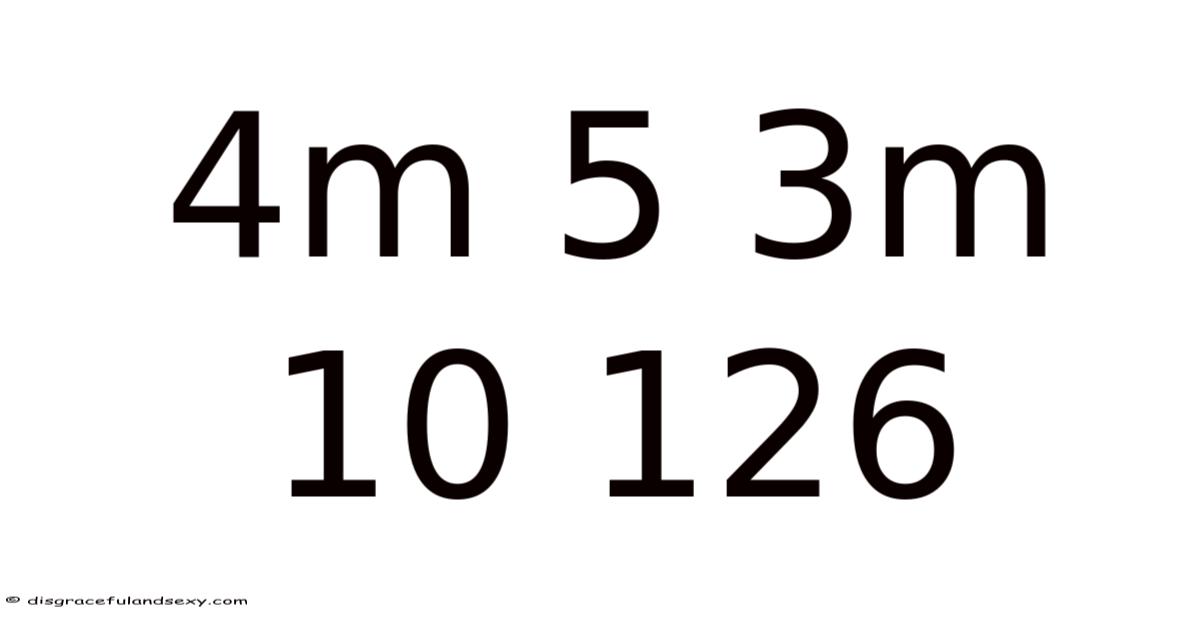
Decoding the Mystery: Unveiling the Significance of "4m 5 3m 10 126"
This seemingly random sequence of numbers, "4m 5 3m 10 126," piques curiosity. It lacks immediate context, inviting speculation about its meaning. This article delves deep into potential interpretations, exploring mathematical patterns, code possibilities, and even the realm of symbolic representation. We’ll examine various approaches to decipher this cryptic string, providing a comprehensive analysis for anyone intrigued by this numerical puzzle.
Potential Interpretations: A Multifaceted Approach
The absence of explicit context makes interpreting "4m 5 3m 10 126" challenging, but also exciting. The string's ambiguity opens doors to several potential interpretations, each requiring a distinct analytical lens. Let's explore some of these possibilities:
1. Mathematical Sequences and Patterns
The most straightforward approach is to examine the sequence for underlying mathematical patterns. At first glance, the numbers appear arbitrary. Still, a closer look reveals several potential avenues for exploration:
- Arithmetic Progression: We can investigate whether there's a constant difference between consecutive numbers. This doesn't appear to be the case with the raw numbers presented. That said, if "m" represents a mathematical operation (like multiplication or addition), a pattern might emerge.
- Geometric Progression: Similarly, we could test if consecutive numbers exhibit a constant ratio. Again, this doesn't seem to be immediately apparent without understanding the function of "m".
- Fibonacci-like Sequence: The Fibonacci sequence is characterized by each number being the sum of the two preceding ones. While this sequence doesn't directly fit, modifying it by incorporating the "m" variable or manipulating the numbers might reveal a hidden Fibonacci-esque relation.
- Modular Arithmetic: This branch of mathematics deals with remainders after division. Perhaps the sequence is derived from specific modulo operations. Further analysis involving modulo arithmetic could uncover hidden patterns, particularly if the "m" values represent specific moduli.
2. Unit Conversions and Measurement Systems
The presence of the "m" (which commonly denotes "meters" in the metric system) hints at the possibility of measurement conversions. The numbers could represent lengths, volumes, or other measurable quantities. For instance:
- Length Measurements: "4m 5" might represent 4 meters and 5 centimeters (or another unit). Similarly, "3m 10" could represent 3 meters and 10 centimeters. Even so, the inclusion of "126" disrupts this consistent pattern. This possibility requires further investigation, possibly looking for a consistent unit for all measurements.
- Time and Distance: Perhaps the numbers represent time intervals (minutes or seconds) and corresponding distances. The "m" could signify a unit of time or distance, depending on the context. A detailed analysis of different time and distance units could shed more light on this interpretation.
3. Code or Cryptography
The string could represent a simple code or cipher. Several possibilities exist:
- Substitution Cipher: Each number might be a substitution for a letter or symbol. Cracking this type of code requires further information or a key. Frequency analysis (examining the frequency of each number) could be a useful tool.
- Caesar Cipher: This involves shifting each letter (or number) a fixed number of positions down the alphabet (or numerical sequence). The "m" could represent the shift value.
- More Complex Ciphers: More sophisticated ciphers, such as Vigenère ciphers or even public-key cryptography, could be involved, but deciphering these would require significantly more information and a deeper understanding of cryptographic techniques.
4. Symbolic Representation
The numbers could represent abstract concepts or symbolic meanings. This interpretation requires knowledge of the context where the sequence was found. Possible avenues for this type of analysis include:
- Numerology: This system assigns symbolic meaning to numbers. Analyzing each number individually and the sequence as a whole could offer insights, but the meaning would highly depend on the chosen numerological system.
- Cultural or Religious Contexts: The sequence might hold a specific significance within certain cultural or religious contexts. Researching different belief systems could reveal hidden meanings.
A Deeper Dive into Mathematical Possibilities
Let’s explore some mathematical avenues more rigorously. We can analyze potential patterns and relationships within the sequence. Since "m" is the most enigmatic element, we will consider different possibilities for its role:
- "m" as a multiplier: If "m" represents multiplication, we might explore relationships like: (4 * m) + 5 = 3m + 10, or other combinations relating the numbers. Solving these equations could provide insights into potential values for "m". Still, it’s unlikely to provide a consistent solution that incorporates "126".
- "m" as an addition operation: Similar to the multiplication scenario, we could experiment with "m" as an additive factor. Relationships like (4 + m) = 5 or (3 + m) = 10 could be explored, though again, finding a solution that integrates "126" consistently seems improbable without additional context.
- "m" as a variable in a larger equation: The sequence might be part of a more complex mathematical equation or formula. The "m" could be a variable affecting the entire system, requiring identification of other variables and the underlying mathematical function.
The Role of "126"
The number 126 stands out as it doesn’t seem to fit directly with the other elements. It could be:
- A Resultant Value: 126 could be the result of a calculation or operation performed on the preceding numbers and "m". This possibility requires defining the type of operation and the value of "m".
- An Independent Parameter: It could represent an entirely separate parameter or piece of information, unrelated to the initial numbers and "m". This adds another layer of complexity to the analysis, as it suggests multiple independent data points.
- A Key to Deciphering the Code: "126" might act as a key or a crucial component necessary for decoding the sequence, perhaps representing a specific cipher or code. We would need to understand the algorithm used to incorporate this number.
Addressing Potential Obstacles and Limitations
Several challenges hinder a definitive solution:
- Lack of Context: The most significant obstacle is the absence of context. Without knowing the origin or intended purpose of the sequence, any interpretation remains speculative.
- Ambiguity of "m": The meaning of "m" remains elusive. Its potential roles are numerous, and without additional information, determining its function is difficult.
- Overfitting: It’s crucial to avoid "overfitting" – finding patterns that don't reflect true underlying structure. Statistical analysis and rigorous testing are needed to validate any discovered patterns.
Conclusion: A Journey of Exploration
Deciphering "4m 5 3m 10 126" requires a multifaceted approach, encompassing mathematical analyses, cryptographic techniques, and even symbolic interpretations. Plus, future insights could potentially be obtained if more information is revealed about the source or background of this intriguing numerical sequence. This puzzle encourages continued investigation and highlights the multifaceted nature of interpreting seemingly random data. Even so, the lack of context significantly limits a definitive solution. Still, the exploration itself is a valuable exercise, highlighting the importance of critical thinking, problem-solving skills, and the interconnectedness of diverse fields of knowledge. The journey itself, filled with exploration and the application of different analytical methods, is as valuable as reaching a concrete answer Easy to understand, harder to ignore. Which is the point..
