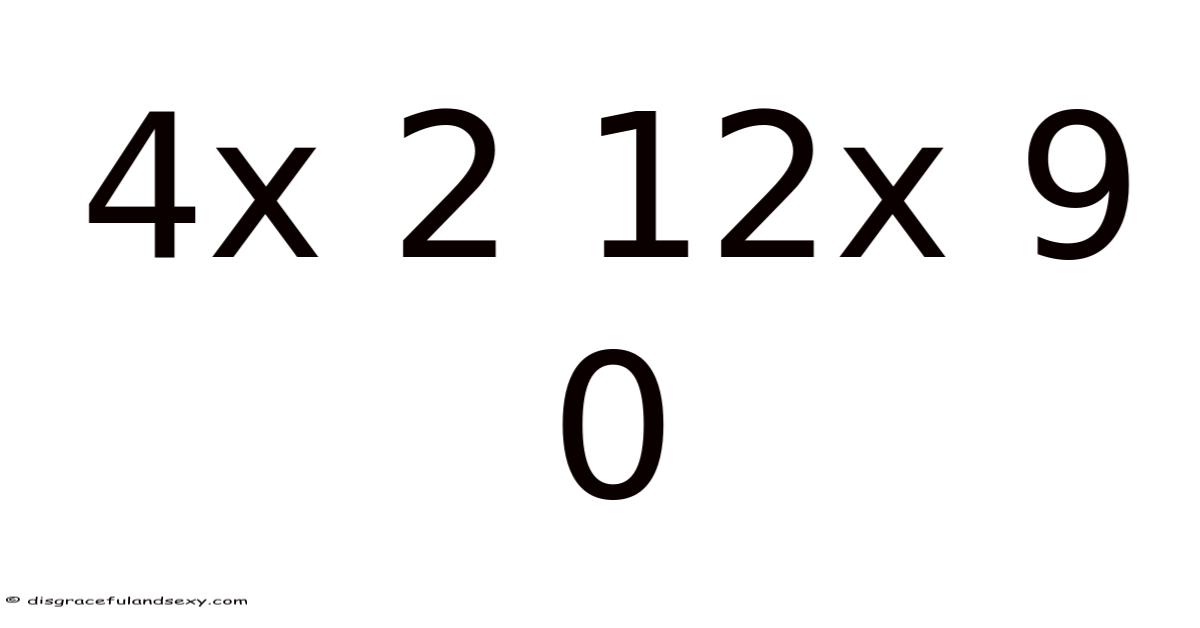
Decoding the Mystery: 4x 2 12x 9 0 – A Deep Dive into Number Patterns and Problem Solving
This article explores the seemingly random sequence "4x 2 12x 9 0" and walks through various methods of interpreting and understanding such numerical puzzles. So naturally, we will investigate potential patterns, mathematical operations, and logical reasoning to uncover the possible meaning or solution behind this sequence. And this exploration will not only reveal the potential solutions but also enhance our understanding of problem-solving techniques and pattern recognition. The core focus will be on unraveling the meaning behind the sequence, demonstrating diverse approaches to numerical analysis.
Worth pausing on this one.
Understanding the Problem: Initial Observations
At first glance, "4x 2 12x 9 0" appears arbitrary. The presence of both numbers and the multiplication symbol "x" suggests a mathematical relationship, but the lack of clear operators between the groups (4x2 and 12x9) makes the sequence ambiguous. On top of that, we need to consider several possibilities to decipher its potential meaning. The inclusion of '0' at the end adds another layer of complexity, suggesting a possible termination point or a significant element within the sequence.
Method 1: Exploring Arithmetic Operations
One approach is to treat each group of numbers separated by a space as individual mathematical expressions. This leads to the following calculations:
- 4 x 2 = 8
- 12 x 9 = 108
This gives us the sequence 8, 108, 0. We might consider this a remainder, a stopping point, or even a representation of a null value. The significance of the '0' remains unclear in this context. Further analysis is needed to interpret the relationship between 8, 108, and 0 Simple as that..
To proceed further, let's consider other arithmetic operations. Are there any hidden additions, subtractions, or divisions? Could the 'x' represent a different operation entirely, possibly a concatenation? This requires exploring different interpretations But it adds up..
Consider the following options:
- Concatenation: Could the 'x' signify joining numbers? This would result in 42 129 0. That said, without further information or context, this sequence remains nonsensical.
- Alternating operations: Perhaps the operations alternate between multiplication and addition (or subtraction, or division). This approach yields varying and equally non-obvious results without further context or rules.
Method 2: Searching for Number Patterns
Another approach is to look for underlying mathematical patterns within the sequence itself. Are there any relationships between 4, 2, 12, 9, and 0? This involves exploring different mathematical properties, such as:
- Prime factorization: Decomposing each number into its prime factors might reveal hidden relationships. The prime factorization of 4 is 2 x 2, 12 is 2 x 2 x 3. On the flip side, no immediate obvious pattern emerges from this method.
- Sequence differences: Analyzing the differences between consecutive numbers could reveal a pattern. This is less useful in this case due to the multiplication signs and the varying sizes of numbers.
- Geometric Progression: Checking for a common ratio or a pattern that follows a geometric progression would also be a valuable approach. Again, this method doesn't readily present a clear pattern.
Method 3: Considering External Factors and Context
The sequence "4x 2 12x 9 0" might not be a stand-alone mathematical puzzle. Its meaning could depend heavily on the context in which it was presented. Without knowing the source or origin of this sequence, it's difficult to provide a definitive interpretation.
- Coded message: The sequence could be a simple code, where each number or group of numbers represents a letter or symbol. This would require a key or cipher to decipher the message.
- Part of a larger equation: The sequence might be a fragment of a longer or more complex mathematical problem. More information is necessary to understand its role.
- Data representation: It could represent data points, coordinates, or values from a table or graph.
Method 4: Exploring Advanced Mathematical Concepts
For a more exhaustive exploration, let's consider more advanced concepts:
- Modular Arithmetic: Could the sequence represent operations within a specific modulus? Experimentation with different moduli might reveal patterns. Even so, without a defined modulus, this approach remains inconclusive.
- Matrix operations: Could the sequence be represented as a matrix or a system of equations? More data would be necessary to test this hypothesis.
- Continued Fractions: Could the sequence be encoded within a continued fraction representation of a particular number? This approach is more speculative without a given starting point.
Addressing Potential Interpretations and Limitations
It's crucial to acknowledge the limitations of interpreting this sequence without further context. Multiple interpretations are possible, and none can be definitively confirmed without additional information. The ambiguity is inherent in the lack of explicit instructions or delimiters Worth keeping that in mind..
It is possible the sequence represents something completely unrelated to pure mathematics; it could be a random combination, a typographical error, or a part of a broader code or system not yet deciphered And that's really what it comes down to..
Frequently Asked Questions (FAQ)
Q1: Is there a single, definitive solution to this sequence?
A1: No. Without additional context or constraints, there is no single, definitive solution. Multiple interpretations are possible, each with varying degrees of plausibility.
Q2: What are the key limitations in solving this type of puzzle?
A2: The main limitations are the ambiguity of the sequence and the lack of context. The absence of clear operators, delimiters, or further instructions restricts the ability to determine a unique solution.
Q3: What other approaches could be used to investigate similar numerical puzzles?
A3: For similar puzzles, consider examining: the number's properties (prime factors, divisibility rules), sequences of differences or ratios, geometric and arithmetic progressions, recursive patterns, and searching for potential codes or ciphers. External context and the puzzle's origin should always be considered It's one of those things that adds up. That alone is useful..
Conclusion: The Importance of Context and Critical Thinking
The seemingly simple sequence "4x 2 12x 9 0" highlights the importance of context in problem-solving. While several mathematical approaches can be applied, the lack of clear instructions or a broader context prevents a definitive solution. This exercise emphasizes the need for critical thinking, creativity, and the exploration of various problem-solving strategies. The ambiguity of the sequence encourages us to consider different perspectives and hypotheses, demonstrating the value of open-ended exploration in mathematical problem-solving. In practice, further information or context would be needed to provide a more specific and conclusive answer. The exploration itself, however, serves as a valuable exercise in mathematical reasoning and pattern recognition The details matter here..
Most guides skip this. Don't.
