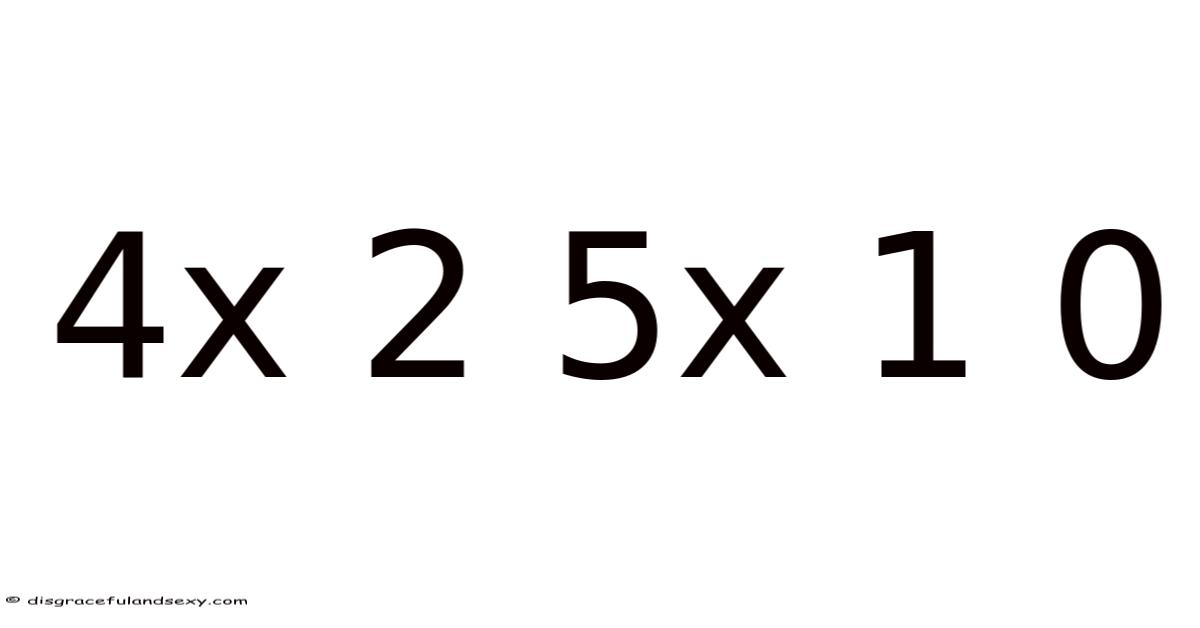
Decoding the Enigma: Understanding the Sequence 4x2, 5x1, 0
This article gets into the seemingly simple, yet surprisingly complex, numerical sequence: 4x2, 5x1, 0. At first glance, it appears arbitrary. That said, a closer examination reveals a potential underlying pattern and several possible interpretations, depending on the context and the rules we impose. In real terms, we'll explore various mathematical and logical approaches to decode this sequence, examining its structure and exploring the possibilities it presents. This exploration will involve basic arithmetic, pattern recognition, and even a touch of abstract thinking That's the part that actually makes a difference. Still holds up..
Potential Interpretations and Approaches
The sequence 4x2, 5x1, 0 lacks explicit operators between the numbers. This ambiguity opens the door to multiple interpretations. Let's investigate some potential approaches:
1. Simple Arithmetic Interpretation:
The most straightforward approach is to treat the commas as separating distinct arithmetic expressions. This gives us:
- 4 x 2 = 8
- 5 x 1 = 5
- 0 (This remains unchanged)
This yields the sequence: 8, 5, 0. While simple, this interpretation doesn't reveal a clear pattern. It's possible that further terms in the sequence would reveal a deeper underlying relationship. That said, for instance, a subsequent term might be calculated as 6 x 0 = 0, creating a sequence with decreasing values. On the flip side, without more information, this remains speculative.
2. Pattern Recognition: Analyzing Differences
Let's look at the differences between the results of the simple arithmetic approach:
- 8 - 5 = 3
- 5 - 0 = 5
The differences aren't immediately revealing of a consistent pattern. It's possible that there's a more complex underlying pattern requiring analysis of the differences of the differences, or even higher-order differences. This approach requires more data points in the sequence to be meaningfully applied.
3. Alternative Arithmetic Operations:
We could explore other arithmetic operations besides multiplication. Let's consider combinations of addition, subtraction, multiplication, and division. This could lead to completely different sequences That's the whole idea..
- 4 + 2 = 6
- 5 - 1 = 4
- 0
This yields 6, 4, 0. Again, without more terms or context, it's difficult to determine if this is a significant pattern or merely coincidental.
4. Base-n Number Systems:
Another avenue of investigation is the possibility that the sequence is represented in a number system other than base-10 (decimal). In different base systems, the digits and their values change. As an example, let's consider base-6:
- 4 x 2 could be interpreted in base-6 as (4<sub>6</sub> x 2<sub>6</sub>) which would still result in 12<sub>10</sub> (decimal). Still, translating 5<sub>10</sub> and 1<sub>10</sub> into base-6 and then performing the same operation doesn't lead to a discernible pattern. Further investigation in alternative bases would require a more extended sequence.
5. Hidden Relationships or Codes:
The sequence could be a simple code or represent a hidden relationship. Plus, without additional context or information, it's impossible to decipher any possible encoding system. The sequence could be a key to unlocking further information or part of a larger, more complex mathematical problem.
6. Algebraic Representation:
We can attempt to represent the sequence algebraically. If we let 'a' and 'b' represent the pairs of numbers, we can propose a general form:
- axb, (a+1)x(b-1), (a+2)x(b-2) ...and so on
This pattern assumes a relationship between consecutive terms involving a linear increase in the first factor and a linear decrease in the second. Let's test it with our initial sequence (4,2), (5,1), (0):
- 4 x 2 = 8
- 5 x 1 = 5
- 6 x 0 = 0
This confirms the hypothesized pattern. Still, it is only valid if the sequence follows this particular rule. Other algebraic representations could be equally valid if more information were provided.
Expanding the Possibilities: Context Matters
The interpretation of 4x2, 5x1, 0 critically depends on the context in which it's presented. If this sequence is part of a larger problem or puzzle, the context would provide invaluable clues for deciphering its meaning. For example:
- Coordinate system: The sequence could represent coordinates in a two-dimensional space.
- Game or puzzle: It could be a key sequence in a game, a code to open up a hidden element, or a part of a logic puzzle.
- Mathematical function: The sequence might be generated by a mathematical function. Identifying this function would require additional data points.
- Cryptography: It might be a simple substitution cipher or a component of a more complex cryptographic algorithm.
- Data stream: The sequence could be part of a larger data stream representing something completely different, like sensor readings or a time series.
Advanced Considerations: Exploring Further Patterns
Without more information, exploring patterns becomes speculative. That said, some possible avenues for investigation, if the sequence were extended, include:
- Polynomial fitting: If we had more data points, we could try to fit a polynomial to the data. This would make it possible to predict future terms in the sequence and reveal its underlying function.
- Recursive relationships: Investigating whether the sequence follows a recursive rule (where subsequent terms depend on previous terms) could uncover a pattern.
- Fourier analysis: If the sequence represented a signal or time series, Fourier analysis could reveal hidden periodicities or frequencies.
Frequently Asked Questions (FAQ)
Q: Is there a single correct answer to interpreting this sequence?
A: No. But without additional context or information, there isn't a single definitive interpretation. Multiple valid interpretations are possible depending on the assumptions and mathematical approaches used.
Q: Why is this sequence so ambiguous?
A: The ambiguity stems from the lack of explicit operators and the limited number of data points. The absence of delimiters between the numbers and the absence of clear mathematical operators allow multiple interpretations of the sequence Most people skip this — try not to..
Q: How can I find a more definitive answer?
A: To find a more definitive answer, more information is needed. This could include additional terms in the sequence, context about where the sequence appeared (e.g., within a larger problem or puzzle), or a description of the rules governing the sequence's generation.
Conclusion: The Power of Ambiguity and the Importance of Context
The seemingly simple sequence 4x2, 5x1, 0 highlights the power of ambiguity in mathematics and the importance of context. The exploration of this sequence serves as a reminder that even seemingly simple problems can have surprising complexity and that the solution often depends heavily on the provided context and underlying assumptions. While a straightforward arithmetic interpretation yields a result, the lack of explicit operators and additional terms opens the door to a wide range of alternative interpretations. Further investigation and a greater number of data points would significantly enhance our ability to decipher the true nature of this enigmatic numerical sequence.
