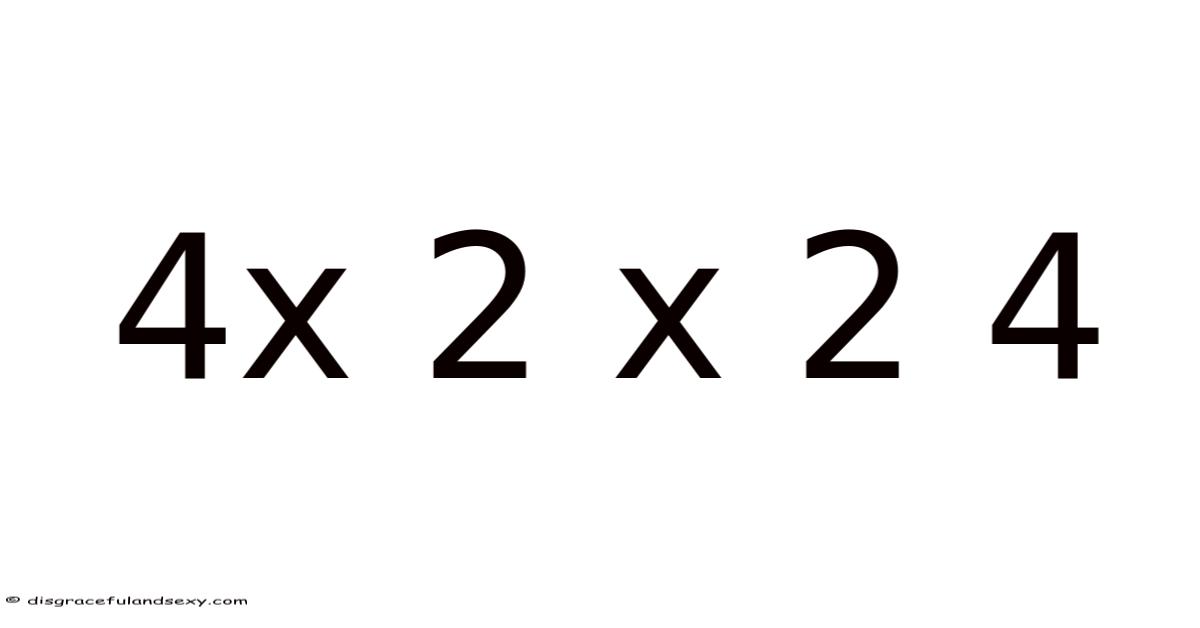
Decoding the Mystery: A Deep Dive into "4 x 2 x 2 = 4" and its Mathematical Implications
The seemingly simple equation, "4 x 2 x 2 = 4," immediately strikes many as incorrect. Basic arithmetic dictates that 4 multiplied by 2, then multiplied by 2 again, equals 16, not 4. On the flip side, the allure of this seemingly false equation lies in the possibility of hidden mathematical principles, alternative interpretations, or perhaps even a clever trick. This article will explore various perspectives to unravel the mystery behind this intriguing statement and uncover the underlying mathematical concepts involved. That's why we will break down the realms of modular arithmetic, Boolean algebra, and even consider potential misinterpretations or deliberate misrepresentations. This exploration will not only clarify the apparent contradiction but also enhance your understanding of fundamental mathematical operations and their diverse applications Most people skip this — try not to..
Understanding the Obvious: Standard Arithmetic
Before venturing into more complex interpretations, let's firmly establish the standard arithmetic solution. The equation, 4 x 2 x 2, follows the order of operations (PEMDAS/BODMAS), meaning we perform multiplication from left to right:
- 4 x 2 = 8
- 8 x 2 = 16
That's why, the correct answer using standard arithmetic is unequivocally 16. The statement "4 x 2 x 2 = 4" is demonstrably false under conventional mathematical rules.
Exploring Alternative Interpretations: Modular Arithmetic
The discrepancy between the expected result (16) and the given result (4) might suggest the involvement of a less common mathematical system. One such system is modular arithmetic. Modular arithmetic, often denoted as "mod n," performs arithmetic within a specific range (a modulus). The result is always the remainder after division by the modulus.
Let's consider if there's a modulus that could make "4 x 2 x 2 = 4" true. To find out, we need to determine if there is a value 'n' such that 16 mod n = 4. Simply put, when 16 is divided by n, the remainder is 4 Not complicated — just consistent..
-
If n = 12: 16 divided by 12 leaves a remainder of 4. Which means, in modulo 12 arithmetic (mod 12), 16 ≡ 4 (mod 12). This doesn't directly solve our original problem, as we need to consider the entire calculation within the modulo system. Let's look at the steps:
- 4 x 2 = 8 (mod 12)
- 8 x 2 = 16 ≡ 4 (mod 12) This shows that within the context of modulo 12 arithmetic, the expression "4 x 2 x 2 = 4" is valid.
-
Other Moduli: There are other moduli which, when applied appropriately, could result in similar outcomes. The key is finding a system where the intermediate and final results align with the modulo operation.
The Role of Boolean Algebra
Boolean algebra, a branch of algebra dealing with logical operations, offers a different perspective. In Boolean algebra, numbers are represented by binary digits (0 and 1), and operations are logical rather than arithmetic. While it might seem unrelated at first, a specific interpretation could be applied here.
One could potentially consider the numbers in the equation as binary values representing true (1) or false (0) statements, but this interpretation would require significant assumptions and context that doesn't naturally arise from the given expression But it adds up..
The Concept of Misinterpretation and Context
The most straightforward explanation for the equation "4 x 2 x 2 = 4" is simply that it is incorrect. It's essential to consider the potential for:
- Typographical errors: A simple mistake in transcription could be responsible for the incorrect equation.
- Misunderstanding of the problem: The context in which the equation was presented might be crucial. There might be hidden assumptions or constraints not explicitly mentioned.
- Deliberate misrepresentation: The equation could be intentionally presented incorrectly, perhaps to test understanding or as part of a puzzle or riddle.
Addressing Potential Misconceptions: Order of Operations
PEMDAS/BODMAS (Parentheses/Brackets, Exponents/Orders, Multiplication and Division, Addition and Subtraction) is the standard order of operations in arithmetic. This ensures that calculations are performed consistently, regardless of how an equation is written. The equation "4 x 2 x 2 = 4" ignores these rules, leading to the incorrect result.
Counterintuitive, but true.
Further Exploration: Advanced Mathematical Concepts
While the initial problem doesn't directly necessitate complex mathematical concepts, it opens a door to exploring broader areas of mathematics:
- Abstract algebra: This branch of mathematics deals with abstract structures such as groups, rings, and fields. The concepts of modular arithmetic touched upon earlier are a part of abstract algebra.
- Number theory: This area focuses on the properties of integers. The search for suitable moduli in modular arithmetic is a problem within number theory.
FAQ: Frequently Asked Questions
Q: Is the equation 4 x 2 x 2 = 4 ever correct?
A: No, it is not correct using standard arithmetic. Still, it can be made true within specific mathematical systems such as modular arithmetic by choosing an appropriate modulus Turns out it matters..
Q: What is the significance of this equation?
A: While seemingly trivial, the equation highlights the importance of understanding the underlying mathematical framework. It demonstrates how seemingly simple equations can yield different results based on the mathematical system being applied And that's really what it comes down to. And it works..
Q: Can this equation be used to illustrate any mathematical principles?
A: Yes, it can illustrate the concept of modular arithmetic and the importance of context and correct application of mathematical rules. It serves as a simple example of how a change in the underlying rules can lead to a different outcome The details matter here..
Q: Why is it important to understand order of operations?
A: Following the order of operations is crucial to obtain consistent and correct results when performing calculations. Without this standard, mathematical results would be ambiguous.
Conclusion: Unraveling the Apparent Paradox
The equation "4 x 2 x 2 = 4" presents a fascinating paradox. But while incorrect in standard arithmetic, it opens up opportunities to explore other mathematical systems like modular arithmetic, highlighting the richness and complexity of mathematical principles. Which means the initial apparent falsehood underscores the importance of understanding not just the mechanics of arithmetic but also the underlying mathematical structures and the context in which calculations are performed. Understanding such nuances enhances our mathematical literacy and allows us to appreciate the broader scope of mathematical possibilities beyond simple arithmetic operations. This simple equation thus serves as a powerful tool for illustrating the diverse and fascinating world of mathematics.
