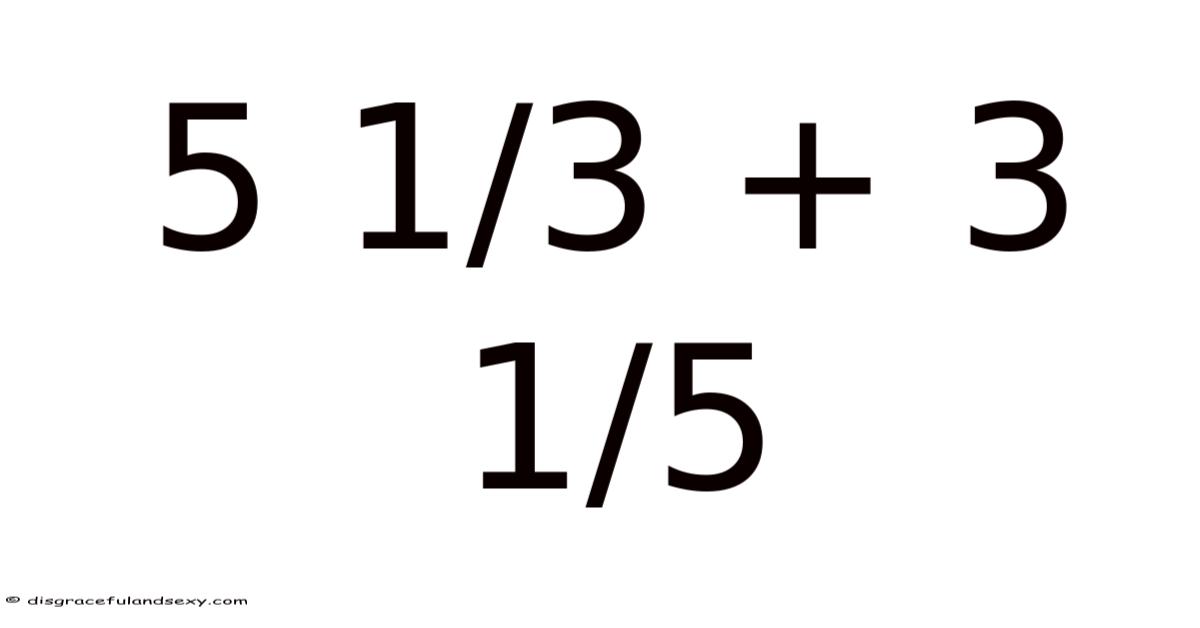
Decoding Mixed Numbers: A Deep Dive into 5 1/3 + 3 1/5
Adding fractions might seem like a simple task, but when dealing with mixed numbers – whole numbers combined with fractions – it can become a bit more challenging. Think about it: this will equip you with the skills to confidently tackle similar problems in the future. Which means this article will guide you through the process of adding 5 1/3 + 3 1/5, not just providing the answer, but also exploring the underlying principles and offering a broader understanding of fraction manipulation. We'll cover the steps involved, explore the underlying mathematical concepts, and even get into some frequently asked questions Turns out it matters..
Quick note before moving on.
Understanding Mixed Numbers
Before diving into the addition, let's clarify what mixed numbers are. To give you an idea, 5 1/3 represents five whole units and one-third of another unit. A mixed number is a combination of a whole number and a proper fraction (a fraction where the numerator is smaller than the denominator). Similarly, 3 1/5 represents three whole units and one-fifth of another unit.
Step-by-Step Calculation: 5 1/3 + 3 1/5
Adding mixed numbers requires a systematic approach. Here's a step-by-step guide to solving 5 1/3 + 3 1/5:
Step 1: Find a Common Denominator
The key to adding fractions is to ensure they share a common denominator. In this case, we need to find the least common multiple (LCM) of 3 and 5. So naturally, the LCM is the smallest number that both 3 and 5 divide into evenly. In this instance, the LCM of 3 and 5 is 15 Most people skip this — try not to. Still holds up..
Step 2: Convert Fractions to Equivalent Fractions
Now, we convert both fractions (1/3 and 1/5) into equivalent fractions with the common denominator of 15:
- 1/3 is equivalent to 5/15 (multiply both the numerator and denominator by 5)
- 1/5 is equivalent to 3/15 (multiply both the numerator and denominator by 3)
Step 3: Rewrite the Mixed Numbers
Our original problem now becomes:
5 5/15 + 3 3/15
Step 4: Add the Whole Numbers
Add the whole numbers separately: 5 + 3 = 8
Step 5: Add the Fractions
Add the fractions: 5/15 + 3/15 = 8/15
Step 6: Combine the Results
Combine the sum of the whole numbers and the sum of the fractions to get the final answer:
8 + 8/15 = 8 8/15
Which means, 5 1/3 + 3 1/5 = 8 8/15
A Deeper Dive into the Mathematics
Let's explore the mathematical principles underlying this process. The fundamental concept is that of equivalent fractions. Two fractions are equivalent if they represent the same proportion or value. Multiplying or dividing both the numerator and denominator of a fraction by the same non-zero number results in an equivalent fraction. This is crucial because it allows us to add or subtract fractions with different denominators.
Finding the least common multiple (LCM) is essential for efficiency. Practically speaking, while you could use any common multiple, using the LCM simplifies the calculations and results in the simplest form of the final answer. Methods for finding the LCM include listing multiples, prime factorization, or using the formula LCM(a,b) = (a*b)/GCD(a,b) where GCD represents the greatest common divisor.
The addition of fractions is based on the principle of combining parts of a whole. That said, this is because the denominator represents the size of the parts (e. g.Which means when the denominators are the same, we simply add the numerators and keep the denominator unchanged. , fifths, fifteenths), while the numerator represents the number of those parts.
Alternative Methods: Improper Fractions
Another approach to solving this problem involves converting the mixed numbers into improper fractions first. An improper fraction is a fraction where the numerator is greater than or equal to the denominator Surprisingly effective..
Step 1: Convert to Improper Fractions
- 5 1/3 = (5 * 3 + 1) / 3 = 16/3
- 3 1/5 = (3 * 5 + 1) / 5 = 16/5
Step 2: Find a Common Denominator
The LCM of 3 and 5 is 15 The details matter here. Simple as that..
Step 3: Convert to Equivalent Fractions
- 16/3 = (16 * 5) / (3 * 5) = 80/15
- 16/5 = (16 * 3) / (5 * 3) = 48/15
Step 4: Add the Fractions
80/15 + 48/15 = 128/15
Step 5: Convert Back to a Mixed Number
To convert the improper fraction 128/15 back to a mixed number, we perform the division: 128 ÷ 15 = 8 with a remainder of 8. So in practice, 128/15 is equal to 8 8/15 It's one of those things that adds up. That alone is useful..
This method yields the same result: 8 8/15
Real-World Applications
Understanding mixed numbers and how to add them is crucial in various real-world scenarios. Consider these examples:
- Baking: Recipes often call for mixed amounts of ingredients. Adding different fractional amounts of ingredients accurately is essential for successful baking.
- Construction: Measuring distances, cutting materials, and calculating quantities in construction rely heavily on precise calculations with fractions and mixed numbers.
- Finance: Working with budgets, calculating interest rates, or dealing with fractional shares of stocks involves manipulating fractions and decimals, often expressed as mixed numbers.
Frequently Asked Questions (FAQs)
Q1: Can I add the whole numbers and fractions separately in any order? Yes, the commutative property of addition allows you to add the whole numbers and the fractions in any order.
Q2: What if the fractions don't have a common denominator? You must find a common denominator before you can add the fractions.
Q3: What if I get an improper fraction as a result? Convert the improper fraction to a mixed number for a clear and simplified answer.
Q4: Are there other methods for adding mixed numbers? Yes, you can convert everything to decimals and then add, although this might lead to rounding errors.
Q5: How can I improve my skills with fraction addition? Practice regularly with various examples, focusing on understanding the underlying principles rather than just memorizing steps.
Conclusion
Adding mixed numbers like 5 1/3 + 3 1/5 might initially seem daunting, but with a systematic approach and a strong understanding of fundamental fraction principles, it becomes a manageable task. But this article provided a step-by-step solution using two different methods: directly adding the mixed numbers and converting to improper fractions. In practice, the core concept revolves around finding a common denominator, enabling the addition of the fractions before combining with the whole numbers. Remember that practice is key to mastering this skill, leading to confidence and proficiency in tackling more complex arithmetic problems involving fractions and mixed numbers. By understanding the underlying principles of equivalent fractions and least common multiples, you can approach any fraction addition problem with a clear and effective strategy.
Counterintuitive, but true.
