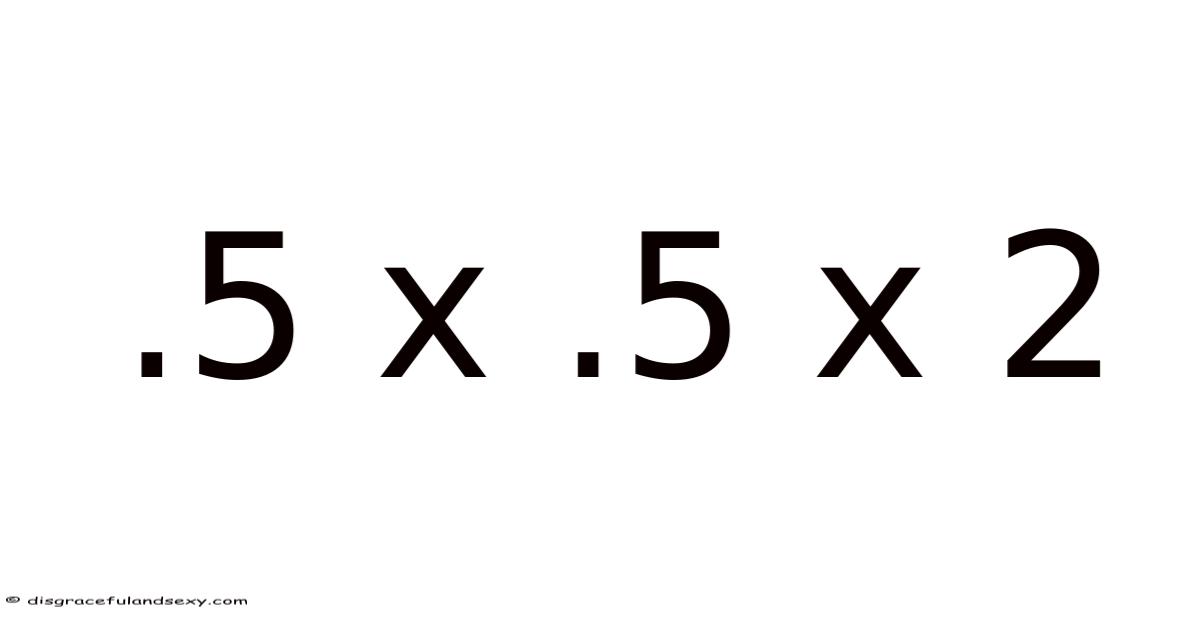
Decoding .5 x .5 x 2: Exploring Volume, Cubes, and Practical Applications
This article looks at the seemingly simple calculation of 0.5 x 0.5 x 2, exploring its mathematical basis, practical applications, and extending the concept to broader understanding of volume calculation and its relevance in various fields. We'll move beyond the simple arithmetic to understand the underlying principles and the real-world implications of this calculation. This exploration will be particularly useful for students learning about volume, geometry, and those working with measurements in practical settings.
Understanding the Fundamentals: Volume and Cuboids
The expression ".Still, 5 x . Still, 5 x 2" represents a volume calculation. Specifically, it calculates the volume of a cuboid (a three-dimensional rectangular prism) Turns out it matters..
-
0.5 (or ½): Represents the length and width of the cuboid's base. This means the base is a square with sides measuring 0.5 units each. These units could be centimeters, meters, inches, feet—any consistent unit of length.
-
2: Represents the height of the cuboid. The cuboid stands 2 units tall.
-
Multiplication: The multiplication operation (x) is used to determine the volume. The formula for the volume of a cuboid is: Volume = Length x Width x Height.
Because of this, .5 x .But 5 units by 0. 5 x 2 calculates the volume of a cuboid with a square base of 0.5 units, and a height of 2 units.
Calculating the Volume: A Step-by-Step Approach
Let's perform the calculation:
-
Base Area: First, we find the area of the square base: 0.5 x 0.5 = 0.25 square units.
-
Volume: Next, we multiply the base area by the height: 0.25 x 2 = 0.5 cubic units.
So, the volume of the cuboid is 0.5 cubic units. Even so, the "cubic units" designation is crucial because we are measuring three-dimensional space. This means the cuboid occupies 0.5 units of volume.
Visualizing the Cuboid: A Practical Example
Imagine a small box. This box has a square bottom that measures half a foot (0.5 feet) on each side. The box is 2 feet tall. This is our cuboid. Applying the calculation, we find its volume is 0.5 cubic feet. This small box could hold 0.5 cubic feet of sand, water, or any other material.
Extending the Concept: Different Units and Scaling
The calculation remains the same regardless of the units used. If the measurements were in centimeters:
- 0.5 cm x 0.5 cm x 2 cm = 0.5 cubic centimeters
If we were to double the dimensions:
- 1 cm x 1 cm x 4 cm = 4 cubic centimeters
This illustrates the relationship between dimensions and volume. A proportional increase in dimensions results in a much larger increase in volume. This is a key concept in understanding scaling in various fields, from architecture to biology Not complicated — just consistent. Practical, not theoretical..
Practical Applications Across Disciplines
The concept of calculating volume, even with seemingly simple dimensions like .5 x .5 x 2, has wide-ranging practical applications:
-
Engineering and Construction: Calculating volumes is essential for determining the amount of material needed for various projects. This could range from calculating the volume of concrete needed for a foundation to the volume of soil needed for landscaping.
-
Manufacturing and Packaging: Understanding volume helps in designing packaging to fit a product efficiently. Optimizing packaging size minimizes material waste and shipping costs.
-
Fluid Dynamics: Calculating volumes is crucial in understanding fluid flow and pressure. It's used in designing pipelines, reservoirs, and other fluid handling systems.
-
Medicine and Pharmaceuticals: Accurate volume calculations are vital in dispensing medications, preparing solutions, and designing medical equipment Easy to understand, harder to ignore..
-
Agriculture: Understanding volumes is essential for calculating the amount of water, fertilizer, or pesticides needed for a given area.
-
Computer Graphics and 3D Modeling: The calculation of volume underlies the creation of three-dimensional objects and environments in digital spaces. It is the foundation of creating realistic and accurate models.
Beyond the Cube: Exploring Other Shapes
While our example focuses on a cuboid, the principle of calculating volume extends to various other three-dimensional shapes. The formula varies depending on the shape:
-
Sphere: (4/3)πr³ (where r is the radius)
-
Cylinder: πr²h (where r is the radius and h is the height)
-
Cone: (1/3)πr²h (where r is the radius and h is the height)
Understanding these formulas allows for accurate volume calculations for a wide range of shapes, extending the application of volume calculation far beyond simple cuboids Turns out it matters..
Advanced Concepts: Irregular Shapes and Integration
For irregular shapes, calculating the volume becomes more complex. Techniques from calculus, specifically integration, are employed to determine the volume of irregularly shaped objects. This involves breaking the shape down into smaller, manageable volumes and summing them up using integral calculus Small thing, real impact. Took long enough..
Frequently Asked Questions (FAQ)
Q: What if the units are different?
A: Ensure all dimensions are converted to the same unit before calculation. Take this case: if you have a length in meters and a height in centimeters, convert both to either meters or centimeters before performing the calculation.
Q: What are some common mistakes in volume calculations?
A: Common mistakes include forgetting to cube the units (e.That's why g. , writing cubic meters as just meters), using incorrect formulas for different shapes, and misinterpreting the units of measurement The details matter here..
Q: Can I use this calculation for liquids?
A: Yes, this calculation applies to liquids as well. The volume of a liquid in a container of a specific shape and dimension can be calculated using the appropriate volume formula for that container.
Conclusion: The Significance of a Simple Calculation
The seemingly straightforward calculation of 0.Practically speaking, 5 x 0. In practice, 5 x 2, while simple in its execution, reveals fundamental principles of geometry and volume calculation. This understanding has widespread practical implications across various scientific, engineering, and everyday applications. From designing buildings to packaging products, from understanding fluid dynamics to calculating medication dosages, the ability to accurately calculate volume is indispensable. Practically speaking, this exploration has not only demonstrated the calculation itself but also highlighted its significance and how it serves as a foundation for more complex three-dimensional problems. Mastering this basic concept empowers you to approach more advanced geometrical problems with confidence and understanding.
It sounds simple, but the gap is usually here.
