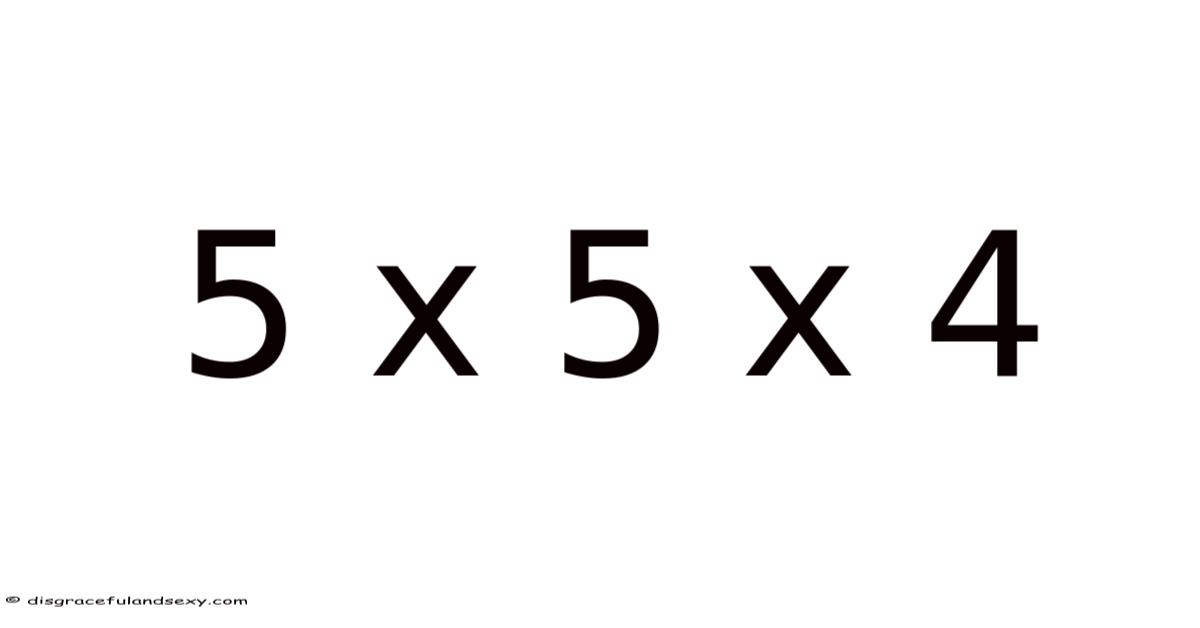
Decoding 5 x 5 x 4: Exploring the Math, Applications, and Intriguing Possibilities
This article gets into the seemingly simple mathematical expression "5 x 5 x 4," exploring its fundamental calculations, practical applications across various fields, and even venturing into some intriguing possibilities and extensions of this concept. Understanding this seemingly basic equation opens doors to a broader understanding of multiplication, volume calculations, and problem-solving strategies. We’ll move beyond the simple answer and uncover the richness embedded within this numerical expression Worth keeping that in mind. Nothing fancy..
I. The Fundamental Calculation: 5 x 5 x 4 = 100
The core of this expression is straightforward multiplication. We simply follow the order of operations (often remembered by the acronym PEMDAS/BODMAS): Parentheses/Brackets, Exponents/Orders, Multiplication and Division (from left to right), and Addition and Subtraction (from left to right). In this case, we have only multiplication:
- Step 1: 5 x 5 = 25
- Step 2: 25 x 4 = 100
Because of this, the answer to 5 x 5 x 4 is 100. This is a foundational calculation that forms the basis for many more complex mathematical operations But it adds up..
II. Practical Applications: Real-World Examples of 5 x 5 x 4
While the calculation itself is simple, the dimensions 5 x 5 x 4 frequently appear in real-world scenarios. Understanding these applications helps solidify the concept and demonstrates its practical relevance Not complicated — just consistent..
-
Volume Calculations: The most immediate application lies in calculating volume. Imagine a rectangular box or container with dimensions of 5 units by 5 units by 4 units (e.g., 5 cm x 5 cm x 4 cm). The volume of this container would be 100 cubic units (100 cm³). This principle applies to various contexts:
- Storage: Calculating the storage capacity of a container, a warehouse space, or even a digital storage unit.
- Construction: Determining the amount of material needed for a project (concrete, bricks, etc.).
- Packaging: Designing packaging to fit a specific product, ensuring efficient space utilization.
-
Array Representation: In computer science and data structures, a 5 x 5 x 4 array represents a three-dimensional data structure. Each dimension signifies a different characteristic or attribute. For instance:
- Image Processing: A 5 x 5 pixel region in a 4-layered image (e.g., RGB + Alpha channel).
- Data Analysis: Organizing data points across multiple categories.
-
Combinatorics: While not directly apparent, 5 x 5 x 4 could also represent combinations in certain scenarios. Take this: if you have 5 choices for color, 5 choices for size, and 4 choices for material, the total number of possible combinations would be 100. This applies to various decision-making processes or design choices.
-
Everyday Examples: Consider organizing items into a grid: 5 rows of 5 items, arranged across 4 different shelves. The total number of items would be 100. This simple example emphasizes the ubiquitous nature of this calculation in our daily lives.
III. Extending the Concept: Beyond the Simple Calculation
Moving beyond the immediate calculation, let's explore some extensions and related concepts that build upon the 5 x 5 x 4 framework.
-
Variations on Dimensions: What if we alter the dimensions? Exploring variations, such as 4 x 5 x 5, 5 x 4 x 5, or even different dimensions entirely (e.g., 10 x 5 x 2), allows us to understand the relationship between dimensions and volume. This reinforces the concept of commutativity in multiplication (order doesn't matter) and introduces the concept of scaling Small thing, real impact. No workaround needed..
-
Factors and Prime Factorization: The number 100 itself can be broken down into its prime factors (2 x 2 x 5 x 5). Understanding prime factorization is a fundamental concept in number theory and has applications in cryptography and other advanced mathematical fields.
-
Geometric Progression: The sequence could be viewed as part of a geometric progression. If we think of this as a three-dimensional series, we can explore how the volume changes when we modify the dimensions systematically.
-
Algebraic Representation: The expression can be generalized algebraically. Instead of using specific numbers, we can represent the dimensions with variables (e.g., a x b x c). This opens the door to solving for unknown dimensions given a specific volume That's the part that actually makes a difference..
IV. Exploring Connections to Other Mathematical Concepts
The 5 x 5 x 4 calculation isn't isolated; it connects to several other important mathematical concepts.
-
Multiplication Tables: It directly reinforces the understanding of multiplication tables, particularly the 4s, 5s, and 25s. Mastering multiplication tables is fundamental to efficient mathematical problem-solving.
-
Exponents and Powers: The 5 x 5 component can be represented as 5², highlighting the concept of exponents and powers. Understanding exponents is crucial for advanced mathematics and physics And that's really what it comes down to..
-
Geometry and Spatial Reasoning: The calculation is inherently linked to geometric concepts of volume, area, and spatial reasoning. Visualizing the three-dimensional representation helps develop these spatial reasoning skills.
-
Number Theory: Breaking down 100 into its prime factors connects us to number theory, which explores the properties of integers and their relationships.
V. Applications in Different Fields
The seemingly simple 5 x 5 x 4 calculation finds surprising applications across numerous disciplines:
-
Engineering: Calculating material requirements, designing structures, or simulating physical processes But it adds up..
-
Physics: Modeling three-dimensional systems, calculating forces, and solving problems related to volume and density That's the part that actually makes a difference..
-
Computer Science: Working with data structures, memory allocation, and image processing.
-
Business and Economics: Inventory management, resource allocation, and financial modeling Easy to understand, harder to ignore. Less friction, more output..
-
Statistics: Analyzing data sets, organizing information, and performing calculations.
VI. Frequently Asked Questions (FAQ)
-
Q: What are the different ways to calculate 5 x 5 x 4?
- A: You can calculate it step-by-step (5 x 5 = 25, then 25 x 4 = 100) or use mental math techniques depending on your comfort level. You could also multiply in a different order (5 x 4 x 5 = 100) due to the commutative property of multiplication.
-
Q: What is the significance of the number 100 in this context?
- A: 100 is the result of the multiplication and represents the total quantity, volume, or number of combinations depending on the application. It's also a significant number culturally and mathematically, representing a century or a complete set of one hundred items.
-
Q: How can I apply this calculation to real-life problems?
- A: Think about situations where you need to calculate volume (e.g., filling a box, estimating storage space) or determine the total number of items arranged in a three-dimensional grid.
-
Q: Are there any advanced mathematical concepts related to this simple calculation?
- A: Yes, the calculation connects to concepts like prime factorization, exponents, geometric progressions, and algebraic representation, opening the door to more complex mathematical explorations.
VII. Conclusion: The Power of Simple Calculations
The seemingly simple calculation 5 x 5 x 4 = 100 serves as a powerful illustration of how fundamental mathematical principles underpin a wide range of real-world applications. Still, by exploring its various applications and extensions, we can appreciate the interconnectedness of mathematical concepts and their relevance in our daily lives. The beauty of mathematics lies in its ability to reach complex ideas from seemingly simple foundations. From calculating volumes and organizing data to understanding geometric progressions and prime factorization, this seemingly basic equation offers a gateway to deeper mathematical understanding and problem-solving skills. Remember, the journey of learning is ongoing, and even the smallest calculation can tap into a world of knowledge and possibilities.
