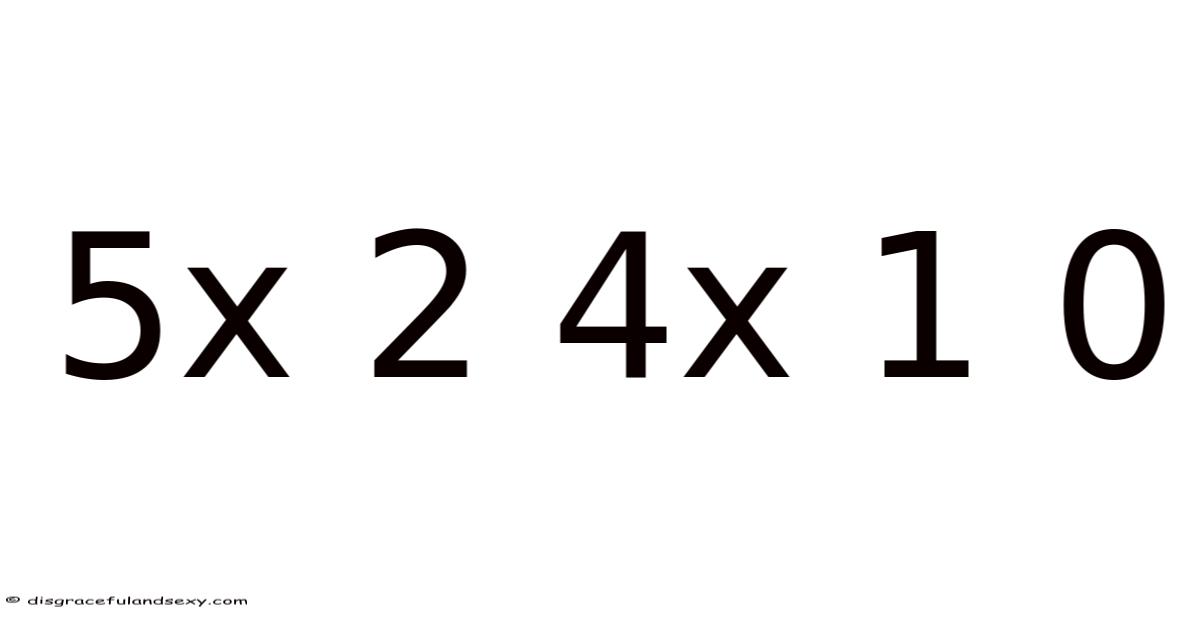
Decoding the Mystery: 5x 2 4x 1 0 and the Power of Pattern Recognition
This article breaks down the fascinating world of numerical patterns and problem-solving, focusing on the seemingly simple sequence: 5x 2 4x 1 0. Because of that, while it might look like a random collection of numbers and symbols, a deeper look reveals underlying logic and principles applicable to various fields, from mathematics and programming to cryptography and even music theory. We'll explore different interpretations, possible solutions, and the broader implications of pattern recognition in problem-solving.
And yeah — that's actually more nuanced than it sounds Not complicated — just consistent..
Understanding the Puzzle: Initial Observations
At first glance, "5x 2 4x 1 0" appears ambiguous. The presence of "x" suggests multiplication, but the lack of clear operators between the other numbers creates uncertainty. On top of that, this ambiguity is precisely what makes the puzzle engaging. Several interpretations are possible, each leading to a different solution and highlighting various problem-solving approaches Most people skip this — try not to..
Possible Interpretations:
-
Multiplication Sequence: One interpretation assumes that "x" represents multiplication throughout the sequence. This would lead to 5 multiplied by 2, then 4 multiplied by 1, and finally 0. The result would be a sequence of individual calculations: 10, 4, 0. Even so, this interpretation doesn't offer a continuous pattern or a single, unified answer Simple, but easy to overlook. Less friction, more output..
-
Alternating Operations: Another interpretation suggests an alternating sequence of operations. We could have multiplication followed by addition, subtraction, or another operation. Here's one way to look at it: (5 x 2) + 4 - 1 + 0 would yield 13. Still, without further information or context, this remains speculative Took long enough..
-
Hidden Codes or Ciphers: A more sophisticated interpretation involves considering the sequence as a potential code or cipher. The numbers could represent letters (e.g., A=1, B=2, etc.), symbols, or components of a larger, more complex system. The "x" might be a placeholder for a different operation or a delimiter. This approach requires a deeper analysis of potential coding systems Nothing fancy..
Exploring Mathematical Solutions and Patterns
Let's explore potential mathematical relationships that might tap into the meaning behind this sequence. While a single, definitive answer isn't immediately apparent, we can investigate various mathematical concepts that could be at play Nothing fancy..
1. Arithmetic Sequences: An arithmetic sequence is characterized by a constant difference between consecutive terms. This doesn't seem to apply directly to our sequence in its current form.
2. Geometric Sequences: A geometric sequence involves a constant ratio between consecutive terms. Again, this doesn't appear to be the case here without further manipulation.
3. Fibonacci-like Sequences: The Fibonacci sequence is a famous example of a recursive sequence where each term is the sum of the two preceding ones (e.g., 1, 1, 2, 3, 5, 8...). While not directly apparent, variations or modifications of the Fibonacci sequence could potentially generate similar patterns. We might explore sequences with different starting numbers or variations in the recursive rule.
4. Modular Arithmetic: Modular arithmetic involves operations within a specific range (modulo). Take this case: if we consider the sequence modulo 5, we get 0, 2, 4, 1, 0. This suggests potential cyclical behavior, though the significance of this cyclical pattern needs further investigation.
The Importance of Context and Additional Information
The key to unlocking the mystery of "5x 2 4x 1 0" lies in understanding the context in which this sequence appears. Without additional information, we're left with multiple interpretations and possibilities. Consider the following scenarios:
-
Mathematical Problem: If this sequence is part of a larger mathematical problem, the surrounding context would be crucial. This could include additional equations, instructions, or a specific mathematical concept to be applied.
-
Programming or Coding: In programming, this sequence could represent an array, a list, or part of an algorithm. The "x" could be a separator, a variable, or an operator within a larger program And that's really what it comes down to..
-
Cryptography: If this sequence is part of a cryptographic puzzle, then understanding the encryption or decryption method is essential. The "x" might represent a specific function or transformation within the cipher.
-
Real-world Application: The sequence could represent real-world data, such as measurements, coordinates, or some form of encoded information. The meaning would depend on the specific application or context.
Advanced Approaches: Numerical Analysis and Pattern Recognition
If the context remains unclear, we can explore more advanced techniques to analyze the numerical sequence and identify potential underlying patterns Not complicated — just consistent..
1. Data Transformation: We can apply various mathematical transformations to the sequence to reveal hidden patterns. This might involve logarithms, exponentials, or other mathematical functions.
2. Statistical Analysis: Statistical techniques could help identify trends, correlations, or other statistical properties within the sequence. This could reveal hidden relationships or patterns not readily apparent from a visual inspection.
3. Machine Learning: Advanced machine learning algorithms could be employed to analyze the sequence and predict potential future terms or patterns. This approach would require a larger dataset, possibly involving extensions or variations of the original sequence.
4. Symbolic Computation: Symbolic computation tools can be used to manipulate and analyze the sequence symbolically, allowing for the exploration of more abstract patterns and relationships that might not be easily captured through numerical analysis That's the whole idea..
FAQ: Frequently Asked Questions
Q1: Is there a single correct answer to the sequence "5x 2 4x 1 0"?
A1: No, without additional context or information, there isn't a single definitive answer. Multiple interpretations are possible, each leading to a different result.
Q2: What mathematical principles are relevant to understanding this sequence?
A2: Several mathematical principles could be relevant, including arithmetic and geometric sequences, Fibonacci-like sequences, modular arithmetic, and more advanced concepts in numerical analysis.
Q3: How can I improve my ability to solve such puzzles?
A3: Practice is key! Solving a variety of puzzles and mathematical problems will enhance your pattern recognition skills and your ability to approach problems from different angles. Familiarize yourself with various mathematical concepts and techniques.
Conclusion: The Power of Pattern Recognition and Critical Thinking
The sequence "5x 2 4x 1 0" serves as a fascinating illustration of the importance of pattern recognition and critical thinking in problem-solving. On top of that, the ambiguity of the sequence highlights how the absence of context can lead to multiple interpretations. On the flip side, by systematically exploring different approaches, applying various mathematical tools, and considering the potential context, we can gain valuable insights and broaden our understanding of numerical sequences and problem-solving techniques. The ultimate solution depends entirely on uncovering the hidden context or intended meaning behind the given sequence. The true value of this exercise lies in developing the ability to analyze patterns, formulate hypotheses, and critically assess the information available – skills that are invaluable across various disciplines. The puzzle, therefore, isn't just about finding a numerical answer, but about cultivating a sharper, more analytical mind Took long enough..
