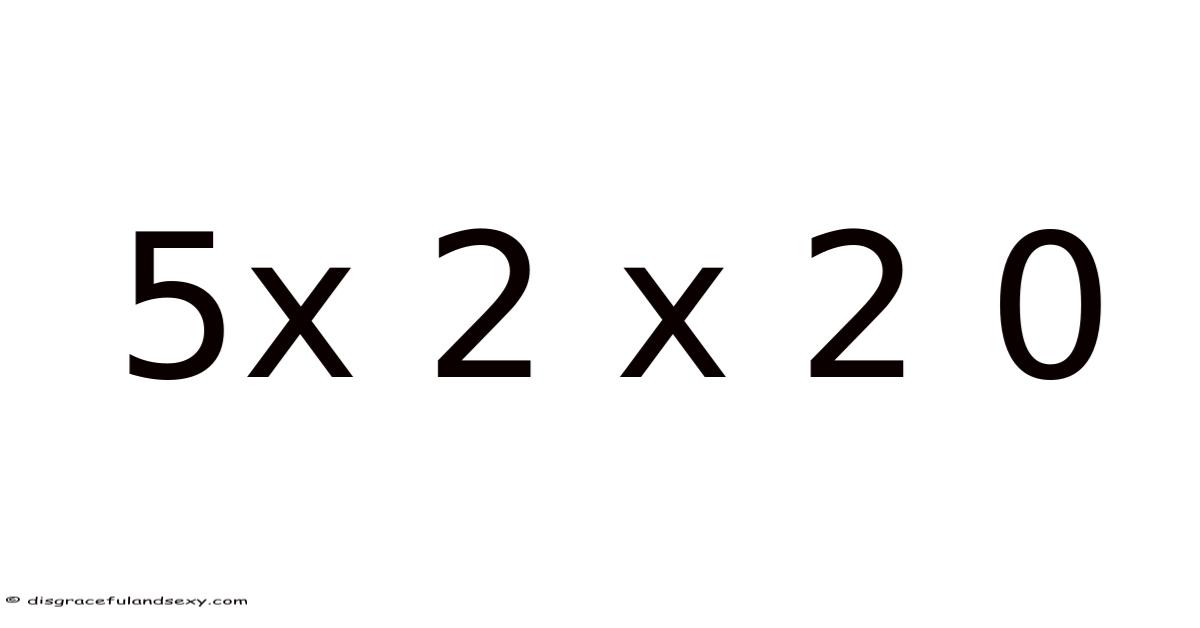
Decoding 5 x 2 x 2 x 0: A Deep Dive into the Mathematics of Zero
The seemingly simple expression "5 x 2 x 2 x 0" might appear trivial at first glance. Even so, it provides a powerful opportunity to explore fundamental concepts in arithmetic, specifically the profound impact of zero in multiplication. This article will not only solve the equation but will walk through the underlying mathematical principles, address common misconceptions, and explore the broader significance of zero in various mathematical contexts. Understanding this seemingly simple calculation unlocks a deeper appreciation for the elegance and power of mathematics Small thing, real impact. Nothing fancy..
Understanding the Basics: Multiplication and the Role of Zero
Before we tackle the equation directly, let's refresh our understanding of multiplication. Multiplication is essentially repeated addition. To give you an idea, 5 x 2 means adding 5 to itself two times (5 + 5 = 10). This concept extends to any number of factors The details matter here. Turns out it matters..
Now, let's introduce zero. That said, its role in multiplication is especially significant. Worth including here, it acts as an identity element (a number that, when added to another, leaves the other number unchanged). Zero, denoted as 0, is a unique number with several crucial properties. The multiplicative property of zero states that any number multiplied by zero equals zero. This is a fundamental principle that underpins many mathematical operations and concepts Turns out it matters..
Solving the Equation: 5 x 2 x 2 x 0
Now, let's apply these principles to the equation: 5 x 2 x 2 x 0. We can solve this equation in a few ways:
-
Method 1: Step-by-step calculation: We can perform the multiplication sequentially. First, 5 x 2 = 10. Then, 10 x 2 = 20. Finally, 20 x 0 = 0 Still holds up..
-
Method 2: The Power of Zero: Because of the multiplicative property of zero, we can immediately recognize that any number multiplied by zero will result in zero. That's why, regardless of the values of the other numbers (5, 2, and 2), the final answer will always be 0. This method highlights the efficiency of understanding the properties of zero.
So, the solution to the equation 5 x 2 x 2 x 0 is definitively 0.
The Significance of Zero: A Historical and Mathematical Perspective
Zero's role in mathematics is far more significant than its simple presence as a placeholder suggests. Its discovery and adoption represent a landmark achievement in the history of mathematics.
-
Ancient Civilizations: While the concept of "nothing" existed in various ancient cultures, the formal representation and understanding of zero as a number took time to develop. Ancient Babylonian and Mayan civilizations used place-value systems that implicitly acknowledged zero's significance, but the concept wasn't fully integrated into their number systems in the same way it is in ours.
-
The Indian Contribution: The development of the concept of zero as a number, as we understand it today, is largely attributed to Indian mathematicians around the 5th century CE. Brahmagupta's work explicitly defined zero and its properties, including its role in arithmetic operations.
-
Global Impact: The concept of zero, along with the decimal number system (which relies heavily on zero), spread from India through the Middle East and eventually to Europe. This transmission fundamentally changed the landscape of mathematics, paving the way for advancements in algebra, calculus, and many other branches of the field.
Without zero, our modern number system would be vastly different and significantly less efficient. Complex calculations, algebraic manipulations, and even the development of modern computing would be inconceivable.
Beyond Arithmetic: Zero's Role in Other Mathematical Contexts
Zero's impact extends far beyond basic arithmetic. It matters a lot in various other mathematical domains:
-
Algebra: In algebra, zero is crucial in solving equations. Here's a good example: solving the equation x + 5 = 5 leads to x = 0. Zero also acts as an identity element in addition, meaning a + 0 = a for any number 'a'.
-
Calculus: In calculus, the concept of limits often involves approaching zero. Derivatives and integrals use the concept of infinitesimally small changes, which are often represented as approaching zero.
-
Set Theory: In set theory, the empty set (a set containing no elements) is often represented by the symbol ∅, and it is analogous to zero in its properties.
-
Linear Algebra: The zero vector in linear algebra is a vector with all components equal to zero, and it plays a vital role in vector spaces and matrix operations That's the whole idea..
-
Complex Numbers: The complex number system includes zero, which acts as the additive identity and has a unique role in complex analysis Easy to understand, harder to ignore. Less friction, more output..
Addressing Common Misconceptions about Zero
Several common misconceptions surround zero, which are worth clarifying:
-
Zero is not "nothing": While zero represents the absence of quantity, it is a number in its own right and has well-defined mathematical properties. It's not simply a placeholder; it's a fundamental element of our number system.
-
Division by zero is undefined: This is a crucial point. Unlike multiplication, division by zero is not defined within the standard number system. It leads to inconsistencies and paradoxes, making it an undefined operation Which is the point..
-
Zero is neither positive nor negative: Zero sits precisely between positive and negative numbers on the number line, serving as a boundary between them.
Frequently Asked Questions (FAQs)
Q: Why is anything multiplied by zero equal to zero?
A: This stems from the definition of multiplication as repeated addition. If you add a number zero times, you haven't added anything, resulting in a sum of zero.
Q: What happens if you add zero to a number?
A: Adding zero to a number leaves the number unchanged. This is the additive identity property of zero Simple as that..
Q: What is the difference between zero and nothing?
A: Zero is a number representing the absence of quantity, while "nothing" is a more general philosophical concept that doesn't necessarily have a mathematical representation. Zero is a specific mathematical entity with well-defined properties Simple, but easy to overlook. Which is the point..
Q: Can zero be a significant figure?
A: Yes, the significance of zero depends on its placement in a number. g., in 1., in 0.005) are not significant, whereas trailing zeros after a decimal point (e.g.Leading zeros (e.00) are significant, indicating precision. Zeros between non-zero digits are also significant And that's really what it comes down to. That's the whole idea..
Q: Is zero an even number?
A: Yes, zero is considered an even number because it's divisible by 2 (0/2 = 0).
Conclusion: The Unsung Hero of Mathematics
To wrap this up, the seemingly simple equation 5 x 2 x 2 x 0 highlights the fundamental and far-reaching impact of zero in mathematics. It's not just a placeholder or a symbol for "nothing"; it's a crucial number with unique properties that have profoundly shaped the development and application of mathematics throughout history. Here's the thing — from basic arithmetic to advanced calculus and beyond, zero is an essential component of our mathematical framework, a testament to its power and elegance. Understanding its properties is fundamental to grasping the deeper concepts and intricacies of mathematics as a whole. The next time you encounter zero in an equation, remember its rich history and profound significance beyond its simple appearance.
