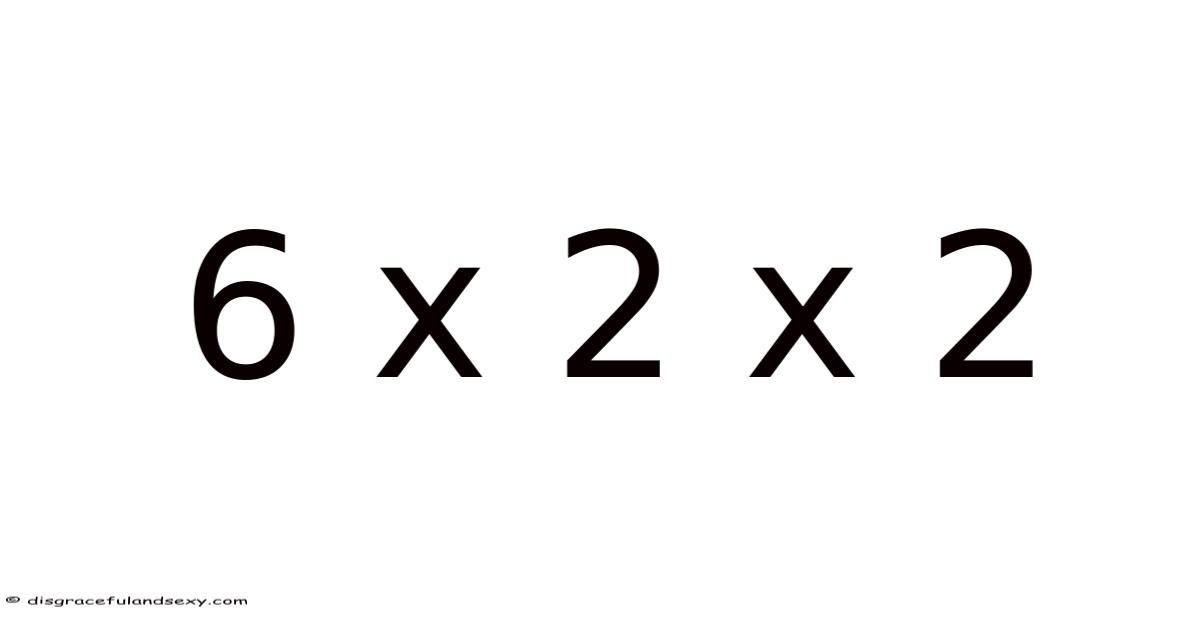
Decoding 6 x 2 x 2: A Deep Dive into Multiplication, Volume, and Beyond
This article explores the seemingly simple calculation of 6 x 2 x 2, delving far beyond the immediate answer of 24. We'll uncover its relevance in various mathematical contexts, from basic arithmetic to more complex concepts like volume calculation and combinatorial analysis. This exploration will illuminate the underlying principles of multiplication and its applications in the real world, making it suitable for learners of all levels Simple, but easy to overlook..
Understanding the Fundamentals: Multiplication
Before diving into 6 x 2 x 2, let's refresh our understanding of multiplication. Practically speaking, this simple concept forms the bedrock for more complex mathematical operations. In real terms, the numbers in a multiplication problem have specific names: the numbers being multiplied are called factors, and the result is called the product. Multiplication is a fundamental arithmetic operation representing repeated addition. Now, for example, 6 x 2 means adding six 'twos' together: 2 + 2 + 2 + 2 + 2 + 2 = 12. In 6 x 2, 6 and 2 are the factors, and 12 is the product Less friction, more output..
The commutative property of multiplication states that the order of the factors doesn't change the product. This means 6 x 2 is the same as 2 x 6. The associative property allows us to group factors in different ways without altering the final product. Day to day, this property simplifies many calculations and is crucial for understanding more complex mathematical ideas. As an example, (6 x 2) x 2 is equal to 6 x (2 x 2) Small thing, real impact..
Calculating 6 x 2 x 2: A Step-by-Step Approach
Now, let's tackle 6 x 2 x 2. Using the associative property, we can simplify the calculation in several ways:
-
Method 1: Left to Right: We can perform the multiplication from left to right: (6 x 2) x 2 = 12 x 2 = 24.
-
Method 2: Right to Left: Alternatively, we can start from the right: 6 x (2 x 2) = 6 x 4 = 24 It's one of those things that adds up..
-
Method 3: Grouping Strategically: We can choose any grouping that simplifies the calculation. Both methods above demonstrate this Not complicated — just consistent..
Regardless of the approach, the product remains consistent: 24. This simple calculation highlights the power and flexibility of the associative property in multiplication It's one of those things that adds up..
Real-World Applications: Volume and Measurement
The calculation 6 x 2 x 2 has direct applications in various real-world scenarios, most notably in calculating volume. So imagine a rectangular prism, such as a box or a room. The volume of a rectangular prism is given by the formula: Volume = Length x Width x Height.
If we have a box with a length of 6 units, a width of 2 units, and a height of 2 units, the volume would be calculated as 6 x 2 x 2 = 24 cubic units. This calculation is fundamental in various fields, including:
-
Packaging and Shipping: Determining the size and capacity of shipping containers Worth knowing..
-
Construction and Engineering: Calculating the volume of materials needed for construction projects.
-
Manufacturing: Designing products and their packaging And it works..
-
Science: Measuring the volume of liquids or solids.
Expanding the Concept: Combinatorics and Probability
Beyond its application in calculating volumes, 6 x 2 x 2 has connections to combinatorics and probability. Let’s explore a scenario:
Suppose you have 6 shirts, 2 pairs of pants, and 2 pairs of shoes. To find the total number of combinations, we multiply the number of choices for each item: 6 x 2 x 2 = 24. Because of that, how many different outfits can you create? This illustrates the fundamental counting principle in combinatorics, where the total number of possibilities is the product of the number of choices for each independent event Worth keeping that in mind..
This principle extends to more complex scenarios in probability and statistics, helping to determine the likelihood of specific outcomes in various experiments or events.
Beyond the Numbers: Mathematical Thinking
The seemingly simple calculation of 6 x 2 x 2 provides a gateway to explore more profound mathematical concepts. Here are some key takeaways:
-
Order of Operations: While the commutative and associative properties allow for flexibility, understanding the order of operations (PEMDAS/BODMAS) is crucial when dealing with more complex expressions involving multiple operations Worth knowing..
-
Algebraic Representation: The calculation can be represented algebraically as: x = 6 * y * z, where x is the product, and y and z represent the factors. This allows for the exploration of various values and relationships between the variables But it adds up..
-
Geometric Interpretation: As demonstrated with the volume calculation, the equation has a geometric interpretation, representing the volume of a three-dimensional object Took long enough..
-
Developing Number Sense: Repeated practice with calculations like this builds number sense and improves mental arithmetic skills.
Frequently Asked Questions (FAQ)
Q1: What is the prime factorization of 24?
A1: The prime factorization of 24 is 2 x 2 x 2 x 3. This means 24 can be expressed as the product of its prime factors (numbers divisible only by 1 and themselves).
Q2: How can I use this calculation in everyday life?
A2: The calculation is useful in various everyday situations, from determining the volume of a container to calculating the number of possible combinations of clothing items Nothing fancy..
Q3: Are there other ways to represent 6 x 2 x 2?
A3: Yes, it can be represented as 6 * 2 * 2, 6(2)(2), or even as 2³ * 3 (using exponents and prime factorization) Less friction, more output..
Q4: What if one of the numbers was a decimal or fraction?
A4: The same principles apply. Here's the thing — you would perform the multiplication using the same methods, but the result would be a decimal or fraction, reflecting the input values. To give you an idea, 6 x 2.5 x 2 = 30 Worth knowing..
Conclusion: More Than Just a Calculation
The seemingly simple calculation of 6 x 2 x 2 opens doors to a broader understanding of mathematical principles and their real-world applications. Understanding this seemingly simple calculation empowers us to approach more complex mathematical challenges with confidence and a deeper appreciation for the elegance and practicality of mathematics. That said, the key takeaway is not just the answer (24), but the journey of understanding the underlying concepts and their wider implications. From basic arithmetic operations to volume calculations and combinatorial analysis, this equation reveals the interconnectedness of mathematical concepts and their power in solving problems and modeling real-world scenarios. Continue exploring, and you'll discover even more hidden depths within this seemingly simple equation.
