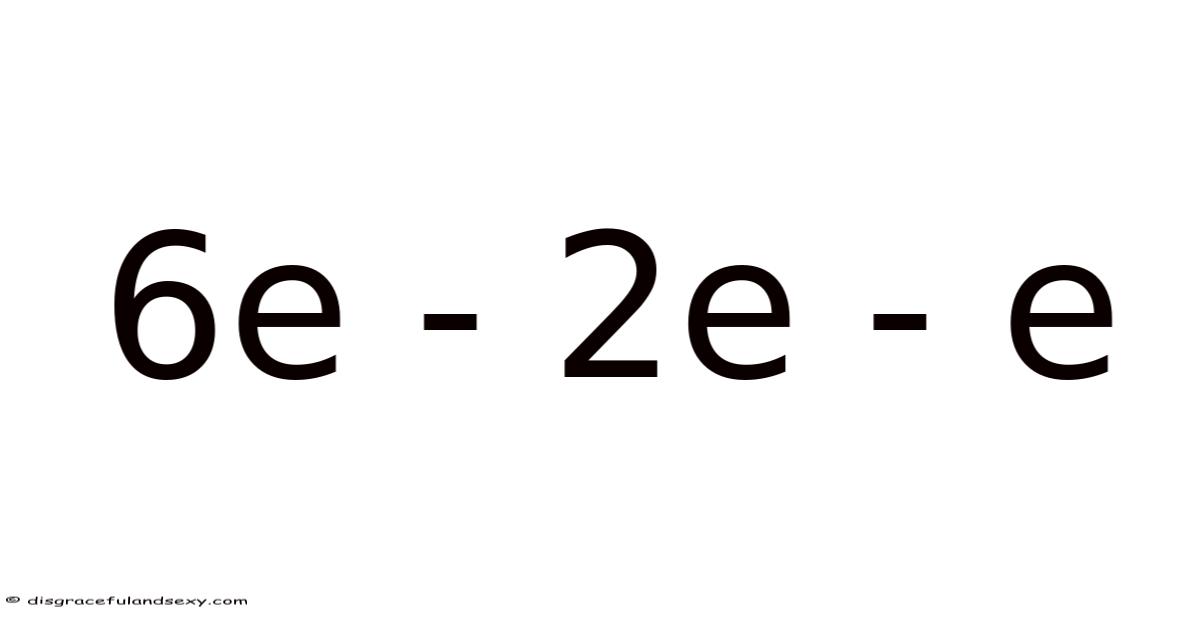
Decoding the Mystery: A Deep Dive into 6e - 2e - e
This article looks at the mathematical expression "6e - 2e - e," exploring its simplification, applications, and broader implications within the context of algebraic manipulation. Understanding this seemingly simple equation provides a foundational understanding of essential algebraic principles, applicable across numerous scientific and engineering disciplines. We'll unravel this expression step-by-step, clarifying common points of confusion and broadening your understanding of exponential notation and algebraic operations.
Understanding Exponential Notation: The "e" Factor
Before tackling the expression, let's establish a solid grasp of the "e" we're dealing with. That said, 71828. Unlike other numbers you might encounter, 'e' is not a result of a specific calculation but arises naturally within numerous mathematical contexts. In this context, "e" represents Euler's number, an irrational mathematical constant approximately equal to 2.That said, it's a fundamental constant in mathematics, appearing in various areas like calculus, complex analysis, and probability theory. Its unique properties make it crucial for describing exponential growth and decay. Understanding its role is key to comprehending our expression Surprisingly effective..
Step-by-Step Simplification: Solving 6e - 2e - e
The beauty of algebraic expressions like "6e - 2e - e" lies in their straightforward simplification. So we can treat "e" as a variable, just like 'x' or 'y'. This allows us to apply basic algebraic principles to solve the equation.
Step 1: Combining like terms. We have three terms involving "e": 6e, -2e, and -e. Since they share the same variable, we can combine them through addition and subtraction.
Step 2: Performing the addition and subtraction. This involves adding and subtracting the coefficients (the numbers in front of "e").
- 6e - 2e = 4e
- 4e - e = 3e
That's why, the simplified form of 6e - 2e - e is 3e.
Beyond Simplification: The Broader Context
While the simplification itself seems trivial, understanding the underlying principles allows us to tackle more complex algebraic problems. That's why the process of combining like terms is fundamental to algebra. Mastering this skill builds a strong foundation for manipulating equations involving multiple variables and terms Worth knowing..
We're talking about the bit that actually matters in practice.
-
Solving equations: The ability to simplify expressions like "6e - 2e - e" is crucial for solving more complex equations. Imagine an equation where "3e" is part of a larger expression; being able to simplify this portion streamlines the entire solving process Took long enough..
-
Calculus: Euler's number, "e," has a real impact in calculus, specifically in the context of exponential functions and their derivatives and integrals. Understanding the manipulation of "e" in simpler algebraic contexts prepares you for the more advanced applications in calculus It's one of those things that adds up..
-
Exponential Growth and Decay: The constant "e" is intrinsically linked to models describing exponential growth or decay. Many real-world phenomena, from population growth to radioactive decay, work with exponential functions incorporating "e." Understanding the basic algebraic manipulation of "e" is fundamental to grasping and interpreting these models.
-
Financial Mathematics: Exponential functions, particularly those involving "e," underpin many calculations in finance. Compound interest, for instance, often involves exponential growth described using Euler's number. A solid understanding of manipulating expressions with "e" is beneficial in financial modeling and analysis.
Illustrative Examples: Practical Applications
Let's explore some practical scenarios where understanding the simplification of "6e - 2e - e" can be valuable.
Example 1: Calculating Population Growth
Imagine a population of bacteria growing exponentially. By simplifying this equation to P(t) = 3e<sup>t</sup>, we've made the equation far more manageable for analysis and prediction. The population at time 't' might be modeled by the equation P(t) = 6e<sup>t</sup> - 2e<sup>t</sup> - e<sup>t</sup>. This simplification allows for easier calculation of the population at specific times Worth keeping that in mind..
Example 2: Analyzing Radioactive Decay
In radioactive decay, the amount of a substance remaining after time 't' can often be expressed using an exponential function involving "e". Practically speaking, an equation might look like this: A(t) = 6e<sup>-kt</sup> - 2e<sup>-kt</sup> - e<sup>-kt</sup>, where 'k' is a decay constant. Simplifying to A(t) = 3e<sup>-kt</sup> significantly eases the calculation of the remaining amount at a given time.
The official docs gloss over this. That's a mistake.
Example 3: Financial Modeling
Suppose you're modeling compound interest. And the accumulated amount 'A' after 't' years, with principal 'P', interest rate 'r', and compounding 'n' times per year might be expressed: A = 6Pe<sup>(r/n)t</sup> - 2Pe<sup>(r/n)t</sup> - Pe<sup>(r/n)t</sup>. Simplifying this to A = 3Pe<sup>(r/n)t</sup> gives a more efficient formula for calculating the future value of an investment.
Addressing Potential Confusion: FAQs
Q1: Can "e" be treated as a variable like "x"?
A1: Yes, in the context of algebraic simplification, "e" can be treated as a variable. That said, make sure to remember that "e" also holds a specific numerical value (approximately 2.71828) Simple, but easy to overlook. That's the whole idea..
Q2: What if the expression involved different powers of "e", like 6e² - 2e - e?
A2: In this case, you cannot combine the terms directly because they have different powers of "e." Simplification would not be as straightforward and might involve factoring or other algebraic techniques. You can only combine terms with identical powers of "e".
Q3: Why is it important to simplify algebraic expressions?
A3: Simplifying makes equations more manageable and easier to work with. It reduces errors and facilitates solving more complex problems. Simplified equations are often more efficient for calculations and analysis It's one of those things that adds up..
Q4: Are there other common mathematical constants besides "e"?
A4: Yes, other important mathematical constants include π (pi), approximately 3.14159, which represents the ratio of a circle's circumference to its diameter; and i (the imaginary unit), √(-1), which is essential in complex numbers Turns out it matters..
Conclusion: Mastering the Fundamentals
The simplification of "6e - 2e - e" to "3e," while seemingly basic, lays a crucial foundation for understanding more advanced mathematical concepts. By mastering the basic principles illustrated here, you'll be better equipped to tackle increasingly complex mathematical problems in various disciplines. Remember, the journey to mathematical proficiency is built upon mastering the fundamentals, and this simple expression offers a powerful starting point. Now, this process demonstrates the importance of combining like terms, a fundamental algebraic skill. Adding to this, it underscores the significance of Euler's number ("e") in various fields. From population growth models to sophisticated financial calculations, the ability to manipulate expressions involving "e" provides a crucial skillset for understanding and solving real-world problems Worth knowing..
