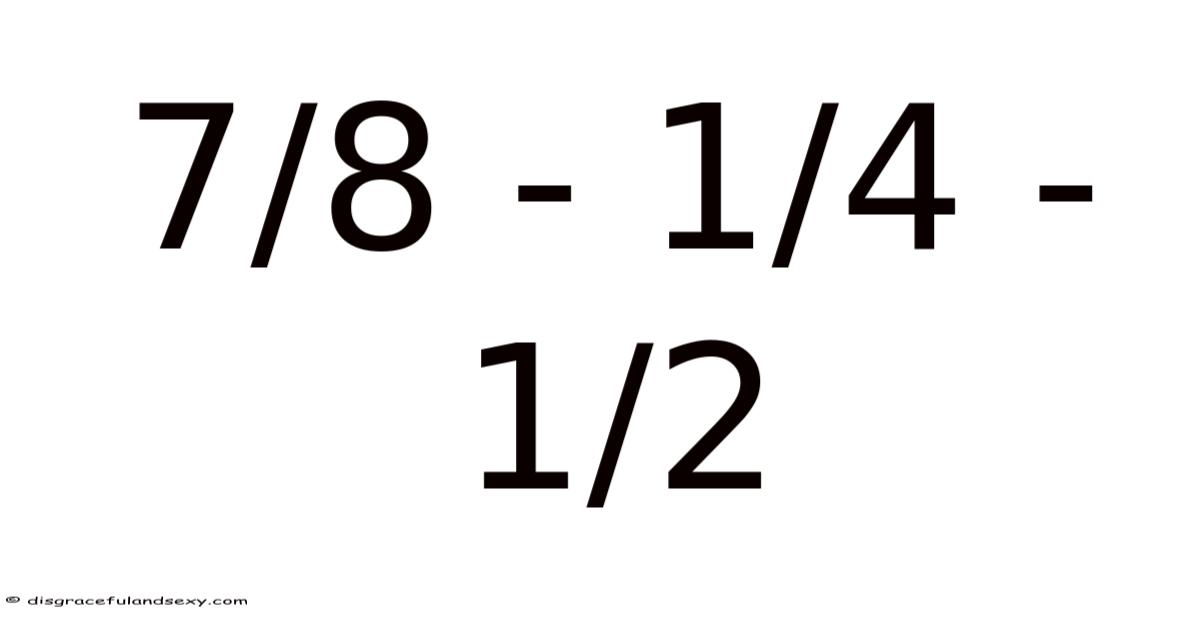
Unlocking the Mystery of 7/8 - 1/4 - 1/2: A Deep Dive into Fraction Subtraction
This article explores the seemingly simple yet surprisingly multifaceted problem of subtracting fractions: 7/8 - 1/4 - 1/2. We'll break down the process step-by-step, clarifying common misconceptions and providing a solid understanding of fraction operations. This guide is perfect for anyone needing a refresher on fraction arithmetic, from elementary school students to adults looking to improve their mathematical skills. Understanding fraction subtraction is crucial for various applications, from baking and sewing to advanced mathematical concepts That alone is useful..
Not obvious, but once you see it — you'll see it everywhere.
Introduction to Fraction Subtraction
Subtracting fractions might seem daunting at first, but it's a straightforward process once you understand the fundamental principles. Now, the key lies in finding a common denominator, a shared multiple of the denominators of all the fractions involved. This common denominator allows us to express all the fractions in terms of the same unit, making subtraction as easy as subtracting whole numbers.
Let's revisit our initial problem: 7/8 - 1/4 - 1/2. Before we dive into the solution, let's quickly review some key concepts:
- Numerator: The top number in a fraction, indicating the number of parts we have.
- Denominator: The bottom number in a fraction, indicating the total number of equal parts in a whole.
- Common Denominator: A number that is a multiple of all the denominators in a set of fractions.
Finding the Least Common Denominator (LCD)
The first step in solving 7/8 - 1/4 - 1/2 is to identify the least common denominator (LCD) of 8, 4, and 2. The LCD is the smallest number that is divisible by all three denominators.
One method to find the LCD is to list the multiples of each denominator:
- Multiples of 8: 8, 16, 24, 32...
- Multiples of 4: 4, 8, 12, 16, 20...
- Multiples of 2: 2, 4, 6, 8, 10...
Notice that 8 is the smallest number that appears in all three lists. That's why, the LCD of 8, 4, and 2 is 8 Surprisingly effective..
Another, more efficient method is to find the prime factorization of each denominator:
- 8 = 2 x 2 x 2 = 2³
- 4 = 2 x 2 = 2²
- 2 = 2
To find the LCD, take the highest power of each prime factor present in the factorizations: The only prime factor is 2, and its highest power is 2³. Which means, the LCD is 2³ = 8 And that's really what it comes down to..
Converting Fractions to the Common Denominator
Now that we've found the LCD (8), we need to convert each fraction so that its denominator is 8.
-
7/8: This fraction already has a denominator of 8, so it remains unchanged No workaround needed..
-
1/4: To convert 1/4 to a fraction with a denominator of 8, we multiply both the numerator and the denominator by 2: (1 x 2) / (4 x 2) = 2/8
-
1/2: To convert 1/2 to a fraction with a denominator of 8, we multiply both the numerator and the denominator by 4: (1 x 4) / (2 x 4) = 4/8
Performing the Subtraction
With all fractions now having a common denominator of 8, we can perform the subtraction:
7/8 - 2/8 - 4/8
Since the denominators are the same, we simply subtract the numerators:
(7 - 2 - 4) / 8 = 1/8
Because of this, the solution to 7/8 - 1/4 - 1/2 is 1/8 Simple, but easy to overlook..
Visualizing Fraction Subtraction
Visualizing fractions can significantly aid understanding. Imagine a pizza cut into 8 equal slices.
- 7/8 represents 7 slices of the pizza.
- 1/4 represents 2 slices (half of 1/2).
- 1/2 represents 4 slices (half of the pizza).
Subtracting these slices from the initial 7 slices leaves us with only 1 slice, which represents 1/8 of the pizza The details matter here..
Addressing Common Mistakes
Several common mistakes can arise when subtracting fractions:
-
Incorrectly identifying the LCD: Failing to find the correct LCD will lead to an incorrect answer. Always double-check your work Simple, but easy to overlook. Surprisingly effective..
-
Forgetting to convert all fractions to the common denominator: Each fraction must be expressed with the LCD before subtraction can be performed The details matter here..
-
Incorrectly subtracting the numerators: Remember to only subtract the numerators once the denominators are the same.
-
Simplifying incorrectly: Always simplify the final fraction to its lowest terms if possible. In our example, 1/8 is already in its simplest form.
Expanding on Fraction Subtraction: More Complex Scenarios
While the initial problem was relatively straightforward, let's explore more complex scenarios involving fraction subtraction.
Consider the following problem: 5/6 - 1/3 - 1/2 + 1/4 Took long enough..
-
Find the LCD: The LCD of 6, 3, 2, and 4 is 12.
-
Convert fractions to the LCD:
- 5/6 = 10/12
- 1/3 = 4/12
- 1/2 = 6/12
- 1/4 = 3/12
-
Perform the subtraction: 10/12 - 4/12 - 6/12 + 3/12 = 3/12
-
Simplify: 3/12 simplifies to 1/4. Because of this, the answer is 1/4 Worth knowing..
Practical Applications of Fraction Subtraction
Understanding fraction subtraction is vital in various real-world contexts:
-
Cooking and Baking: Adjusting recipes, measuring ingredients accurately.
-
Sewing and Tailoring: Calculating fabric requirements, adjusting patterns.
-
Construction and Engineering: Precise measurements, material calculations And that's really what it comes down to..
-
Finance: Calculating discounts, portions of payments.
-
Data Analysis: Working with proportions and percentages.
These applications highlight the importance of mastering fraction arithmetic for everyday life and professional success.
Frequently Asked Questions (FAQ)
Q: What if the denominators have no common factors?
A: If the denominators have no common factors, the LCD is simply the product of the denominators. As an example, if you were subtracting 1/3 and 1/5, the LCD would be 15 (3 x 5).
Q: Can I use decimals instead of fractions?
A: You can convert fractions to decimals before subtracting, but this might introduce rounding errors, particularly if you deal with recurring decimals. Working with fractions directly offers greater accuracy.
Q: What if I have mixed numbers?
A: Convert mixed numbers (like 2 1/2) to improper fractions (like 5/2) before performing the subtraction.
Conclusion: Mastering Fraction Subtraction
Subtracting fractions, though initially challenging, becomes manageable with a clear understanding of the underlying principles. Don't be afraid to break down complex problems into smaller, manageable steps, and always double-check your work. In real terms, by consistently following the steps outlined – finding the LCD, converting fractions, performing the subtraction, and simplifying the result – you can confidently tackle even complex fraction subtraction problems. On the flip side, remember, practice is key to mastering this fundamental mathematical skill, opening doors to numerous real-world applications and further mathematical explorations. With persistence and patience, you'll soon be a fraction subtraction expert!
