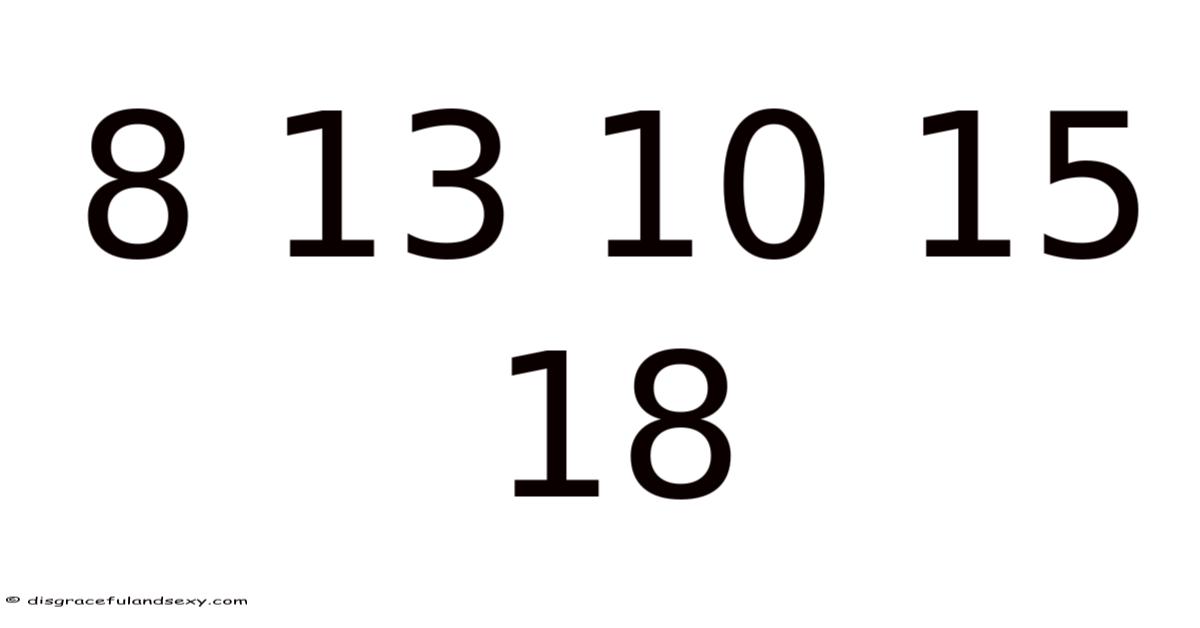
Unraveling the Mystery: The Significance of the Sequence 8 13 10 15 18
The sequence 8, 13, 10, 15, 18... might seem like a random collection of numbers at first glance. That said, a deeper dive reveals a fascinating pattern and opens up avenues for exploring various mathematical concepts, including sequences, series, and potential applications in cryptography or coding. This article will explore this seemingly simple sequence, uncovering its underlying structure, examining potential patterns, and discussing possible extensions and interpretations. Understanding this sequence can provide valuable insights into mathematical thinking and problem-solving.
Understanding the Pattern: Identifying the Underlying Logic
The initial challenge lies in identifying the pattern governing the sequence 8, 13, 10, 15, 18. Simple arithmetic progressions (adding a constant value) or geometric progressions (multiplying by a constant value) don't immediately apply. A cursory observation might lead to dead ends. The key lies in recognizing that this sequence might be composed of interwoven or alternating sub-sequences.
Some disagree here. Fair enough.
Let's break it down:
-
Analyzing the Odd-Positioned Numbers: Examining the odd-positioned numbers (8, 10, 18), we see a less obvious pattern. The difference between 8 and 10 is 2, and the difference between 10 and 18 is 8. This doesn't immediately reveal a straightforward pattern.
-
Analyzing the Even-Positioned Numbers: Now, let's analyze the even-positioned numbers (13, 15). Here, the difference is a consistent 2. This suggests a simple arithmetic progression within this subset of the sequence It's one of those things that adds up..
-
Combining the Observations: This difference in pattern behavior between odd and even positions hints at a more complex structure. The sequence might be built from two interwoven sequences, each following its own rule. That said, without more terms, definitively identifying the rule governing the odd-numbered positions remains challenging. We need more data to confirm or refute possible hypotheses.
Extending the Sequence: Hypothetical Patterns and Possibilities
The limited number of terms in the original sequence (8, 13, 10, 15, 18) makes definitive conclusion challenging. To explore further, let's hypothesize about possible extensions and the rules governing them. We can explore several scenarios:
Scenario 1: Alternating Arithmetic Progressions
This scenario assumes two separate arithmetic progressions interwoven Took long enough..
-
Sequence A (Odd Positions): This sequence might follow a more complex rule, possibly involving a changing common difference. Without more data, we can only speculate. Take this: it could be based on the Fibonacci sequence or some other recursively defined pattern Worth keeping that in mind..
-
Sequence B (Even Positions): This sequence clearly follows an arithmetic progression with a common difference of 2. Because of this, we can confidently extend this sequence: 13, 15, 17, 19, 21...
Scenario 2: A Single, More Complex Rule
It’s also possible that a single, more complex mathematical function governs the entire sequence. Even so, this function could involve modulo operations, or recursive relationships making it more difficult to unravel. Without further terms or a hint about the underlying mathematical structure, this remains purely speculative Nothing fancy..
Mathematical Concepts Involved: Sequences, Series, and Beyond
This seemingly simple sequence touches upon several important mathematical concepts:
-
Sequences: A sequence is an ordered list of numbers or objects. The sequence 8, 13, 10, 15, 18 is a finite sequence, meaning it has a limited number of terms. Infinite sequences extend indefinitely.
-
Series: A series is the sum of the terms in a sequence. While we haven't explored summing the terms of this specific sequence, the concept is relevant. The sum of the sequence would be 8 + 13 + 10 + 15 + 18 = 64 Practical, not theoretical..
-
Arithmetic Progressions: This type of sequence is characterized by a constant difference between consecutive terms. The even-numbered terms in our sequence (13, 15, 17... if extended) are an example of an arithmetic progression.
-
Geometric Progressions: These sequences involve multiplying each term by a constant value to get the next term. Our sequence doesn't appear to be a geometric progression Simple as that..
-
Recursive Sequences: These sequences are defined by a rule that relates each term to one or more preceding terms. The Fibonacci sequence is a classic example. The odd-numbered sequence might be a recursive sequence, but we lack sufficient information to confirm this.
-
Modulo Arithmetic: Modulo operations involve finding the remainder after division. This type of operation might be involved in a more complex underlying rule, but we cannot confirm this without further data Not complicated — just consistent..
Potential Applications: Cryptography and Coding
While the presented sequence doesn't have immediately obvious applications in cryptography or coding in its current form, the principles involved are relevant to these fields. Understanding how to identify patterns and construct complex sequences is crucial in designing encryption algorithms and creating secure codes. Sequences form the basis of many cryptographic techniques, and the ability to create and analyze sequences with hidden patterns is a valuable skill.
Frequently Asked Questions (FAQ)
Q: Is there a definitive answer to the pattern in the sequence 8, 13, 10, 15, 18?
A: No, not with only five terms. Several hypotheses are possible, but without more data points, we cannot definitively identify the underlying rule. The sequence could follow alternating arithmetic progressions, a single, more complex function, or even a completely different pattern not yet identified.
Q: Can this sequence be extended infinitely?
A: Theoretically, yes, but only by making assumptions about the governing rule. Each assumption would lead to a different extension. Without knowing the true underlying pattern, any extension is speculative.
Q: What mathematical concepts are most relevant to understanding this sequence?
A: The concepts of sequences, series, arithmetic progressions, and potentially recursive sequences are most relevant. More complex concepts like modulo arithmetic might also be involved, but are difficult to confirm without more data Simple, but easy to overlook..
Conclusion: The Importance of Observation and Hypothesis Testing
The sequence 8, 13, 10, 15, 18 serves as a compelling example of the importance of careful observation and hypothesis testing in mathematics. While a simple answer might seem elusive at first, exploring the possibilities and considering different approaches sheds light on fundamental mathematical principles. In practice, the limited length of the sequence makes a definitive solution impossible without additional data. Still, the exercise of analyzing this sequence demonstrates valuable problem-solving strategies applicable across various mathematical and computational fields. Think about it: the exploration reinforces the need for rigorous investigation and the understanding that apparent randomness might mask underlying structure and order. Further terms in the sequence would allow for a more definitive and conclusive analysis Which is the point..
