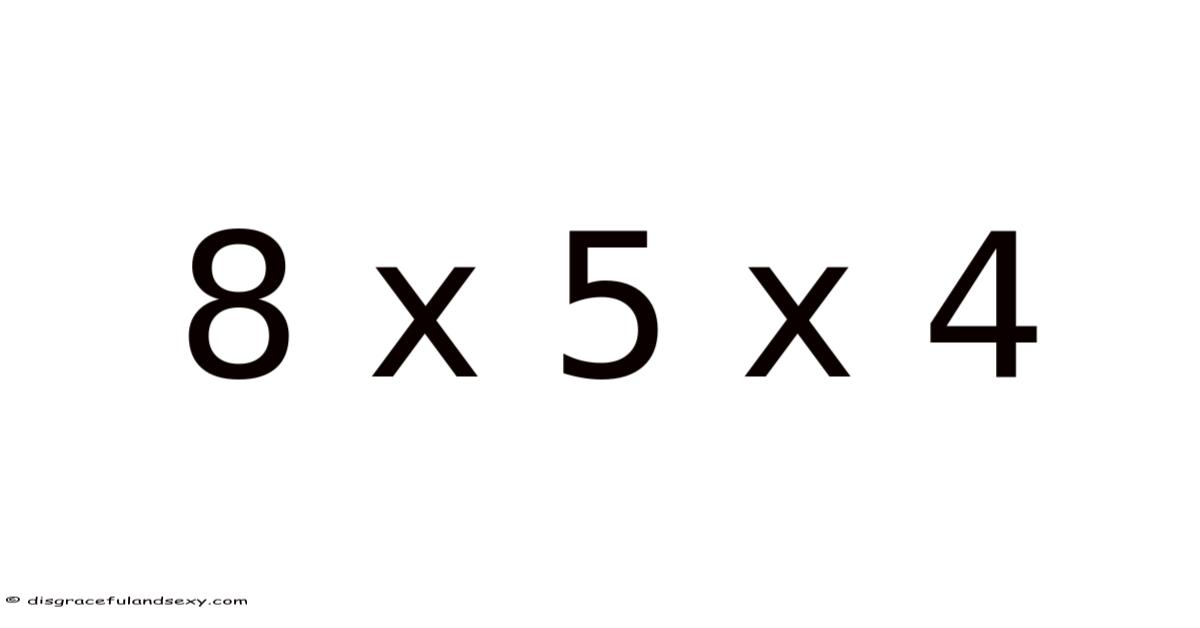
Exploring the Mathematical Landscape of 8 x 5 x 4: Beyond the Simple Calculation
This article looks at the seemingly simple calculation of 8 x 5 x 4, exploring its mathematical implications beyond the basic arithmetic answer. Here's the thing — we'll unpack the fundamental concepts involved, examine different approaches to solving the problem, and discuss its relevance within broader mathematical contexts. Understanding this seemingly straightforward equation opens doors to a deeper appreciation of multiplication, volume calculations, and even combinatorial analysis. Let's embark on this mathematical journey together!
Understanding the Basics: Multiplication and its Properties
At its core, 8 x 5 x 4 is a multiplication problem. Multiplication is a fundamental arithmetic operation that represents repeated addition. In this case, we are essentially adding eight groups of five, and then multiplying that result by four.
-
Commutative Property: This property states that the order of the numbers in a multiplication problem doesn't affect the result. Which means, 8 x 5 x 4 is equal to 5 x 8 x 4, 4 x 5 x 8, and so on. This flexibility allows us to choose the most efficient order for calculation No workaround needed..
-
Associative Property: This allows us to group numbers in different ways without altering the result. As an example, (8 x 5) x 4 is the same as 8 x (5 x 4). This property proves extremely useful when dealing with larger multiplication problems.
-
Distributive Property: This property is essential when dealing with multiplication involving addition or subtraction. It states that a number multiplied by a sum or difference is equal to the sum or difference of the products. Here's a good example: 8 x (5 + 4) = (8 x 5) + (8 x 4) Not complicated — just consistent. Practical, not theoretical..
Calculating 8 x 5 x 4: Different Approaches
Several approaches can be used to solve 8 x 5 x 4. Let's explore some of them:
1. Step-by-Step Multiplication:
It's the most straightforward method. Think about it: first, multiply 8 by 5, resulting in 40. Then, multiply 40 by 4, resulting in 160. This method is easily understood and ideal for beginners.
2. Using the Commutative and Associative Properties:
Rearranging the numbers can simplify the calculation. To give you an idea, we can group 5 and 4 together: 8 x (5 x 4) = 8 x 20 = 160. This method reduces the complexity of the calculation Took long enough..
3. Mental Math Techniques:
With practice, mental math techniques can significantly speed up the calculation process. Take this case: recognizing that 8 x 5 is 40, and then doubling 40 twice (40 x 2 = 80, 80 x 2 = 160) can provide a quicker solution.
4. Using a Calculator:
While seemingly simple, using a calculator provides a quick and accurate result, especially for more complex calculations. This approach is helpful for checking your work or when dealing with very large numbers And that's really what it comes down to..
Real-World Applications: Volume and Beyond
The calculation 8 x 5 x 4 has practical applications in various real-world scenarios, particularly in the calculation of volume.
Imagine a rectangular prism (or box). Practically speaking, if its dimensions are 8 units long, 5 units wide, and 4 units high, the volume of this prism is calculated by multiplying these three dimensions: 8 x 5 x 4 = 160 cubic units. Because of that, this could represent the volume of a storage container, a room, or even a building, depending on the unit of measurement (centimeters, meters, etc. ).
To build on this, this calculation can extend to other areas:
-
Combinatorics: If you have 8 choices for item A, 5 choices for item B, and 4 choices for item C, the total number of possible combinations is 8 x 5 x 4 = 160. This principle is applied extensively in probability and statistics.
-
Data Structures: In computer science, understanding multiplication of dimensions is crucial when working with multi-dimensional arrays or matrices. The calculation can help determine the total number of elements within such structures That alone is useful..
Delving Deeper: Prime Factorization and Exponents
Let's analyze the numbers involved in a more advanced context. The prime factorization of each number is:
- 8 = 2 x 2 x 2 = 2³
- 5 = 5
- 4 = 2 x 2 = 2²
So, 8 x 5 x 4 can be expressed as 2³ x 5 x 2² = 2⁵ x 5 = 32 x 5 = 160. And this prime factorization approach highlights the fundamental building blocks of the numbers involved and provides an alternative method for calculating the final product. This is particularly useful in more complex mathematical problems involving finding greatest common divisors (GCD) or least common multiples (LCM). The use of exponents simplifies the representation and manipulation of these numbers.
Expanding the Concept: Beyond Three Dimensions
While we've focused on the three-dimensional application of 8 x 5 x 4 in calculating volume, the principle of multiplication extends to higher dimensions. Imagine a four-dimensional hypercube; its "hypervolume" would be calculated by multiplying four dimensions. This concept, although abstract, is crucial in advanced mathematical fields such as linear algebra and theoretical physics Simple, but easy to overlook. Still holds up..
Frequently Asked Questions (FAQ)
Q: What is the best way to calculate 8 x 5 x 4?
A: There's no single "best" way. The ideal method depends on your skill level and the context. Day to day, the step-by-step approach is excellent for beginners, while using the commutative and associative properties can simplify calculations. Mental math techniques are efficient for those proficient in them.
Q: Are there any shortcuts to solve this problem?
A: Yes, using the commutative and associative properties allows you to rearrange and group the numbers for easier calculation. Mental math techniques, such as doubling, can also significantly speed up the process.
Q: What if the numbers were much larger?
A: For larger numbers, a calculator is often the most efficient tool. On the flip side, understanding the principles of prime factorization and exponent rules can still be beneficial in simplifying calculations.
Q: What are some real-world examples beyond volume?
A: The calculation finds application in combinatorics (counting possibilities), data structures (determining array sizes), and various other scenarios where multiple independent choices or dimensions are involved.
Conclusion: The Significance of Simple Calculations
While the calculation of 8 x 5 x 4 might seem trivial, its exploration reveals a wealth of mathematical principles and real-world applications. Consider this: understanding the properties of multiplication, different calculation methods, and the connection to concepts like volume and combinatorics provides a deeper appreciation for the beauty and power of mathematics. This seemingly simple equation serves as a gateway to more complex and fascinating mathematical concepts, emphasizing the importance of mastering fundamental principles to tackle advanced challenges. The ability to manipulate numbers and understand their relationships is a crucial skill applicable across various disciplines and everyday situations.
