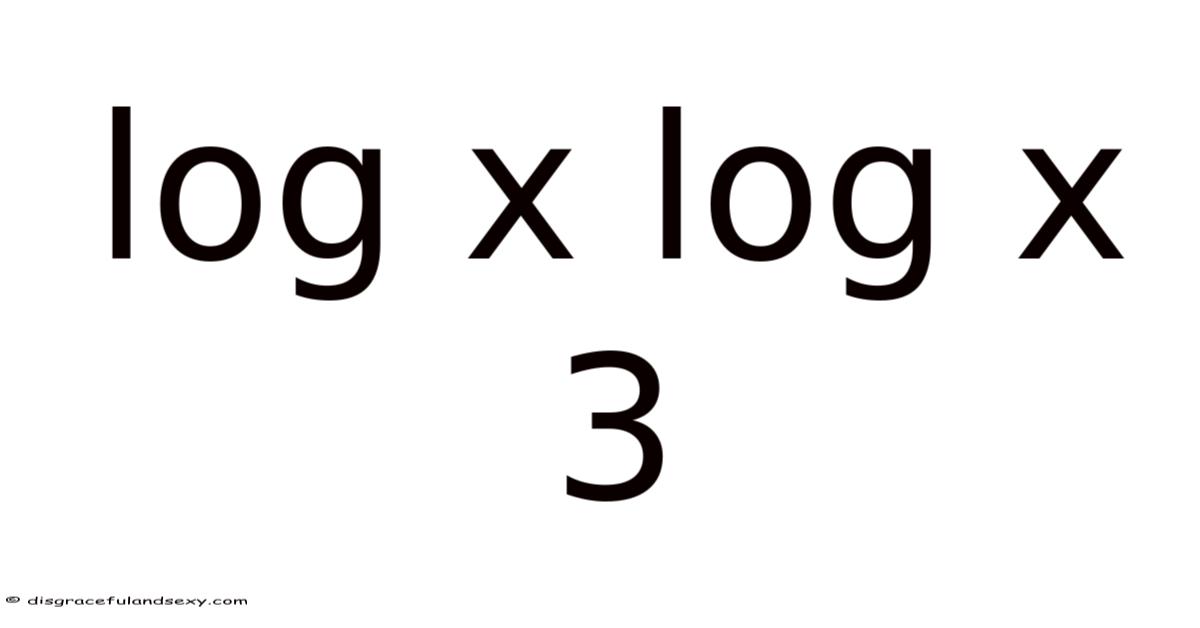
Deconstructing the Mathematical Enigma: log x log x 3
Understanding the expression "log x log x 3" requires a nuanced approach, delving into the fundamentals of logarithms, their properties, and how they interact within complex expressions. We'll examine the impact of different bases, address potential ambiguities, and even venture into the realm of graphical representations to solidify comprehension. This article will break down this expression step-by-step, explaining the underlying principles and exploring various scenarios. By the end, you'll not only understand this specific expression but gain a deeper appreciation for the power and elegance of logarithmic functions.
Understanding Logarithms: A Foundation
Before diving into the complexities of log x log x 3, let's establish a firm grasp on the basics of logarithms. Also, a logarithm is essentially the inverse operation of exponentiation. The expression log<sub>b</sub> a = c means that b<sup>c</sup> = a It's one of those things that adds up..
Not obvious, but once you see it — you'll see it everywhere.
bis the base of the logarithm.ais the argument (the number whose logarithm we're finding).cis the exponent (the logarithm itself).
To give you an idea, log<sub>10</sub> 100 = 2 because 10<sup>2</sup> = 100. Commonly, if the base isn't explicitly stated, it's assumed to be 10 (common logarithm) or e (the natural logarithm, denoted as ln).
Important Logarithmic Properties:
Understanding the following properties is crucial for manipulating and simplifying logarithmic expressions:
- Product Rule:
log<sub>b</sub> (xy) = log<sub>b</sub> x + log<sub>b</sub> y - Quotient Rule:
log<sub>b</sub> (x/y) = log<sub>b</sub> x - log<sub>b</sub> y - Power Rule:
log<sub>b</sub> x<sup>p</sup> = p log<sub>b</sub> x - Change of Base Formula:
log<sub>b</sub> x = (log<sub>a</sub> x) / (log<sub>a</sub> b)This allows you to convert between different bases.
Deconstructing log x log x 3: Ambiguity and Interpretation
The expression log x log x 3 presents an immediate challenge: it's ambiguous. On top of that, without parentheses or explicit base specification, we need to consider several interpretations. This ambiguity highlights the importance of precise mathematical notation.
Interpretation 1: (log x) * (log x * 3)
This interpretation assumes the expression should be read as the product of two terms: log x and (log x * 3). Here, the second term implies a multiplication of the logarithm of x by 3. This would be written more clearly as: (log x) * (3 log x) = 3(log x)<sup>2</sup>
In this case, the result is a quadratic function of log x. The specific shape and behavior of the graph will depend on the base of the logarithm. If the base is 10, it will represent a parabola.
Interpretation 2: log(x * log(x * 3))
Another interpretation could involve nested logarithms. This would be understood as the logarithm (with an unspecified base) of the product of x and the logarithm of (x*3). Now, it would be more clearly written as: log(x * log(3x)). Day to day, this is far less common but needs consideration due to the lack of explicit parentheses. Solving this requires knowing the base Easy to understand, harder to ignore..
Interpretation 3: log(x) * log(x*3)
This interpretation treats the expression as the product of two separate logarithmic terms. The first is simply the log of x, while the second is the log of the product x*3. Using the product rule, this could be rewritten as: log(x) * (log(x) + log(3))
Solving for Specific Cases: The Importance of the Base
To illustrate the impact of the base and the different interpretations, let's examine specific examples. We'll focus primarily on Interpretation 1 due to its greater likelihood and simpler analysis Worth keeping that in mind. But it adds up..
Example 1: Base 10, Interpretation 1
Let's assume the base is 10 and we're using Interpretation 1: 3(log<sub>10</sub> x)<sup>2</sup> Worth knowing..
If x = 10, then log<sub>10</sub> 10 = 1, and the expression simplifies to 3(1)<sup>2</sup> = 3.
If x = 100, then log<sub>10</sub> 100 = 2, and the expression becomes 3(2)<sup>2</sup> = 12 That alone is useful..
If x = 1000, then log<sub>10</sub> 1000 = 3, leading to 3(3)<sup>2</sup> = 27.
As you can see, the value of the expression is directly related to the logarithm of x, increasing quadratically.
Example 2: Natural Logarithm (Base e), Interpretation 1
Using the natural logarithm (ln), and Interpretation 1, we get 3(ln x)<sup>2</sup> No workaround needed..
If x = e, then ln e = 1, and the expression simplifies to 3(1)<sup>2</sup> = 3 Worth keeping that in mind..
If x = e<sup>2</sup>, then ln e<sup>2</sup> = 2, resulting in 3(2)<sup>2</sup> = 12.
The pattern is similar to the base 10 example, showing the quadratic relationship between the expression's value and the natural logarithm of x.
Graphical Representation
Visualizing these expressions through graphs can significantly enhance understanding. For Interpretation 1, regardless of the base, the graph will always be a parabola, opening upwards. Also, the specific curvature will depend on the base, but the quadratic nature will remain consistent. Plotting points for different values of x will clearly showcase this quadratic relationship And it works..
Addressing Potential Complications and FAQs
Q1: What happens when x is negative or zero?
The logarithm of a non-positive number is undefined in the real number system. So, the expression log x log x 3 is only defined for positive values of x.
Q2: How does the choice of base affect the result?
The choice of base significantly impacts the numerical value of the result, altering the scale and the rate of change. While the quadratic relationship remains, the specific values for a given x will vary depending on the base The details matter here..
Q3: Are there any practical applications of this expression?
While this specific expression might not have immediate real-world applications in its raw form, the underlying concepts of logarithms and their properties are ubiquitous in various fields, including physics, engineering, finance, and computer science. They appear in models of exponential growth and decay, signal processing, and many other areas.
Conclusion: Precision, Interpretation, and Understanding
The expression log x log x 3 underscores the critical importance of precise mathematical notation and careful interpretation. The exercise of dissecting this expression provides valuable insight into the fundamental properties of logarithms and their practical applications within a broader mathematical context. The ambiguity inherent in the original expression highlights the need for clarity in mathematical writing. On the flip side, by exploring different interpretations, examining specific examples with varying bases, and employing graphical representations, we've gained a comprehensive understanding of this seemingly simple yet complex mathematical statement. Remember to always prioritize clear notation and consider the implications of different interpretations when working with logarithmic expressions.
