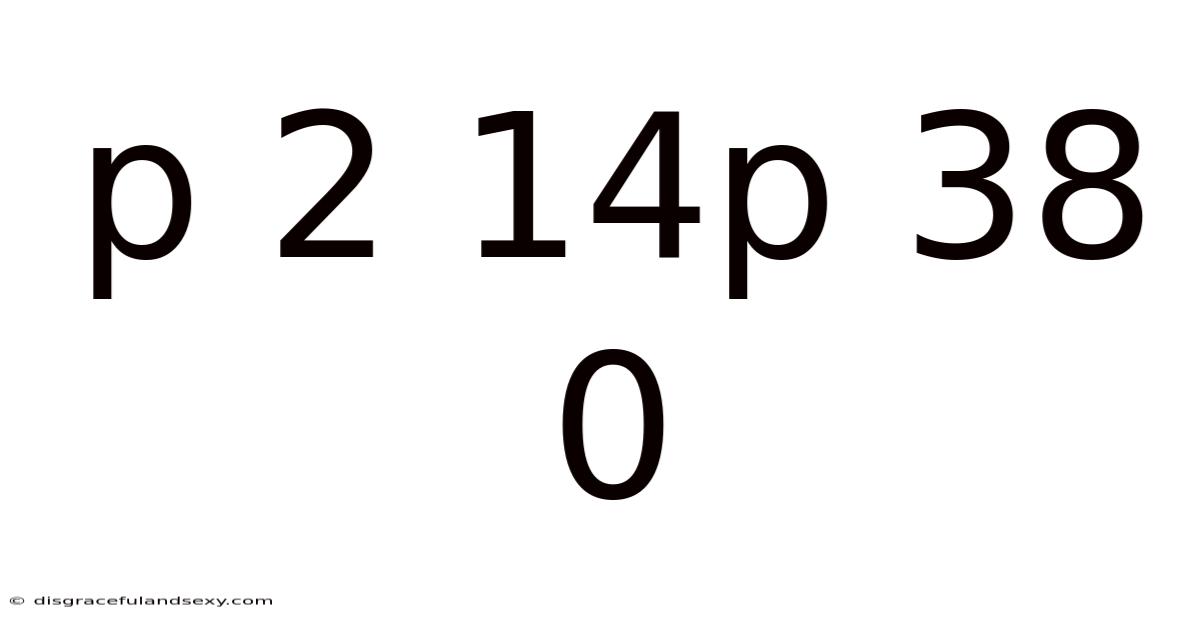
Decoding the Mystery: Understanding P 2 14P 38 0
The sequence "P 2 14P 38 0" initially appears cryptic, like a secret code or a random string of characters. This article explores potential interpretations, examining different possibilities and emphasizing the importance of context in deciphering such sequences. Even so, without further information, several interpretations are possible, depending on the field of study or system it originates from. Worth adding: we will analyze potential scenarios, ranging from simple numerical patterns to more complex systems like coding or specialized notations. That said, understanding its context is crucial to deciphering its meaning. By the end, we hope to make sense of the possible meaning of "P 2 14P 38 0" and offer a framework for approaching similar enigmatic sequences It's one of those things that adds up. Less friction, more output..
Potential Interpretations: Exploring the Possibilities
The ambiguity of "P 2 14P 38 0" stems from the lack of context. To unravel its meaning, let's explore several hypothetical contexts:
1. A Numerical Sequence with an Unknown Pattern
At first glance, the sequence might represent a numerical pattern. Even so, the inclusion of "P" complicates the matter. "P" could represent a variable, a placeholder, or an operation Simple as that..
-
Simple Arithmetic Progression: If "P" were ignored, we might look for an arithmetic progression in the numbers 2, 14, 38, and 0. Even so, no clear arithmetic progression emerges. The differences between consecutive numbers are not consistent Worth keeping that in mind..
-
Geometric Progression: Similarly, a geometric progression is unlikely. There’s no consistent ratio between the numbers that would lead to a predictable pattern Small thing, real impact..
-
Polynomial Relationship: The sequence could potentially represent points on a polynomial curve. Further analysis using numerical methods, such as polynomial interpolation, would be needed to determine if a polynomial relationship exists. This would require additional data points or knowledge of the underlying function Easy to understand, harder to ignore..
-
P as a Variable: The "P" could represent a variable within a mathematical equation or formula. Without knowing the equation, it's impossible to determine the relationship between "P" and the numbers. Here's a good example: it could be part of a more complex mathematical expression involving exponents, logarithms, or trigonometric functions Worth keeping that in mind. Practical, not theoretical..
-
P as an Operation: "P" could represent a specific operation or function that transforms one number into the next. The nature of this operation is unknown and requires further information Easy to understand, harder to ignore. No workaround needed..
2. A Code or Cipher
The sequence could be a part of a code or cipher, commonly used in cryptography or other secure communication systems. Several possibilities exist:
-
Substitution Cipher: Each character or number could represent another character or number according to a specific substitution key. Without the key, deciphering this would be extremely challenging Nothing fancy..
-
Transposition Cipher: The sequence might be a result of rearranging letters or numbers according to a specific algorithm. This again requires knowledge of the encryption method Surprisingly effective..
-
Caesar Cipher Variant: While unlikely given the mixture of letters and numbers, a modified Caesar cipher incorporating numerical values could be a possibility.
-
More Complex Ciphers: Advanced ciphers like the Enigma machine or modern encryption algorithms are also possibilities, but deciphering them requires specialized knowledge and potentially computational resources.
3. A Specialized Notation System
The sequence could belong to a specialized notation system used in a particular field:
-
Scientific Notation: While less likely given the lack of scientific context, the sequence could potentially represent scientific measurements or data points using a non-standard notation Which is the point..
-
Engineering or Technical Notation: Many technical fields use unique notations for various purposes. The sequence could represent a code for a specific component, a measurement, or a process within a specialized system.
-
Computer Science: In programming or computer science, the sequence could be a reference to memory addresses, data structures, or system codes.
-
Financial Notation: Some financial systems use specific codes or identifiers. The possibility of this requires specific information about the financial system involved.
4. Part of a Larger Sequence or Context
The sequence "P 2 14P 38 0" may be only a segment of a longer sequence or part of a larger context. Consider this: more data or information would be needed to interpret it within a larger system. And the surrounding elements might contain clues to its meaning. As an example, if this sequence is part of a database entry, a log file, or a message, understanding the context surrounding the sequence is essential.
The Importance of Context: Deciphering the Unknown
The key to understanding "P 2 14P 38 0" lies in discovering its context. Worth adding: without knowing where this sequence originated, any interpretation is purely speculative. The same sequence can have vastly different meanings depending on its source And that's really what it comes down to. But it adds up..
To illustrate this point, consider these examples:
-
Context A: Imagine finding the sequence within a research paper on fluid dynamics. The "P" might represent pressure, while the numbers could be measurements of pressure at different times or locations.
-
Context B: If found within a software program’s log file, the sequence might represent error codes, memory locations, or timestamps.
-
Context C: In a historical document, the sequence might be a cryptic code used for secret communication during a war And that's really what it comes down to..
Which means, providing the source or context of the sequence "P 2 14P 38 0" is absolutely crucial for accurate interpretation.
Methods for Further Investigation
If you encountered this sequence in a specific situation, consider these steps for further investigation:
-
Identify the Source: Determine where you found the sequence. Was it in a book, a computer program, a research paper, or elsewhere?
-
Examine the Surrounding Data: Look for patterns or clues in the data surrounding the sequence. Are there other similar sequences? Is there any accompanying text or metadata?
-
Consult Relevant Experts: Depending on the context, seek help from experts in relevant fields, such as mathematicians, cryptographers, computer scientists, or engineers But it adds up..
-
Employ Pattern Recognition Techniques: Use analytical tools or software to identify potential patterns in the sequence, such as statistical analysis or machine learning algorithms Small thing, real impact. Surprisingly effective..
-
Explore Databases: Search relevant databases to see if the sequence appears in any known code systems or notations.
Conclusion: The Elusive Answer
Without additional context, definitively deciphering "P 2 14P 38 0" is impossible. Worth adding: this exercise highlights the critical role of context in interpreting seemingly random or cryptic sequences. The ambiguity of the sequence emphasizes the importance of careful observation, thorough investigation, and the utilization of appropriate tools and expertise when dealing with unknown patterns or codes. The process of deciphering such sequences often involves a combination of logical reasoning, pattern recognition, and domain-specific knowledge. By systematically exploring potential interpretations and considering various contexts, we can significantly improve our chances of understanding the true meaning behind enigmatic sequences like this one. Remember, the key is always to consider the source and context surrounding the sequence.
