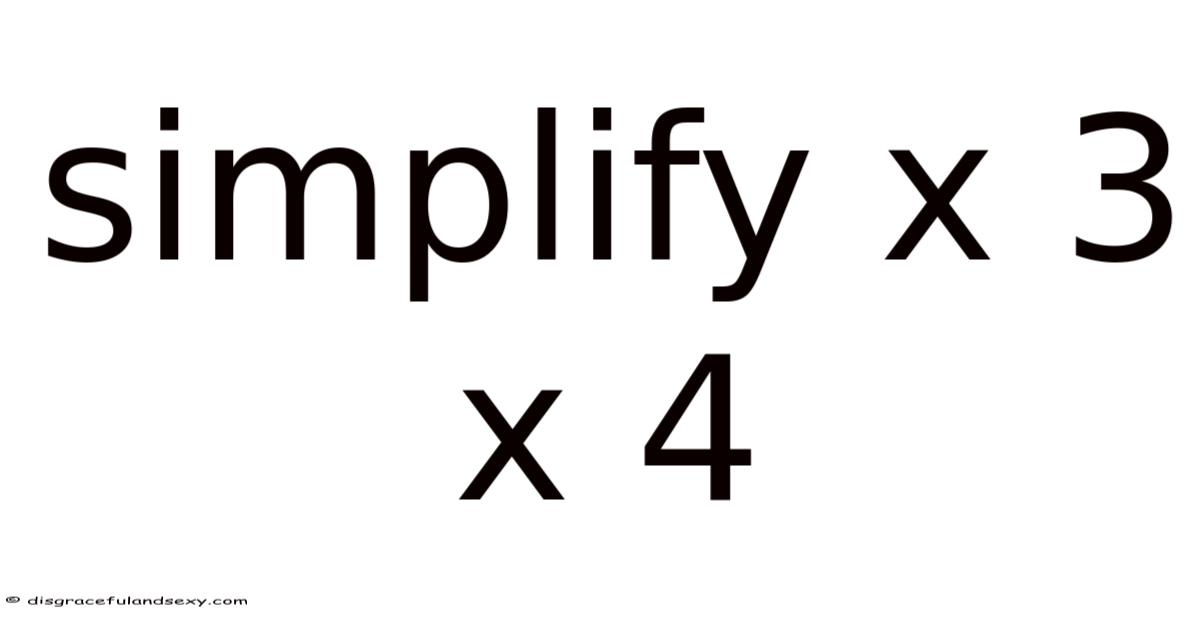
Simplifying x * 3 * 4: A Deep Dive into Algebraic Simplification
This article explores the seemingly simple algebraic expression "x * 3 * 4" and walks through the fundamental principles of simplification. Think about it: this will equip you with the skills to tackle more complex algebraic expressions with confidence. We'll uncover the underlying mathematical concepts, demonstrate the process step-by-step, and explore related topics to provide a comprehensive understanding. Understanding this seemingly basic problem forms a crucial foundation for more advanced algebra That's the whole idea..
Introduction: Understanding the Basics
Before we dive into simplifying x * 3 * 4, let's establish a strong foundation. This expression involves:
- Variables: The letter 'x' represents a variable, a symbol that can take on different numerical values.
- Constants: The numbers '3' and '4' are constants—their values remain fixed.
- Multiplication: The '*' symbol indicates multiplication. In algebra, multiplication is often implied; for instance, 3x is the same as 3 * x.
Our goal is to simplify the expression by combining the constants to express it in its most concise form. This process is crucial in algebra as it allows us to manipulate equations more efficiently and solve for unknowns.
Step-by-Step Simplification
The simplification of x * 3 * 4 involves the commutative and associative properties of multiplication.
1. Commutative Property: This property states that the order of multiplication doesn't change the result. To give you an idea, 2 * 3 is the same as 3 * 2. We can rearrange our expression:
x * 3 * 4 = x * 4 * 3 (Rearranging using the commutative property)
2. Associative Property: This property allows us to group the numbers being multiplied in different ways without altering the result. Take this: (2 * 3) * 4 = 2 * (3 * 4). Let's apply this:
x * 4 * 3 = x * (4 * 3) (Grouping constants using the associative property)
3. Multiplication: Now, perform the multiplication of the constants:
x * (4 * 3) = x * 12
Which means, the simplified form of x * 3 * 4 is 12x Simple, but easy to overlook. That alone is useful..
Why Simplification Matters
Simplifying algebraic expressions isn't just about making things look neater; it's a fundamental skill with far-reaching implications:
- Efficiency: Simplified expressions are easier to work with, especially in more complex equations and problem-solving. Imagine trying to solve an equation with x * 3 * 4 on one side – 12x makes the process significantly smoother.
- Clarity: A simplified expression is more readily understandable. The concise form, 12x, immediately reveals the relationship between the variable and the constant.
- Problem-Solving: Many algebraic problems require simplification as an initial step. Without it, solving becomes considerably more difficult, if not impossible.
- Foundation for Advanced Concepts: Mastering simplification builds a strong base for more advanced concepts in algebra, such as factoring, expanding brackets, and solving complex equations.
Expanding the Concept: More Complex Examples
Let's build upon this foundation by exploring more complex scenarios that involve similar simplification principles.
Example 1: 2x * 5 * y
Following the same principles:
- Rearrange using the commutative property: 2 * 5 * x * y
- Group constants: (2 * 5) * (x * y)
- Multiply: 10xy
The simplified expression is 10xy.
Example 2: (3x)(4y)(2)
In this case, parentheses indicate multiplication.
- Rearrange: 3 * 4 * 2 * x * y
- Group constants: (3 * 4 * 2) * (x * y)
- Multiply: 24xy
The simplified expression is 24xy.
Example 3: -2x * (-3) * 5
Remember the rules of multiplying negative numbers:
- Rearrange: -2 * -3 * 5 * x
- Group constants: (-2 * -3 * 5) * x
- Multiply: 30x
The simplified expression is 30x Not complicated — just consistent..
The Significance of Order of Operations (PEMDAS/BODMAS)
While the examples above primarily focused on multiplication, it's crucial to understand the order of operations, often remembered by the acronyms PEMDAS (Parentheses, Exponents, Multiplication and Division, Addition and Subtraction) or BODMAS (Brackets, Orders, Division and Multiplication, Addition and Subtraction). These acronyms point out the sequence in which operations should be performed. In our simplified examples, multiplication was the only operation present. Even so, in more complex expressions involving multiple operations, adhering to PEMDAS/BODMAS is essential to obtain the correct result.
Practical Applications
The ability to simplify algebraic expressions is fundamental across numerous fields:
- Physics: Formulating and solving equations related to motion, forces, and energy often requires simplifying complex expressions.
- Engineering: Designing structures, circuits, and systems necessitates manipulating algebraic equations, and simplification plays a central role.
- Computer Science: Developing algorithms and writing code often involves working with mathematical expressions, and simplification improves efficiency and clarity.
- Finance: Calculating interest, compound growth, and other financial metrics frequently uses algebraic expressions, simplifying them leads to accurate calculations.
- Economics: Analyzing economic models and solving for equilibrium points often involves simplifying detailed algebraic expressions.
Frequently Asked Questions (FAQ)
Q1: What if the expression involves division?
A1: Division is the inverse of multiplication. That said, you can treat division as multiplication by the reciprocal. To give you an idea, x * 3 / 4 can be rewritten as x * 3 * (1/4) and then simplified.
Q2: What if the expression involves variables with exponents?
A2: The rules for exponents apply. You would simplify the numerical constants as we have shown, and then apply the rules of exponents to the variables. As an example, x² * 3 * x would simplify to 3x³ Small thing, real impact..
Q3: Can I use a calculator to simplify these expressions?
A3: While calculators can perform the numerical calculations, understanding the underlying principles of simplification is vital for tackling more complex problems and developing a strong foundation in algebra.
Q4: Why is it important to understand the commutative and associative properties?
A4: These properties are fundamental to algebraic manipulation. They give us the ability to rearrange and group terms in an expression to make it easier to simplify and solve equations. They are essential tools for working with more complex algebraic expressions.
Conclusion: Mastering the Fundamentals
Simplifying x * 3 * 4, while seemingly trivial, lays the groundwork for a deeper understanding of algebraic manipulation. By mastering these fundamental principles, you build a solid foundation for tackling more advanced algebraic concepts and solving a wide range of problems across various disciplines. Remember, practice is key to mastering this skill, so continue exploring similar problems and gradually increasing the complexity of the expressions you encounter. The concepts of commutative and associative properties, coupled with a firm grasp of the order of operations, are crucial skills that extend far beyond this elementary example. With consistent practice and attention to detail, you'll confidently manage the world of algebraic simplification.
