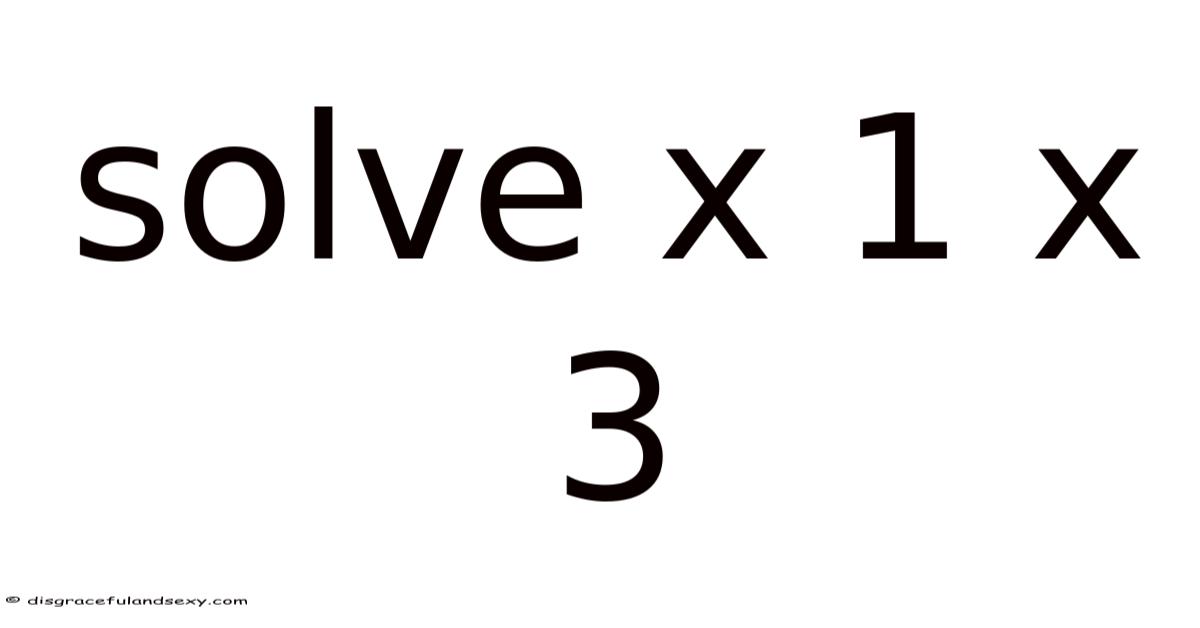
Solving x¹ x ³: A Comprehensive Exploration of Exponential and Algebraic Manipulation
This article looks at the seemingly simple problem of solving "x¹ x ³," unraveling its complexities and expanding upon the underlying mathematical principles involved. While the initial expression might appear straightforward, it offers a valuable opportunity to explore fundamental concepts in algebra and exponents, crucial for a solid understanding of more advanced mathematical topics. We will cover the basics of exponents, the rules governing their manipulation, and then apply these rules to solve the given expression and similar problems. This guide is designed for students of all levels, from beginners grappling with basic algebra to those seeking to refresh their understanding of exponential rules.
Understanding Exponents
Before tackling the problem directly, let's refresh our understanding of exponents. Now, an exponent, also known as a power or index, indicates how many times a base number is multiplied by itself. Practically speaking, the general form is expressed as bⁿ, where 'b' represents the base and 'n' represents the exponent. To give you an idea, in 2³, the base is 2, and the exponent is 3. This means 2 multiplied by itself three times: 2 x 2 x 2 = 8 Surprisingly effective..
-
Understanding the Base: The base can be any number, variable, or even an expression. It represents the fundamental quantity being multiplied repeatedly.
-
Understanding the Exponent: The exponent dictates the number of times the base is multiplied. An exponent of 1 means the base is used only once. An exponent of 0, for any non-zero base, results in 1 (b⁰ = 1). Negative exponents indicate reciprocals (b⁻ⁿ = 1/bⁿ) That alone is useful..
Key Rules of Exponents
Several fundamental rules govern the manipulation of exponents. Understanding and applying these rules correctly is crucial for solving complex algebraic equations and simplifying expressions. Let's review these essential rules:
-
Product Rule: When multiplying two terms with the same base, add their exponents: bᵐ x bⁿ = bᵐ⁺ⁿ. As an example, 2² x 2³ = 2⁽²⁺³⁾ = 2⁵ = 32.
-
Quotient Rule: When dividing two terms with the same base, subtract the exponents: bᵐ / bⁿ = bᵐ⁻ⁿ. Take this: 2⁵ / 2² = 2⁽⁵⁻²⁾ = 2³ = 8 Not complicated — just consistent..
-
Power Rule: When raising a power to another power, multiply the exponents: (bᵐ)ⁿ = bᵐⁿ. Here's one way to look at it: (2²)³ = 2⁽²ˣ³⁾ = 2⁶ = 64.
-
Power of a Product Rule: When raising a product to a power, raise each factor to that power: (a x b)ⁿ = aⁿ x bⁿ. To give you an idea, (2 x 3)² = 2² x 3² = 4 x 9 = 36 The details matter here. And it works..
-
Power of a Quotient Rule: When raising a quotient to a power, raise both the numerator and the denominator to that power: (a/b)ⁿ = aⁿ/bⁿ. As an example, (2/3)² = 2²/3² = 4/9.
-
Zero Exponent Rule: Any non-zero base raised to the power of zero is equal to 1: b⁰ = 1. Take this: 5⁰ = 1.
-
Negative Exponent Rule: A base raised to a negative exponent is equal to the reciprocal of the base raised to the positive exponent: b⁻ⁿ = 1/bⁿ. As an example, 2⁻³ = 1/2³ = 1/8 Easy to understand, harder to ignore..
Solving x¹ x ³
Now, let's apply these rules to solve the given expression, x¹ x ³. Notice that both terms have the same base, which is 'x'. According to the product rule of exponents, we add the exponents:
x¹ x ³ = x⁽¹⁺³⁾ = x⁴
Because of this, the solution to x¹ x ³ is x⁴. This simplified expression represents x multiplied by itself four times: x * x * x * x.
Expanding the Understanding: More Complex Scenarios
While the original problem was relatively straightforward, let's explore more complex scenarios to solidify our understanding of exponential manipulation within algebraic contexts.
Scenario 1: Incorporating Coefficients
Consider the expression 2x¹ x 3x³. Here, we have coefficients (the numbers in front of the variables) in addition to the variables with exponents. We can solve this by multiplying the coefficients and then applying the product rule to the variables:
2x¹ x 3x³ = (2 x 3) x (x¹ x x³) = 6x⁴
Scenario 2: Incorporating Different Bases
Let's consider an expression with different bases: 2² x 3³. In this case, the product rule doesn't directly apply because the bases are different. We simply evaluate each term separately and then multiply the results:
2² x 3³ = 4 x 27 = 108
Scenario 3: Expressions with Parentheses and Multiple Exponents
Consider the expression (2x²)³ x (3x)². Here, we need to apply multiple rules in a sequential manner:
-
Apply the power rule to the first term: (2x²)³ = 2³ x (x²)³ = 8x⁶
-
Apply the power rule to the second term: (3x)² = 3² x x² = 9x²
-
Combine the results using the product rule: 8x⁶ x 9x² = (8 x 9) x (x⁶ x x²) = 72x⁸
Scenario 4: Solving for x
Let's consider a slightly more challenging problem where we need to solve for 'x'. Suppose we have the equation x² = 9. To solve for x, we take the square root of both sides:
√x² = √9
x = ±3
This highlights that when solving for x using even exponents, there will typically be two possible solutions (a positive and a negative solution) Worth keeping that in mind. Practical, not theoretical..
Scenario 5: Dealing with Negative Exponents
Let's look at an example with negative exponents: x⁻² x x³. Recall that x⁻² = 1/x². Therefore:
x⁻² x x³ = (1/x²) x x³ = x³/x² = x⁽³⁻²⁾ = x¹ = x
Scenario 6: Fractional Exponents
Fractional exponents represent roots. Practically speaking, for example, x^(1/2) is the square root of x, and x^(1/3) is the cube root of x. The general rule is: x^(m/n) = ⁿ√xᵐ.
x^(1/2) x x^(1/2) = x^((1/2) + (1/2)) = x¹ = x
This shows that multiplying the square root of x by itself results in x.
Frequently Asked Questions (FAQ)
Q1: What if the exponents are not integers? The rules of exponents apply equally to fractional and decimal exponents. Remember that fractional exponents represent roots and decimals can be converted to fractions Not complicated — just consistent..
Q2: What happens if the bases are different? If the bases are different, the product rule doesn't apply directly. You must evaluate each term separately and then perform the multiplication.
Q3: Can I always simplify an expression with exponents? Not always. Simplification depends on the specific expression. Sometimes, an expression might be in its simplest form already.
Q4: What are some common mistakes to avoid? Common mistakes include incorrectly applying the exponent rules, forgetting about the order of operations (PEMDAS/BODMAS), and overlooking negative or fractional exponents.
Conclusion
Solving expressions involving exponents, like x¹ x ³, is fundamental to algebraic manipulation and is a building block for more advanced mathematical concepts such as calculus and linear algebra. By mastering the rules of exponents and practicing various examples, students can confidently tackle increasingly complex problems. Remember to focus on understanding the underlying principles rather than rote memorization. This will not only help you solve problems accurately but will also deepen your understanding of the beautiful and powerful world of mathematics. The seemingly simple expression x¹ x ³ served as a gateway to exploring a wide range of concepts, highlighting the depth and interconnectedness within mathematics. Continue practicing, and you’ll find yourself progressively more comfortable navigating the intricacies of algebraic manipulation and exponential functions.
