Solving for h: Unraveling the Cylinder's Height
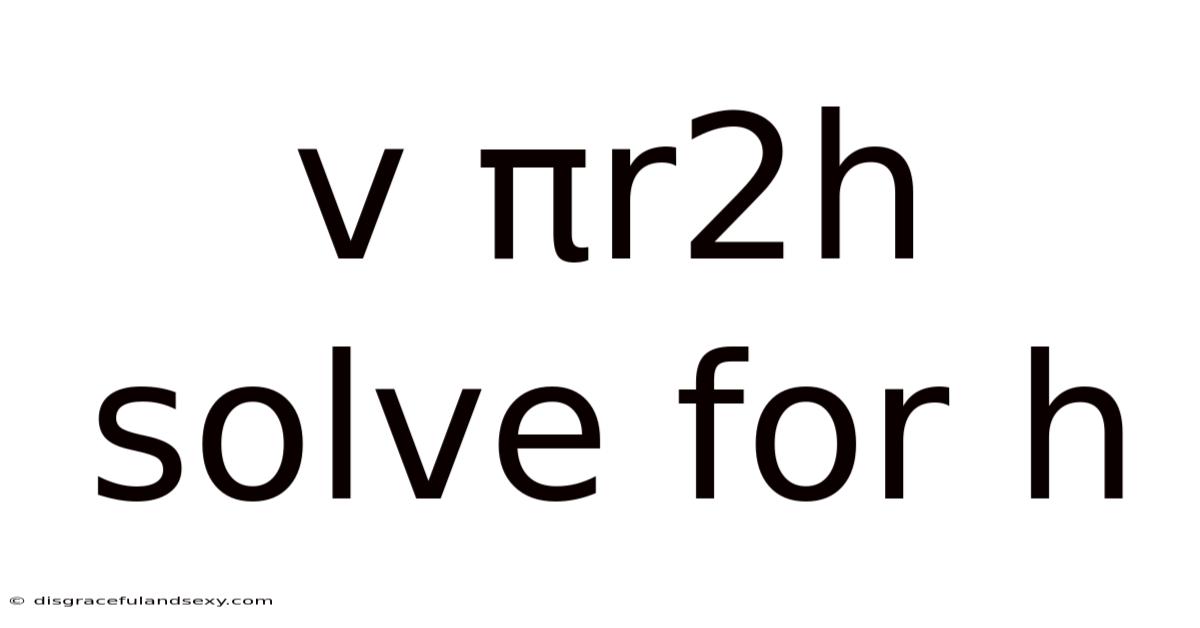
The formula V = πr²h represents the volume (V) of a cylinder, where 'r' is the radius of its circular base and 'h' is its height. Also, this seemingly simple equation is fundamental in various fields, from geometry and engineering to physics and chemistry. Understanding how to manipulate this formula, specifically how to solve for 'h', is crucial for solving a wide range of problems involving cylindrical shapes. This article will guide you through the process, providing a step-by-step explanation, exploring the underlying mathematical principles, and addressing frequently asked questions.
Understanding the Cylinder Volume Formula: V = πr²h
Before diving into solving for 'h', let's solidify our understanding of the formula itself. The volume of a cylinder is essentially the area of its circular base multiplied by its height.
- V: Represents the volume of the cylinder, typically measured in cubic units (e.g., cubic centimeters, cubic meters).
- π (pi): A mathematical constant, approximately equal to 3.14159. It represents the ratio of a circle's circumference to its diameter.
- r: Represents the radius of the cylinder's circular base, the distance from the center of the circle to its edge. It's measured in linear units (e.g., centimeters, meters).
- h: Represents the height of the cylinder, the perpendicular distance between its two circular bases. It's also measured in linear units.
The formula, V = πr²h, combines these elements to calculate the total space occupied by the cylinder.
Solving for h: A Step-by-Step Guide
The goal is to isolate 'h' on one side of the equation. This involves applying algebraic manipulation techniques. Here's how:
1. Identify the Known Variables: Begin by identifying the values you already know. You'll typically be given the volume (V) and the radius (r) of the cylinder.
2. Substitute the Known Values: Replace the variables V and r in the equation V = πr²h with their numerical values.
3. Isolate 'h': To isolate 'h', we need to get rid of π and r². Since πr² is multiplied by h, we perform the inverse operation – division. Divide both sides of the equation by πr²:
V / (πr²) = (πr²h) / (πr²)
4. Simplify: The πr² on the right side cancels out, leaving:
h = V / (πr²)
5. Calculate: Substitute the known values of V and r into the equation h = V / (πr²) and perform the calculation. Remember to follow the order of operations (PEMDAS/BODMAS).
Example Problem: Finding the Height of a Cylinder
Let's say we have a cylinder with a volume (V) of 150 cubic centimeters and a radius (r) of 5 centimeters. We want to find its height (h).
-
Known Variables: V = 150 cm³, r = 5 cm
-
Substitute: Substitute these values into the formula h = V / (πr²):
h = 150 cm³ / (π * (5 cm)²)
- Calculate:
h = 150 cm³ / (π * 25 cm²) ≈ 150 cm³ / (78.54 cm²) ≈ 1.91 cm
Because of this, the height of the cylinder is approximately 1.91 centimeters.
The Mathematical Principles at Play
The process of solving for 'h' utilizes fundamental algebraic principles:
-
Equality Property: Whatever operation you perform on one side of the equation, you must perform the same operation on the other side to maintain balance. This is the core principle behind dividing both sides by πr² Easy to understand, harder to ignore. Surprisingly effective..
-
Inverse Operations: To isolate a variable, you use the inverse operation of what's currently being performed. Multiplication and division are inverse operations, as are addition and subtraction.
-
Order of Operations: When substituting numerical values, remember to follow the order of operations (PEMDAS/BODMAS): Parentheses/Brackets, Exponents/Orders, Multiplication and Division (from left to right), Addition and Subtraction (from left to right). This ensures accurate calculations And that's really what it comes down to. No workaround needed..
Beyond the Basics: Handling More Complex Scenarios
While the basic formula provides a solid foundation, some problems might present variations:
-
Unknown Radius: If the radius is unknown, you'll need additional information, such as the circumference or the area of the base, to solve for 'r' before you can solve for 'h'.
-
Combined Shapes: Problems might involve cylinders combined with other shapes. In such cases, you'll need to break down the problem into smaller, manageable parts, calculating the volume of each component before finding the overall height.
-
Real-World Applications: Remember that the accuracy of your calculations is directly related to the accuracy of the measurements of V and r. In practical applications, always account for potential measurement errors Small thing, real impact..
Frequently Asked Questions (FAQ)
Q: What if I get a negative value for 'h'?
A: A negative height is physically impossible. If you get a negative value, double-check your calculations and ensure you've correctly substituted the values into the equation. A negative value likely indicates an error in the input values or the calculation process.
Honestly, this part trips people up more than it should.
Q: Can I use an approximate value for π (pi)?
A: Yes, using 3.14 is often sufficient for many applications. That said, for greater accuracy, especially in engineering or scientific contexts, you should use a more precise value of π provided by your calculator or computer software But it adds up..
Q: What are the units for 'h'?
A: The units for 'h' will be the same as the units used for the radius (r). If 'r' is in centimeters, then 'h' will also be in centimeters.
Conclusion: Mastering Cylinder Calculations
Solving for 'h' in the equation V = πr²h is a fundamental skill in mathematics and science. Worth adding: by understanding the underlying algebraic principles and following the step-by-step process outlined above, you can confidently tackle problems involving cylindrical volumes. Remember to always double-check your calculations and consider potential sources of error in real-world applications. That's why with practice, you'll master this essential skill and gain a deeper appreciation for the mathematical relationships governing the world around us. On the flip side, this ability to manipulate formulas is not just about solving for 'h'; it's about developing a broader understanding of mathematical problem-solving and its application in numerous fields. The ability to isolate variables and apply inverse operations is a transferable skill that will be invaluable in many academic and professional pursuits Simple, but easy to overlook..
