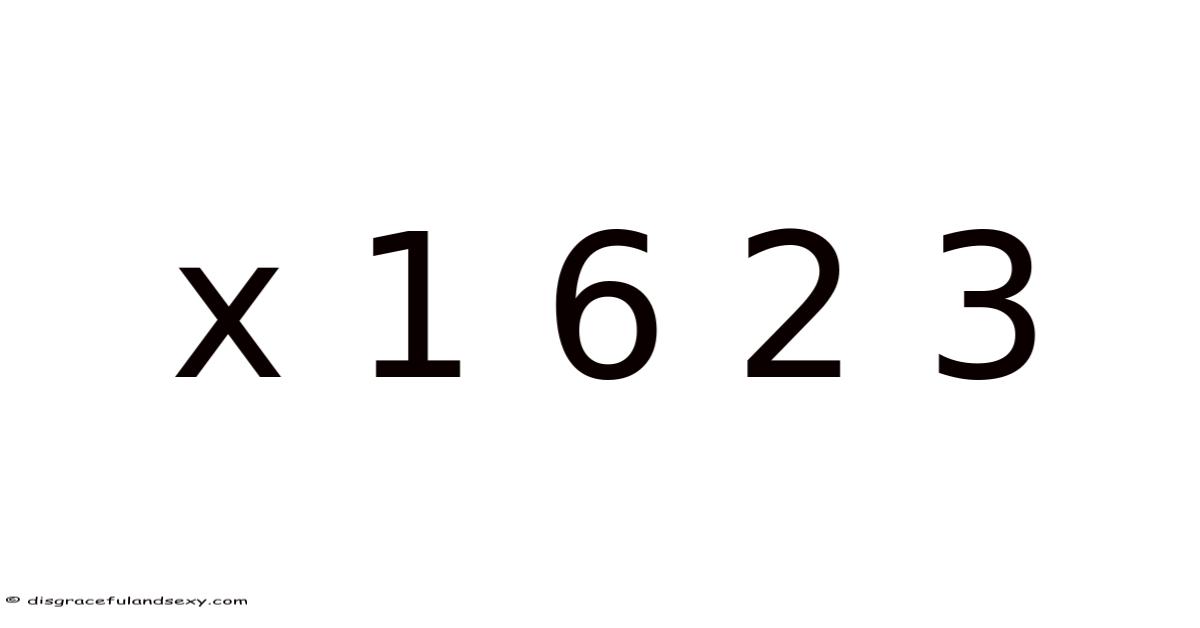
Decoding the Sequence: Exploring the Mysteries of "x 1 6 2 3"
The seemingly simple sequence "x 1 6 2 3" presents a fascinating puzzle, ripe with possibilities for exploration. That said, while a definitive "answer" might be elusive, the journey of exploration itself reveals intriguing insights into logical reasoning, pattern recognition, and problem-solving skills. This article gets into various interpretations and approaches to understanding this sequence, investigating mathematical patterns, linguistic possibilities, and even venturing into the realm of cryptography and code-breaking. This unique sequence acts as a springboard to explore several mathematical and logical concepts And that's really what it comes down to..
Understanding the Problem: Defining the Scope
Before we dive into the intricacies of potential solutions, it's crucial to establish the scope of our investigation. Now, the sequence "x 1 6 2 3" presents an open-ended problem. Think about it: the presence of 'x' suggests an unknown variable, hinting at a potential need for additional information or context. Day to day, without further constraints or clues, countless interpretations are possible. We will, therefore, explore various avenues, examining each approach with a critical and analytical eye.
Mathematical Approaches: Unveiling Numerical Patterns
One of the most intuitive approaches to deciphering this sequence is to explore potential mathematical patterns or relationships between the known numbers: 1, 6, 2, and 3. Let's consider several possibilities:
1. Searching for Arithmetic Progressions:
This involves investigating whether a consistent addition or subtraction operation governs the sequence. That said, a quick inspection reveals no obvious arithmetic progression. The differences between consecutive numbers are not consistent: 6 - 1 = 5, 2 - 6 = -4, 3 - 2 = 1. This eliminates a simple arithmetic sequence That's the part that actually makes a difference..
2. Exploring Geometric Progressions:
A geometric progression involves a consistent multiplication or division factor. Again, a simple geometric progression is unlikely, as the ratios between consecutive numbers are not consistent: 6/1 = 6, 2/6 = 1/3, 3/2 = 1.5.
3. Investigating Higher-Order Relationships:
More complex mathematical relationships could exist. We might consider polynomial functions, recursive sequences, or even more advanced mathematical concepts. On the flip side, for instance, we could attempt to fit a polynomial curve to the known points (assuming the sequence represents coordinates or function values), but this approach lacks sufficient data to yield meaningful results without further constraints. A recursive relationship, where each term is defined by a function of previous terms, is also plausible but would require additional assumptions about the nature of the recursive rule.
And yeah — that's actually more nuanced than it sounds.
4. Considering Modular Arithmetic:
Modular arithmetic, where numbers "wrap around" after reaching a certain modulus, might reveal patterns. That said, applying modular arithmetic requires a predetermined modulus, and without further information, selecting a relevant modulus would be purely speculative.
Linguistic and Cryptographic Possibilities: Beyond the Numbers
Stepping outside the realm of pure mathematics, we can consider alternative interpretations. The sequence "x 1 6 2 3" might represent a coded message or a symbolic representation.
1. Substitution Ciphers:
The sequence could be a substitution cipher, where each number or "x" represents a letter or symbol. That said, without a key or further context, deciphering such a cipher is nearly impossible. The limited number of elements makes frequency analysis, a common technique in cryptography, impractical.
No fluff here — just what actually works Easy to understand, harder to ignore..
2. Code Breaking and Pattern Recognition:
Thinking like a code breaker, we could explore various patterns. Consider this: the "x" could act as a placeholder, indicating a missing element or a specific operational instruction. The numbers themselves might represent positions in a grid, coordinates, or even represent elements of a larger code based on a particular system or language.
3. Context is Key: The Importance of Additional Information
Crucially, the meaning of "x 1 6 2 3" heavily depends on its context. Where did this sequence originate? Even so, what is the surrounding information or accompanying instructions? Now, without this essential context, any interpretation remains speculative. Imagine it as a fragment of a larger puzzle: understanding the surrounding pieces is vital to solving the whole Simple, but easy to overlook. Less friction, more output..
Expanding the Possibilities: Hypothetical Scenarios
Let's explore hypothetical scenarios to further illustrate the diverse possibilities:
Scenario 1: The Sequence as Coordinates
If we assume the sequence represents coordinates (e.The remaining numbers could be y-coordinates or some other relevant spatial dimensions. g.Here's the thing — , x-coordinate, y-coordinate), the presence of 'x' could simply indicate the unknown x-coordinate of a point. Without further information defining the coordinate system, however, this interpretation remains speculative Worth keeping that in mind..
It sounds simple, but the gap is usually here.
Scenario 2: The Sequence as a Key
The sequence could be part of a cryptographic key or a password. 'x' could represent a variable element, or possibly signify a key press or a special character within a larger cryptographic system. This interpretation is plausible but requires additional information about the system this sequence belongs to Simple, but easy to overlook. Less friction, more output..
Scenario 3: The Sequence as a Problem-Solving Clue
The sequence might be part of a larger riddle or puzzle, and only by analyzing the context and incorporating the other clues could we decipher its meaning Worth knowing..
Frequently Asked Questions (FAQ)
Q: Is there a single definitive answer to this sequence?
A: No, without additional context or constraints, there is no single definitive answer. The meaning of "x 1 6 2 3" is heavily dependent on the source and the surrounding information.
Q: What are some common techniques used to decipher numerical sequences?
A: Common techniques include searching for arithmetic or geometric progressions, analyzing differences or ratios between consecutive terms, exploring higher-order mathematical relationships (e.Consider this: g. , polynomial fits), and applying modular arithmetic Nothing fancy..
Q: How important is context when analyzing a sequence?
A: Context is very important. On top of that, without knowing the origin or the surrounding information, interpreting a sequence like "x 1 6 2 3" becomes purely speculative. The context provides crucial clues that can guide the analysis and narrow down the possible interpretations.
Q: What if the 'x' is not a variable but a representation of something else?
A: That's a valid consideration. The 'x' could represent a symbol, a letter, an operation, or a specific element within a larger system. The possibilities are numerous and depend entirely on the context.
Q: Could this sequence be related to a specific mathematical field or theorem?
A: Potentially, but without more information, it's impossible to say definitively. Many mathematical concepts might incorporate such a sequence, but establishing a connection would require discovering a larger pattern or a clear relationship within a specific mathematical framework.
Conclusion: The Open-Ended Nature of Problem-Solving
The sequence "x 1 6 2 3" serves as a potent example of how a seemingly simple problem can unravel into a vast landscape of possibilities. And the absence of definitive constraints makes it an open-ended puzzle, encouraging creative problem-solving and critical thinking. In real terms, this exploration highlights the importance of context, the versatility of different analytical approaches, and the often-elusive nature of finding definitive solutions without sufficient information. Even so, while we might not have uncovered a single, universally accepted solution, the process of exploring the various possibilities has broadened our understanding of mathematical patterns, code-breaking techniques, and the crucial role of context in problem-solving. The real value lies not in finding a specific answer, but in the journey of exploration and the development of analytical skills along the way Easy to understand, harder to ignore..
