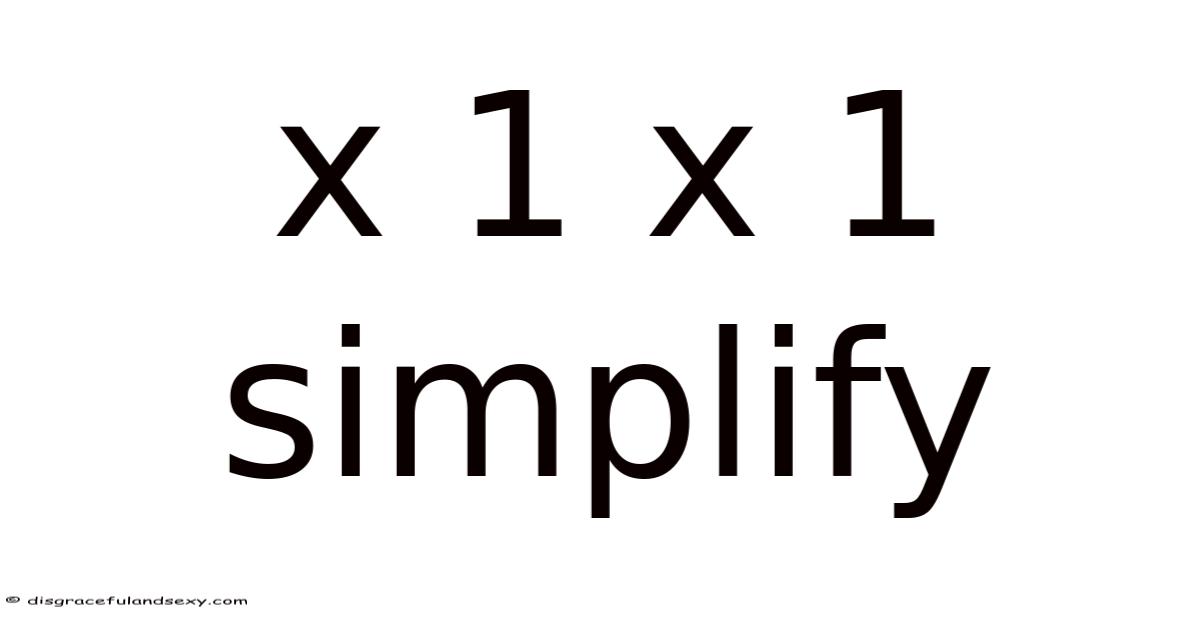
X times 1 times 1: Simplifying Expressions and Understanding Multiplication
This article explores the fundamental concept of simplifying expressions involving multiplication, specifically focusing on the scenario "x * 1 * 1". So we'll walk through the mathematical principles behind this simplification, providing clear explanations and examples to help you grasp this crucial concept, regardless of your mathematical background. Understanding this seemingly simple operation is fundamental to more complex algebraic manipulations and problem-solving. We'll cover the identity property of multiplication, provide practical examples, and address common questions The details matter here..
Understanding the Identity Property of Multiplication
The core principle behind simplifying "x * 1 * 1" is the identity property of multiplication. This property states that any number multiplied by 1 remains unchanged. In simpler terms, 1 is the multiplicative identity. It's like a "magic number" that doesn't alter the value of any other number it's multiplied with. This applies to all numbers, including variables like 'x' in our example That's the part that actually makes a difference. Simple as that..
That's why, x * 1 = x. No matter what value 'x' represents (whether it's 2, 10, -5, or any other number), multiplying it by 1 will always result in 'x' itself.
Simplifying x * 1 * 1: A Step-by-Step Guide
Let's break down the simplification of "x * 1 * 1" step-by-step:
-
Focus on one multiplication at a time: Multiplication is associative, meaning we can group the numbers in any order without changing the result. Let's start with the first multiplication: x * 1.
-
Applying the Identity Property: As we established earlier, x * 1 = x. This simplifies our expression to: x * 1 Most people skip this — try not to. But it adds up..
-
The Second Multiplication: Now we have x * 1. Applying the identity property again, we find that x * 1 = x Small thing, real impact. Simple as that..
-
Final Simplified Form: Because of this, the simplified form of x * 1 * 1 is simply x.
Illustrative Examples: Bringing it to Life
Let's solidify our understanding with some concrete examples. Imagine 'x' represents different values:
-
Example 1: x = 5
The expression becomes 5 * 1 * 1. Following the steps above:
5 * 1 = 5 5 * 1 = 5
The simplified result is 5.
-
Example 2: x = -3
The expression becomes -3 * 1 * 1 The details matter here..
-3 * 1 = -3 -3 * 1 = -3
The simplified result is -3.
-
Example 3: x = 0
The expression becomes 0 * 1 * 1 Took long enough..
0 * 1 = 0 0 * 1 = 0
The simplified result is 0.
These examples demonstrate that regardless of the value assigned to 'x', multiplying it by 1 repeatedly yields the original value of 'x'.
Beyond the Basics: Extending the Concept
The simplification of "x * 1 * 1" is a fundamental building block for more complex algebraic manipulations. Understanding this principle allows you to:
-
Simplify complex expressions: Imagine a more complex expression like (3x * 1 * 1) + (2 * 1 * x). By applying the identity property, you can simplify this to 3x + 2x, which further simplifies to 5x.
-
Solve equations: Consider the equation 2x * 1 * 1 = 10. Simplifying the left side to 2x, the equation becomes 2x = 10, which is much easier to solve.
-
Work with fractions: The identity property also extends to fractions. To give you an idea, (x/1) * 1 * 1 simplifies to x/1 or simply x.
-
Handle variables and constants: The principles remain consistent whether you're dealing with solely numerical values or a mix of variables and constants. The identity property always applies when you encounter multiplication by 1 And it works..
The Importance of Order of Operations (PEMDAS/BODMAS)
While the associative property of multiplication allows us to rearrange the order of multiplication, it's crucial to remember the order of operations, often represented by the acronyms PEMDAS (Parentheses, Exponents, Multiplication and Division, Addition and Subtraction) or BODMAS (Brackets, Orders, Division and Multiplication, Addition and Subtraction). These acronyms make clear that operations within parentheses or brackets must be performed first, followed by exponents/orders, then multiplication and division (from left to right), and finally addition and subtraction (from left to right).
In our case, since we only have multiplication, the order doesn't affect the outcome, but understanding PEMDAS/BODMAS is vital for more complex expressions involving multiple operations Small thing, real impact..
Frequently Asked Questions (FAQ)
Q1: What if there were more than two "1s" in the multiplication?
A1: The identity property still applies. This leads to x * 1 * 1 * 1 * 1... (n number of 1s) will always simplify to x.
Q2: Does this concept apply to other mathematical operations like addition or subtraction?
A2: No, the identity property is specific to multiplication (and its counterpart, division, where dividing by 1 leaves the number unchanged). There is an additive identity (0), meaning adding 0 to any number doesn't change its value.
Q3: Why is understanding this concept important?
A3: It's foundational for more advanced mathematical concepts. Mastering this seemingly simple idea builds a solid base for understanding more complex algebraic manipulations, equation solving, and further mathematical studies.
Q4: Can x be a negative number?
A4: Yes, absolutely! The identity property of multiplication holds true for all real numbers, including negative numbers Turns out it matters..
Q5: Can x be a fraction or a decimal?
A5: Yes, the principle applies to all real numbers, including fractions and decimals. To give you an idea, (1/2) * 1 * 1 simplifies to 1/2.
Conclusion: Mastering the Fundamentals
Simplifying expressions like "x * 1 * 1" may seem trivial at first glance, but mastering this fundamental concept is critical for building a strong foundation in mathematics. Day to day, by consistently applying this property, you'll improve your problem-solving skills and enhance your overall mathematical fluency. Understanding the identity property of multiplication is essential for simplifying complex expressions, solving equations, and progressing to more advanced mathematical topics. Remember, the seemingly simple concepts often form the bedrock of more complex ideas, making mastering them an invaluable investment in your mathematical journey.
Easier said than done, but still worth knowing.
