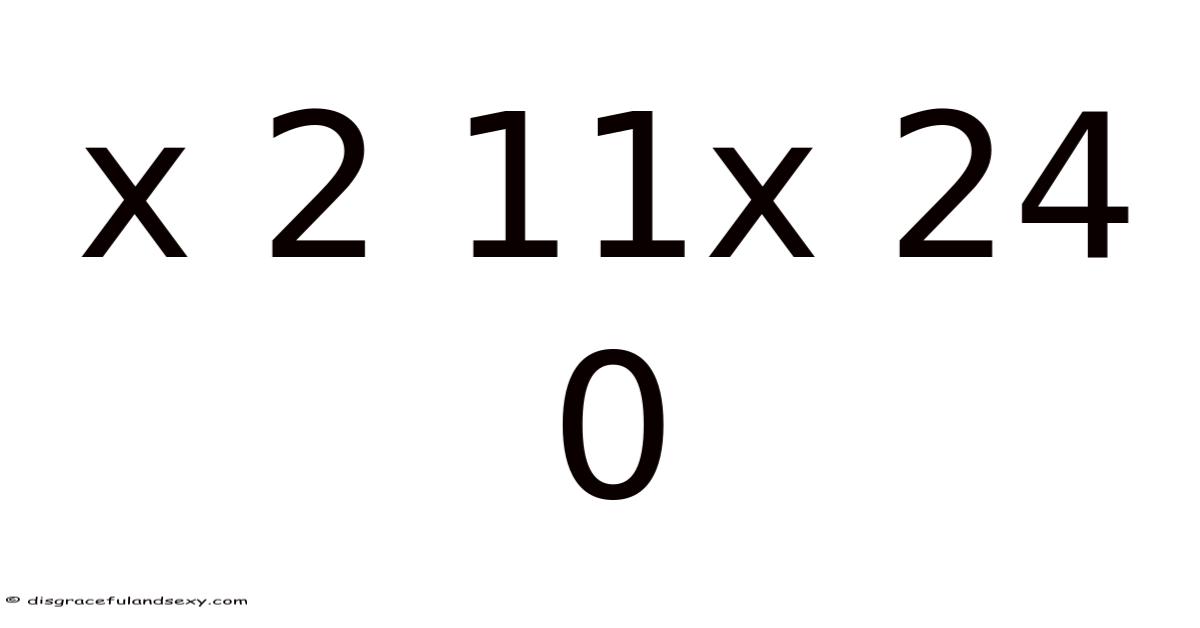
Decoding the Mathematical Puzzle: x² + 11x + 24 = 0
This article breaks down the solution and underlying principles of the quadratic equation x² + 11x + 24 = 0. That's why we'll explore multiple methods for solving this equation, explaining the concepts behind each approach, and ultimately aiming to provide a comprehensive understanding of quadratic equations, suitable for students and anyone interested in brushing up on their algebra skills. We'll also explore the practical applications of solving such equations and address some frequently asked questions.
Introduction to Quadratic Equations
A quadratic equation is a polynomial equation of the second degree, meaning the highest power of the variable (usually x) is 2. The general form of a quadratic equation is ax² + bx + c = 0, where a, b, and c are constants, and a is not equal to zero. Our specific equation, x² + 11x + 24 = 0, fits this general form with a = 1, b = 11, and c = 24. Understanding quadratic equations is crucial in various fields, including physics, engineering, and economics, as they model many real-world phenomena involving parabolic curves and relationships.
Method 1: Factoring the Quadratic Expression
This is often the quickest and easiest method if the quadratic expression can be readily factored. Factoring involves finding two binomials whose product equals the original quadratic expression. We're looking for two numbers that add up to 11 (the coefficient of x) and multiply to 24 (the constant term).
These numbers are 3 and 8. So, we can factor the equation as follows:
(x + 3)(x + 8) = 0
This equation is true if either (x + 3) = 0 or (x + 8) = 0. Solving these simple linear equations gives us the solutions:
- x + 3 = 0 => x = -3
- x + 8 = 0 => x = -8
That's why, the solutions to the quadratic equation x² + 11x + 24 = 0 are x = -3 and x = -8 And that's really what it comes down to..
Method 2: Using the Quadratic Formula
The quadratic formula is a powerful tool that can solve any quadratic equation, regardless of whether it's easily factorable. The formula is derived from completing the square and provides a direct way to find the solutions. The formula is:
x = [-b ± √(b² - 4ac)] / 2a
Substituting the values from our equation (a = 1, b = 11, c = 24), we get:
x = [-11 ± √(11² - 4 * 1 * 24)] / (2 * 1) x = [-11 ± √(121 - 96)] / 2 x = [-11 ± √25] / 2 x = [-11 ± 5] / 2
This gives us two solutions:
- x = (-11 + 5) / 2 = -6 / 2 = -3
- x = (-11 - 5) / 2 = -16 / 2 = -8
Again, we arrive at the same solutions: x = -3 and x = -8.
Method 3: Completing the Square
Completing the square is a technique that transforms the quadratic equation into a perfect square trinomial, making it easier to solve. The steps are as follows:
-
Move the constant term to the right side: x² + 11x = -24
-
Take half of the coefficient of x, square it, and add it to both sides: Half of 11 is 5.5, and 5.5² = 30.25. So we add 30.25 to both sides:
x² + 11x + 30.Worth adding: 25 = -24 + 30. Also, 25 x² + 11x + 30. 25 = 6.
-
Rewrite the left side as a perfect square: (x + 5.5)² = 6.25
-
Take the square root of both sides: x + 5.5 = ±√6.25 = ±2.5
-
Solve for x:
- x + 5.5 = 2.5 => x = 2.5 - 5.5 = -3
- x + 5.5 = -2.5 => x = -2.5 - 5.5 = -8
Once again, we obtain the solutions x = -3 and x = -8.
Graphical Representation and the Discriminant
The solutions to the quadratic equation x² + 11x + 24 = 0 represent the x-intercepts (or roots) of the parabola defined by the function y = x² + 11x + 24. Graphically, these points are where the parabola intersects the x-axis And it works..
The discriminant, denoted as Δ (Delta), is the part of the quadratic formula under the square root: b² - 4ac. It helps determine the nature of the solutions:
- Δ > 0: Two distinct real roots (as in our case).
- Δ = 0: One real root (a repeated root).
- Δ < 0: Two complex roots (involving imaginary numbers).
In our equation, Δ = 11² - 4(1)(24) = 25, which is greater than 0, indicating two distinct real roots, confirming our findings.
Applications of Quadratic Equations
Quadratic equations are not merely abstract mathematical concepts; they have numerous real-world applications. Here are a few examples:
- Projectile motion: The trajectory of a projectile (like a ball thrown in the air) can be modeled using a quadratic equation. Solving the equation helps determine the time it takes to reach a certain height or the maximum height reached.
- Area calculations: Finding the dimensions of a rectangular area given its area and perimeter often involves solving a quadratic equation.
- Engineering and Physics: Quadratic equations are used extensively in various engineering and physics problems, including those related to circuits, mechanics, and optics.
- Economics: Quadratic functions can model cost, revenue, and profit functions, and solving related quadratic equations can help determine optimal production levels or pricing strategies.
Frequently Asked Questions (FAQ)
Q: What if the quadratic equation doesn't factor easily?
A: In such cases, the quadratic formula or completing the square methods are reliable alternatives. These methods always provide the solutions, even if factoring is difficult or impossible.
Q: Can a quadratic equation have only one solution?
A: Yes, if the discriminant (b² - 4ac) is equal to zero, the quadratic equation has exactly one real root (a repeated root) Still holds up..
Q: What if the discriminant is negative?
A: If the discriminant is negative, the quadratic equation has two complex roots, which involve the imaginary unit i (where i² = -1). These complex roots are not typically encountered in basic applications but are important in advanced mathematics and some areas of physics and engineering Which is the point..
Q: Are there other methods to solve quadratic equations?
A: While factoring, the quadratic formula, and completing the square are the most common methods, other less frequently used techniques exist, such as using graphical methods or numerical approximation techniques Most people skip this — try not to..
Conclusion
Solving the quadratic equation x² + 11x + 24 = 0, using factoring, the quadratic formula, or completing the square, consistently yields the solutions x = -3 and x = -8. Understanding the different methods for solving quadratic equations provides a valuable skill set applicable to various mathematical and real-world problems. Remember to practice regularly to solidify your understanding and improve your problem-solving skills. In real terms, mastering quadratic equations is a crucial stepping stone in advanced mathematics and related fields. That's why the concept of the discriminant helps predict the nature of the solutions, and the graphical representation helps visualize the problem. The seemingly simple equation x² + 11x + 24 = 0 opens doors to a much broader understanding of algebra and its diverse applications.
