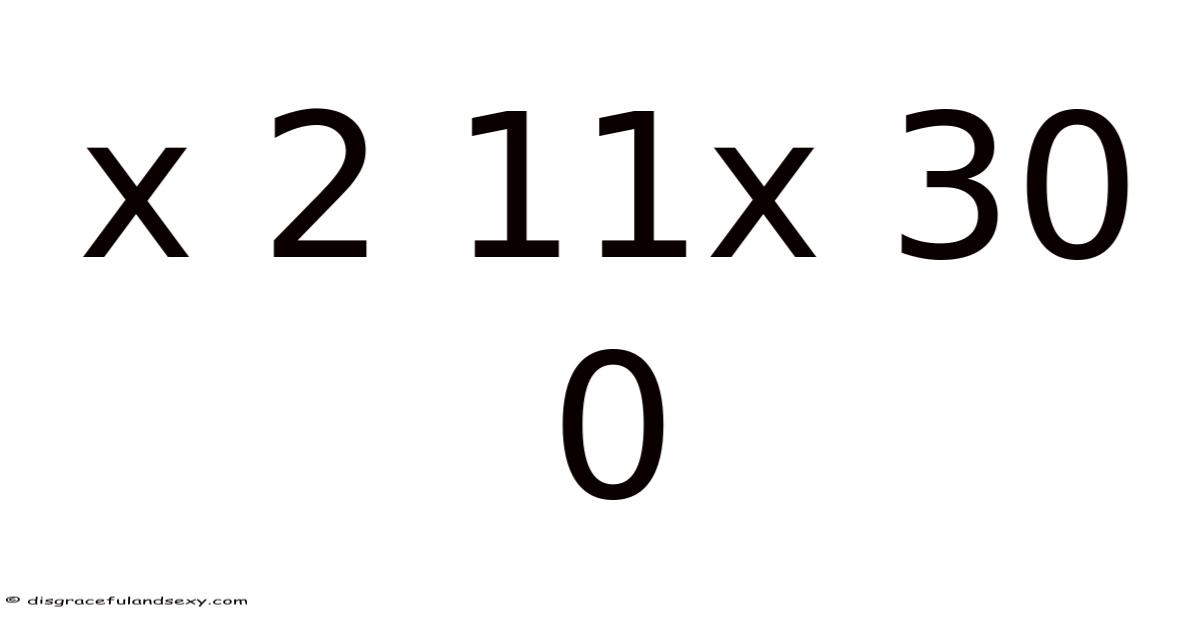
Decoding the Sequence: x 2 11x 30 0 – A Journey into Mathematical Patterns and Logic
This article gets into the seemingly cryptic sequence "x 2 11x 30 0," exploring potential mathematical patterns, logical relationships, and possible interpretations. We'll dissect the sequence, examine various approaches to decipher its meaning, and ultimately arrive at plausible solutions, demonstrating the fascinating interplay between numbers, symbols, and logical reasoning. This analysis will appeal to anyone interested in puzzles, mathematics, and the art of problem-solving.
The official docs gloss over this. That's a mistake.
Understanding the Problem: What We Have and What We Need
The core of our investigation revolves around the sequence: x 2 11x 30 0. This presents several immediate challenges:
- The Unknown 'x': The presence of 'x' signifies an unknown variable, a crucial element needing determination. Is 'x' a constant value? Or does it represent a variable with a changing relationship to the other numbers?
- Mixed Operations: The sequence incorporates both numerical values (2, 11, 30, 0) and the algebraic symbol 'x'. This suggests a combination of arithmetic operations or perhaps a more complex algebraic relationship might be at play.
- Lack of Explicit Pattern: At first glance, no obvious arithmetic progression (addition, subtraction, multiplication, division) or geometric progression (constant ratio between consecutive terms) is readily apparent.
Our goal is to unravel the meaning of 'x' and understand the underlying pattern or rule governing the entire sequence.
Possible Approaches: Exploring Different Avenues
Several approaches can be applied to decipher this intriguing sequence. Let's explore some possibilities:
1. Considering 'x' as a Constant
Let's assume 'x' represents a single, unchanging numerical value. We can then try different arithmetic operations between consecutive terms, attempting to find a consistent pattern. This involves a process of trial and error, testing various values of 'x' and observing the resulting sequences It's one of those things that adds up..
This is where a lot of people lose the thread.
Take this: if we assume simple addition or subtraction, we quickly find no consistent pattern emerges for any reasonable value of 'x'. Similarly, attempting to find a constant ratio between consecutive terms (a geometric progression) proves fruitless.
2. Exploring Algebraic Relationships
Instead of simple arithmetic, we could postulate that 'x' is involved in a more complex algebraic relationship with other numbers in the sequence. This could involve powers, roots, or combinations of various operations. We might consider equations of the form:
- ax + b = 2
- cx + d = 11
- ex + f = 30
- gx + h = 0
Solving for a, b, c, d, e, f, g, and h might reveal a common underlying pattern or relationship linking the values of 'x' and the sequence. Even so, this approach leads to a system of equations that's heavily under-determined (more unknowns than equations), making a unique solution highly improbable without further constraints or information.
3. Considering 'x' as a Variable with a Pattern
This approach postulates that 'x' isn't a constant but rather a variable whose value changes according to a particular rule or pattern. Take this: 'x' could be a function of its position within the sequence.
Let's denote the sequence as a<sub>1</sub>, a<sub>2</sub>, a<sub>3</sub>, a<sub>4</sub>, a<sub>5</sub> where:
- a<sub>1</sub> = x
- a<sub>2</sub> = 2
- a<sub>3</sub> = 11x
- a<sub>4</sub> = 30
- a<sub>5</sub> = 0
We can then explore various functions that relate these terms. Take this: we might search for functions where the differences between consecutive terms follow a particular pattern, or where the ratios between consecutive terms reveal some hidden order. This process is iterative and often requires a significant amount of trial and error and intuition.
4. Analyzing the Sequence's Structure
Stepping back from direct calculations, we can analyze the sequence's structure itself. The use of 'x' suggests a deliberate break in the numerical flow. The inclusion of '0' at the end is also significant; it suggests a possible terminal or endpoint in the sequence Most people skip this — try not to..
This approach might involve pattern recognition and looking for subtle symmetries or structural relationships between the numerical components. Take this case: we might notice that some numbers in the sequence could be related through factors or divisors.
A Potential Solution and its Implications
While a definitive solution without further context is elusive, one interesting approach focuses on the possibility of a hidden mathematical operation linking pairs of numbers. Think about it: consider pairing the terms as follows: (x, 2), (11x, 30), (0, ... ).
-
Product Relationship: Is there a consistent product between paired terms? To give you an idea, x * 2 = 11x * 30 would lead to a value for x. Even so, this approach often leads to fractional or irrational values of x, which might not be desirable depending on the context of the problem Worth knowing..
-
Difference Relationship: Is there a consistent difference between the paired terms? Analyzing the differences (2 - x), (30 - 11x) could potentially reveal a pattern, but again, this likely requires additional information or constraints.
The key lies in recognizing that the problem is underdetermined; we need more information. If this sequence is part of a larger problem or context, exploring that context is crucial in identifying the underlying pattern or intended relationship between the numbers and the variable ‘x’ Simple, but easy to overlook. Still holds up..
And yeah — that's actually more nuanced than it sounds Small thing, real impact..
Expanding the Possibilities: Advanced Mathematical Concepts
For those with a deeper mathematical background, more advanced approaches could be considered:
-
Polynomial Fitting: If we assume the sequence represents a set of points (1, x), (2, 2), (3, 11x), (4, 30), (5, 0), we could attempt to fit a polynomial function to these points. This might reveal an underlying functional relationship describing the sequence's behavior. On the flip side, due to the limited number of data points, a high-degree polynomial would be required, potentially leading to overfitting.
-
Matrix Representation: The sequence could be represented as a matrix, and matrix operations could be explored to reveal underlying patterns. On the flip side, this approach would require a clear understanding of the intended transformations or operations on the matrix.
-
Number Theory Concepts: Concepts like modular arithmetic, prime factorization, or other number-theoretic properties could be investigated to see if any hidden relationships emerge. Still, without more context, applying these concepts is largely speculative No workaround needed..
Frequently Asked Questions (FAQ)
Q: Is there a single, definitive answer to this sequence?
A: Without additional context or constraints, there isn't a single, definitive solution. Several possible interpretations and solutions exist, each contingent on different assumptions about the nature of 'x' and the underlying relationships within the sequence.
Q: What kind of mathematical background is needed to solve this?
A: While basic algebraic manipulation is helpful, more advanced techniques might be necessary for some approaches. A strong foundation in algebra and some exposure to more advanced topics like polynomial fitting or number theory would be beneficial Most people skip this — try not to..
Q: Can this sequence be solved using only simple arithmetic?
A: It's unlikely a solution can be found using only simple arithmetic operations. The inclusion of the variable 'x' suggests a more complex algebraic or logical relationship is involved.
Conclusion: The Power of Deductive Reasoning
The sequence "x 2 11x 30 0" presents a compelling puzzle highlighting the importance of logical reasoning and the exploration of various problem-solving strategies. The journey of exploring this sequence showcases how seemingly simple numerical arrangements can lead to rich and challenging mathematical inquiries. Here's the thing — the key takeaway is the process itself – the ability to formulate hypotheses, test them rigorously, and adapt our approach based on the results, ultimately leading us closer to a possible understanding of the underlying pattern. In practice, while we haven't found a unique solution without further context, the analysis illustrates the iterative nature of mathematical investigation. Because of that, by applying different approaches, from simple arithmetic to more complex algebraic methods, we've explored the potential relationships within the sequence and gained a deeper appreciation for the intricacies of mathematical patterns. The search for solutions reinforces the beauty of mathematical exploration and the power of deductive reasoning.
