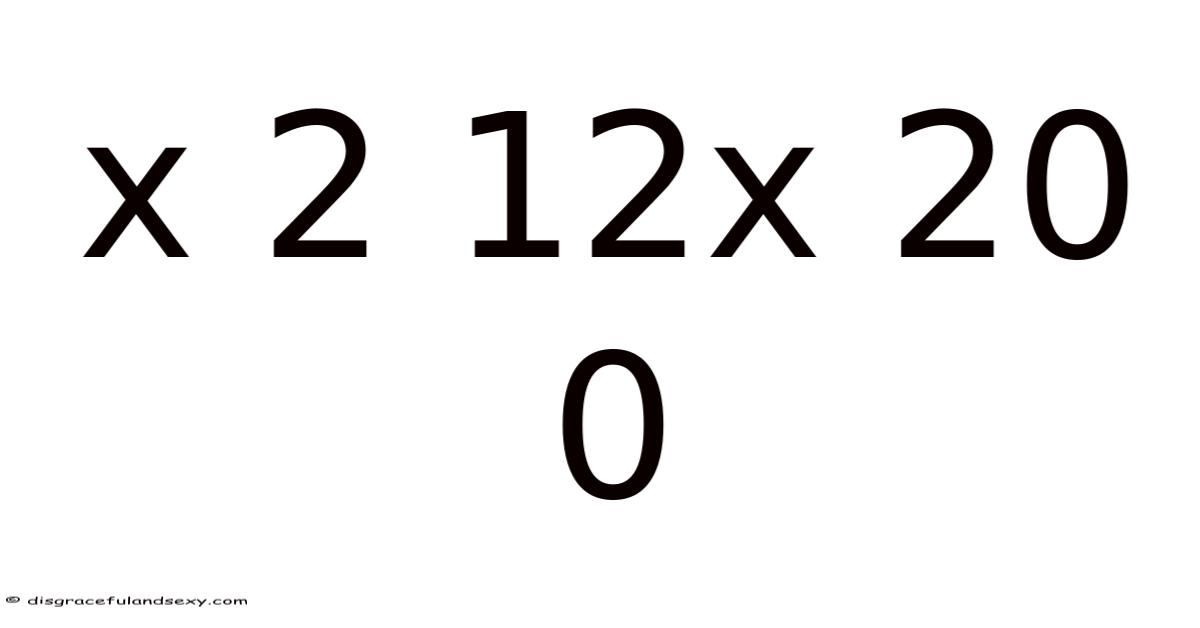
Decoding the Mystery: x² + 12x + 20 = 0
This article digs into the solution and understanding of the quadratic equation x² + 12x + 20 = 0. Practically speaking, we'll explore various methods for solving this equation, including factoring, using the quadratic formula, and completing the square. Understanding quadratic equations is fundamental in algebra and has wide-ranging applications in various fields like physics, engineering, and economics. This guide aims to provide a comprehensive understanding, suitable for students and anyone looking to refresh their algebraic skills Small thing, real impact..
Introduction to Quadratic Equations
A quadratic equation is a polynomial equation of the second degree, meaning the highest power of the variable (x in this case) is 2. Still, our specific equation, x² + 12x + 20 = 0, fits this form with a = 1, b = 12, and c = 20. But the general form of a quadratic equation is ax² + bx + c = 0, where 'a', 'b', and 'c' are constants, and 'a' is not equal to zero. Solving this equation means finding the values of 'x' that make the equation true.
Worth pausing on this one It's one of those things that adds up..
Method 1: Factoring the Quadratic Expression
Factoring is a powerful technique to solve quadratic equations if the expression can be easily factored. Which means we are looking for two numbers that add up to 'b' (12) and multiply to 'c' (20). Those numbers are 2 and 10.
(x + 2)(x + 10) = 0
This equation is true if either (x + 2) = 0 or (x + 10) = 0. Solving these individual equations gives us the solutions:
- x + 2 = 0 => x = -2
- x + 10 = 0 => x = -10
That's why, the solutions to the quadratic equation x² + 12x + 20 = 0 are x = -2 and x = -10. These are also known as the roots or zeros of the equation That's the part that actually makes a difference..
Method 2: Using the Quadratic Formula
The quadratic formula is a universal method for solving any quadratic equation, regardless of whether it's easily factorable. The formula is:
x = [-b ± √(b² - 4ac)] / 2a
Substituting the values from our equation (a = 1, b = 12, c = 20) into the formula, we get:
x = [-12 ± √(12² - 4 * 1 * 20)] / (2 * 1) x = [-12 ± √(144 - 80)] / 2 x = [-12 ± √64] / 2 x = [-12 ± 8] / 2
This gives us two solutions:
- x = (-12 + 8) / 2 = -4 / 2 = -2
- x = (-12 - 8) / 2 = -20 / 2 = -10
Again, we arrive at the solutions x = -2 and x = -10, confirming the results obtained through factoring.
Method 3: Completing the Square
Completing the square is another algebraic technique for solving quadratic equations. This method involves manipulating the equation to create a perfect square trinomial. The steps are as follows:
-
Move the constant term to the right side: x² + 12x = -20
-
Take half of the coefficient of the x term (12/2 = 6), square it (6² = 36), and add it to both sides: x² + 12x + 36 = -20 + 36 x² + 12x + 36 = 16
-
Factor the perfect square trinomial on the left side: (x + 6)² = 16
-
Take the square root of both sides: x + 6 = ±√16 x + 6 = ±4
-
Solve for x:
- x + 6 = 4 => x = 4 - 6 = -2
- x + 6 = -4 => x = -4 - 6 = -10
Once again, we obtain the solutions x = -2 and x = -10.
Graphical Representation and Interpretation
The solutions of a quadratic equation represent the x-intercepts (points where the graph intersects the x-axis) of the parabola defined by the equation y = x² + 12x + 20. That's why the parabola opens upwards because the coefficient of x² (a = 1) is positive. Consider this: if we were to plot this parabola, it would intersect the x-axis at x = -2 and x = -10. This means the parabola has a minimum value.
The Discriminant: Understanding the Nature of Roots
The expression b² - 4ac within the quadratic formula is called the discriminant. It provides information about the nature of the roots of the quadratic equation:
- If b² - 4ac > 0: The equation has two distinct real roots (as in our case).
- If b² - 4ac = 0: The equation has one real root (a repeated root).
- If b² - 4ac < 0: The equation has two complex roots (roots involving the imaginary unit i).
In our equation, the discriminant is 12² - 4(1)(20) = 64, which is positive. This confirms that we have two distinct real roots.
Applications of Quadratic Equations
Quadratic equations are not merely abstract mathematical concepts; they have numerous real-world applications. Here are a few examples:
- Physics: Calculating projectile motion, determining the trajectory of objects under gravity.
- Engineering: Designing bridges, calculating structural stability, analyzing circuits.
- Economics: Modeling supply and demand curves, optimizing production levels.
- Computer Graphics: Creating curves and shapes in 2D and 3D graphics.
Frequently Asked Questions (FAQ)
Q1: What if the quadratic equation cannot be easily factored?
A1: If factoring is difficult or impossible, the quadratic formula or completing the square are reliable alternatives. These methods will always provide the solutions, regardless of the equation's complexity And it works..
Q2: Can a quadratic equation have only one solution?
A2: Yes, a quadratic equation can have one real solution (a repeated root) if the discriminant (b² - 4ac) is equal to zero. This corresponds to the parabola touching the x-axis at only one point.
Q3: What are complex roots?
A3: Complex roots occur when the discriminant (b² - 4ac) is negative. These roots involve the imaginary unit i, where i² = -1. Complex roots often have physical interpretations in areas like electrical engineering and signal processing Less friction, more output..
Q4: How can I check if my solutions are correct?
A4: Substitute the obtained values of 'x' back into the original equation. Here's the thing — if the equation holds true for both values, your solutions are correct. So for example, substituting x = -2 into x² + 12x + 20 = 0 gives (-2)² + 12(-2) + 20 = 4 - 24 + 20 = 0, which is true. Similarly, substituting x = -10 will also result in 0.
Conclusion
Solving quadratic equations like x² + 12x + 20 = 0 is a fundamental skill in algebra. On the flip side, mastering these techniques will undoubtedly enhance your mathematical proficiency and open doors to more advanced mathematical concepts. Day to day, we explored three different methods: factoring, using the quadratic formula, and completing the square, all leading to the same solutions: x = -2 and x = -10. Understanding the discriminant helps predict the nature of the roots. Quadratic equations have broad applications across various disciplines, highlighting their importance in both theoretical mathematics and practical problem-solving. Remember to practice regularly to build confidence and familiarity with these essential algebraic tools.
