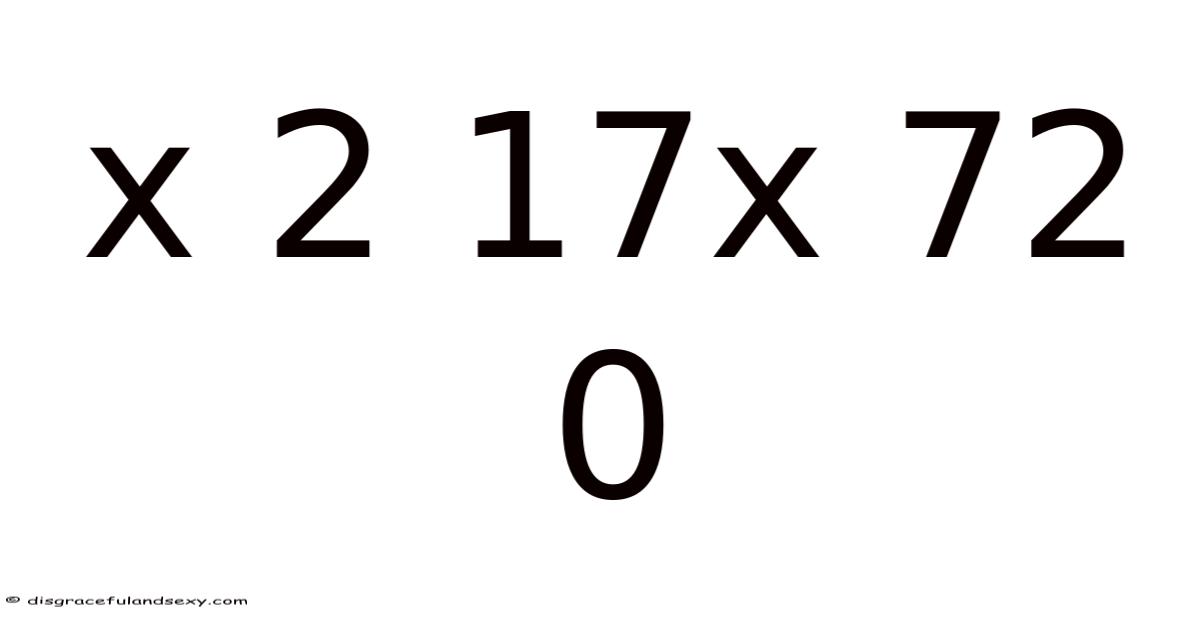
Decoding the Mathematical Puzzle: x² + 17x + 72 = 0
This article walks through the solution and underlying principles of the quadratic equation x² + 17x + 72 = 0. Now, we will explore various methods to solve this equation, providing a comprehensive understanding suitable for students and anyone interested in strengthening their algebra skills. Understanding quadratic equations is crucial for various fields, from physics and engineering to finance and computer science. This guide will not only show you how to solve this specific equation but also equip you with the knowledge to tackle similar problems.
Some disagree here. Fair enough.
Introduction to Quadratic Equations
A quadratic equation is a second-degree polynomial equation of the form ax² + bx + c = 0, where 'a', 'b', and 'c' are constants, and 'a' is not equal to zero. Our equation, x² + 17x + 72 = 0, fits this form perfectly, with a = 1, b = 17, and c = 72. Solving a quadratic equation means finding the values of 'x' that make the equation true. These values are called the roots or solutions of the equation.
Easier said than done, but still worth knowing.
There are several methods to solve quadratic equations: factoring, using the quadratic formula, and completing the square. We will explore each method in detail, applying them to our specific equation Not complicated — just consistent..
Method 1: Factoring
Factoring involves expressing the quadratic expression as a product of two linear expressions. This method is particularly efficient when the quadratic equation has easily identifiable factors. We are looking for two numbers that add up to 'b' (17) and multiply to 'c' (72).
Let's consider the factors of 72: 1 and 72, 2 and 36, 3 and 24, 4 and 18, 6 and 12, 8 and 9 It's one of those things that adds up..
Notice that 8 and 9 add up to 17. Because of this, we can factor the equation as follows:
(x + 8)(x + 9) = 0
This equation is true if either (x + 8) = 0 or (x + 9) = 0. Solving these linear equations gives us the roots:
x + 8 = 0 => x = -8 x + 9 = 0 => x = -9
That's why, the solutions to the quadratic equation x² + 17x + 72 = 0 are x = -8 and x = -9.
Method 2: The Quadratic Formula
The quadratic formula is a general method that can be used to solve any quadratic equation, regardless of whether it can be easily factored. The formula is:
x = [-b ± √(b² - 4ac)] / 2a
Substituting the values from our equation (a = 1, b = 17, c = 72), we get:
x = [-17 ± √(17² - 4 * 1 * 72)] / (2 * 1) x = [-17 ± √(289 - 288)] / 2 x = [-17 ± √1] / 2 x = [-17 ± 1] / 2
This gives us two solutions:
x = (-17 + 1) / 2 = -16 / 2 = -8 x = (-17 - 1) / 2 = -18 / 2 = -9
Again, we arrive at the same solutions: x = -8 and x = -9. The quadratic formula provides a reliable method, especially when factoring is difficult or impossible But it adds up..
Method 3: Completing the Square
Completing the square is another powerful technique for solving quadratic equations. This method involves manipulating the equation to create a perfect square trinomial, which can then be easily factored.
Starting with x² + 17x + 72 = 0, we first move the constant term to the right side of the equation:
x² + 17x = -72
Next, we take half of the coefficient of the 'x' term (17/2 = 8.Worth adding: 5), square it (8. 5² = 72 But it adds up..
x² + 17x + 72.So naturally, 25 = -72 + 72. 25 x² + 17x + 72.25 = 0.
Now, the left side is a perfect square trinomial:
(x + 8.5)² = 0.25
Taking the square root of both sides:
x + 8.Which means 25 x + 8. 5 = ±√0.5 = ±0 Most people skip this — try not to..
Solving for x:
x = -8.5 + 0.In real terms, 5 = -8 x = -8. 5 - 0.
Once again, we obtain the solutions x = -8 and x = -9. While this method might seem more complex initially, it's a valuable tool for understanding the structure of quadratic equations and is essential in various advanced mathematical concepts Simple, but easy to overlook. Took long enough..
Graphical Representation
The solutions to the quadratic equation represent the x-intercepts of the parabola defined by the function y = x² + 17x + 72. Now, if you were to graph this function, you would see that the parabola intersects the x-axis at x = -8 and x = -9. These points visually confirm our calculated solutions Not complicated — just consistent. That's the whole idea..
The Discriminant and Nature of Roots
The expression inside the square root in the quadratic formula, b² - 4ac, is called the discriminant. The discriminant determines the nature of the roots:
- b² - 4ac > 0: The equation has two distinct real roots. This is the case in our example (17² - 4 * 1 * 72 = 1 > 0).
- b² - 4ac = 0: The equation has one real root (a repeated root).
- b² - 4ac < 0: The equation has two complex conjugate roots (involving imaginary numbers).
In our case, the discriminant is positive, indicating two distinct real roots, which we have already found to be -8 and -9 The details matter here. Surprisingly effective..
Applications of Quadratic Equations
Quadratic equations have wide-ranging applications across various fields. Here are a few examples:
- Physics: Calculating projectile motion, determining the trajectory of objects under gravity.
- Engineering: Designing structures, analyzing stresses and strains in materials.
- Economics: Modeling supply and demand curves, optimizing production levels.
- Computer Science: Solving optimization problems, implementing algorithms.
Understanding quadratic equations is foundational to solving many more complex problems in these and other disciplines Simple, but easy to overlook..
Frequently Asked Questions (FAQ)
Q: What if 'a' was not equal to 1 in the equation?
A: The methods remain the same, but you would need to account for the 'a' coefficient throughout the calculations. Worth adding: for example, in the quadratic formula, the 'a' value is directly used in the calculations. Factoring might require a bit more effort, but the principle remains the same Still holds up..
Q: Can I use a calculator to solve quadratic equations?
A: Yes, many scientific calculators have built-in functions to solve quadratic equations directly. That's why you simply input the values of a, b, and c, and the calculator will provide the solutions. Even so, understanding the underlying methods is crucial for grasping the concepts involved.
Q: Why is it important to learn different methods for solving quadratic equations?
A: Each method offers a different approach and perspective on solving quadratic equations. Factoring is efficient when it's possible, the quadratic formula is universally applicable, and completing the square provides insights into the equation's structure and is helpful in more advanced mathematical contexts. Learning multiple methods allows you to choose the most appropriate technique for a given situation And that's really what it comes down to..
Conclusion
Solving the quadratic equation x² + 17x + 72 = 0 has provided us with an opportunity to explore three fundamental methods: factoring, using the quadratic formula, and completing the square. Each method leads to the same solutions: x = -8 and x = -9. Understanding these methods is crucial not only for solving quadratic equations but also for building a solid foundation in algebra and its various applications in different fields. Remember that the discriminant helps determine the nature of the roots, providing further insight into the characteristics of the quadratic equation. Mastering quadratic equations is a significant step towards success in mathematics and related disciplines. The knowledge gained here will empower you to confidently tackle more complex mathematical problems in the future.
