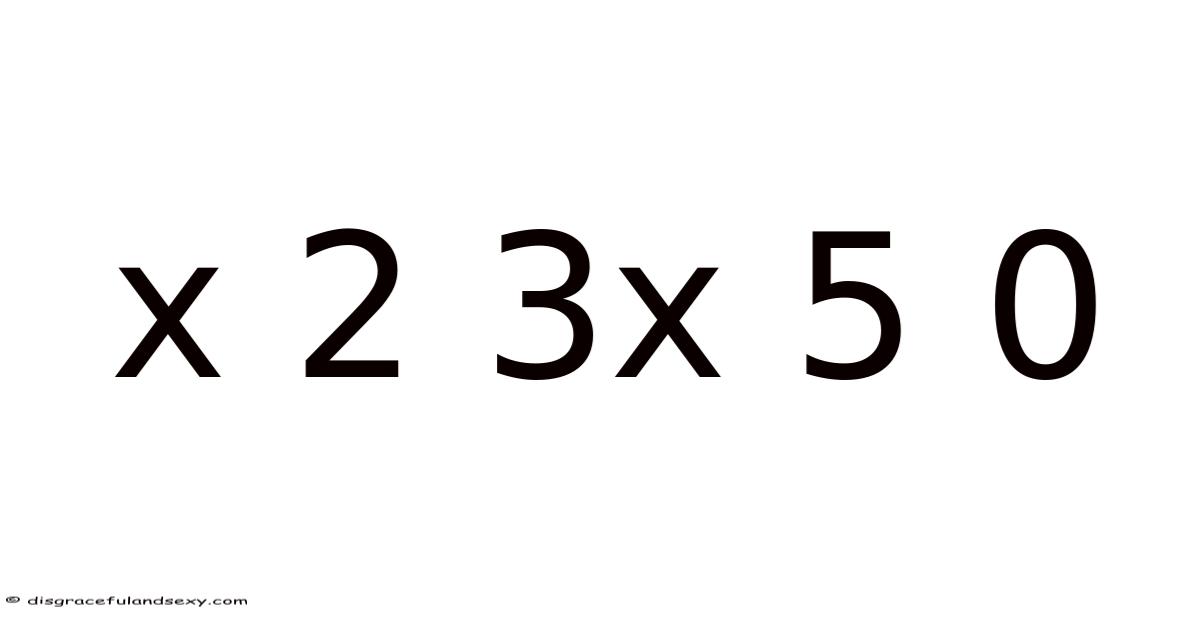
Deconstructing the Mathematical Expression: x² + 3x + 5 = 0
This article explores the mathematical expression x² + 3x + 5 = 0, delving into its meaning, solving methods, and broader applications within the field of algebra. In real terms, we'll cover various approaches to finding solutions, examining both the theoretical underpinnings and the practical steps involved. Understanding quadratic equations like this is fundamental to many areas of mathematics and science, providing a building block for more complex concepts. This guide aims to demystify the process, making it accessible to learners of all levels Took long enough..
Introduction: Understanding Quadratic Equations
The expression x² + 3x + 5 = 0 represents a quadratic equation. A quadratic equation is a polynomial equation of the second degree, meaning the highest power of the variable (in this case, x) is 2. But the general form of a quadratic equation is ax² + bx + c = 0, where 'a', 'b', and 'c' are constants, and 'a' is not equal to zero. In our specific equation, a = 1, b = 3, and c = 5 Less friction, more output..
The solutions to a quadratic equation are the values of x that make the equation true. These solutions are also known as the roots or zeros of the equation. Finding these roots is a central task in algebra, with various techniques available depending on the nature of the equation But it adds up..
The official docs gloss over this. That's a mistake Easy to understand, harder to ignore..
Method 1: Solving Using the Quadratic Formula
The quadratic formula is a powerful tool for solving any quadratic equation. It provides a direct method for calculating the roots, regardless of whether they are real or complex numbers. The formula is derived from completing the square and is expressed as:
x = [-b ± √(b² - 4ac)] / 2a
Let's apply this to our equation, x² + 3x + 5 = 0:
- a = 1
- b = 3
- c = 5
Substituting these values into the quadratic formula, we get:
x = [-3 ± √(3² - 4 * 1 * 5)] / (2 * 1) x = [-3 ± √(9 - 20)] / 2 x = [-3 ± √(-11)] / 2
Notice that we have a negative number under the square root. This indicates that the roots of this particular quadratic equation are complex numbers. Complex numbers involve the imaginary unit 'i', where i² = -1.
x = [-3 ± i√11] / 2
This gives us two complex conjugate roots:
x₁ = (-3 + i√11) / 2 x₂ = (-3 - i√11) / 2
Method 2: Completing the Square
Completing the square is another method for solving quadratic equations. This method involves manipulating the equation to create a perfect square trinomial, which can then be easily factored. Here's how it works for our equation:
-
Move the constant term to the right side:
x² + 3x = -5
-
Take half of the coefficient of x (which is 3), square it ((3/2)² = 9/4), and add it to both sides:
x² + 3x + 9/4 = -5 + 9/4
-
Simplify the right side:
x² + 3x + 9/4 = -11/4
-
Factor the left side as a perfect square:
(x + 3/2)² = -11/4
-
Take the square root of both sides:
x + 3/2 = ±√(-11/4)
-
Solve for x:
x = -3/2 ± (i√11)/2
This again yields the same complex conjugate roots as the quadratic formula:
x₁ = (-3 + i√11) / 2 x₂ = (-3 - i√11) / 2
Method 3: Graphical Representation
While the previous methods provide precise numerical solutions, a graphical representation can offer valuable insight. The graph of a quadratic equation is a parabola. The x-intercepts of the parabola correspond to the roots of the equation. Because of that, since our equation has complex roots, its parabola will not intersect the x-axis. This means there are no real solutions; the parabola lies entirely above the x-axis. Plotting the equation y = x² + 3x + 5 would visually confirm this Easy to understand, harder to ignore..
The Discriminant: Understanding the Nature of Roots
The expression inside the square root of the quadratic formula, b² - 4ac, is called the discriminant. The discriminant determines the nature of the roots of the quadratic equation:
- If b² - 4ac > 0: The equation has two distinct real roots. The parabola intersects the x-axis at two points.
- If b² - 4ac = 0: The equation has one real root (a repeated root). The parabola touches the x-axis at one point.
- If b² - 4ac < 0: The equation has two complex conjugate roots. The parabola does not intersect the x-axis.
In our case, b² - 4ac = 9 - 20 = -11, which is less than 0. This confirms that our equation has two complex conjugate roots, as we've already calculated Took long enough..
Applications of Quadratic Equations
Quadratic equations are not merely abstract mathematical concepts; they have numerous practical applications across various fields:
- Physics: Describing projectile motion, calculating the trajectory of objects under gravity, and analyzing oscillations.
- Engineering: Designing structures, analyzing stress and strain in materials, and modeling electrical circuits.
- Economics: Modeling supply and demand curves, optimizing production levels, and determining profit maximization points.
- Computer Graphics: Creating curves and shapes, simulating realistic movements, and rendering three-dimensional objects.
- Finance: Calculating compound interest, determining investment returns, and modeling financial growth.
Frequently Asked Questions (FAQ)
Q: Why are complex numbers necessary to solve this equation?
A: Complex numbers are required because the discriminant (b² - 4ac) is negative. The square root of a negative number is not a real number, requiring the introduction of the imaginary unit 'i' to represent it Worth keeping that in mind..
Q: Can all quadratic equations be solved using the quadratic formula?
A: Yes, the quadratic formula is a universal method for solving any quadratic equation, regardless of the nature of its coefficients or roots.
Q: What is the significance of complex conjugate roots?
A: Complex conjugate roots always appear in pairs when solving quadratic equations with real coefficients. They represent symmetrical solutions in the complex plane.
Q: Are there other methods to solve quadratic equations besides those mentioned?
A: Yes, other methods exist, such as factoring (when possible), using graphical methods for approximate solutions, or numerical methods for complex equations And that's really what it comes down to..
Conclusion: Mastering Quadratic Equations
Solving the quadratic equation x² + 3x + 5 = 0 has provided a comprehensive example demonstrating the application of various techniques in algebra. In practice, from the quadratic formula and completing the square to understanding the significance of the discriminant and graphical representation, we've covered multiple approaches to solving and interpreting the results. Remember, mastering quadratic equations is not just about finding the solutions; it's about understanding the underlying concepts, appreciating the various solution methods, and recognizing their widespread applications across different disciplines. This foundational knowledge forms a critical stepping stone for tackling more advanced mathematical concepts and real-world problems. The journey into the world of algebra is a rewarding one, and understanding quadratic equations is a key element in this journey Small thing, real impact..
