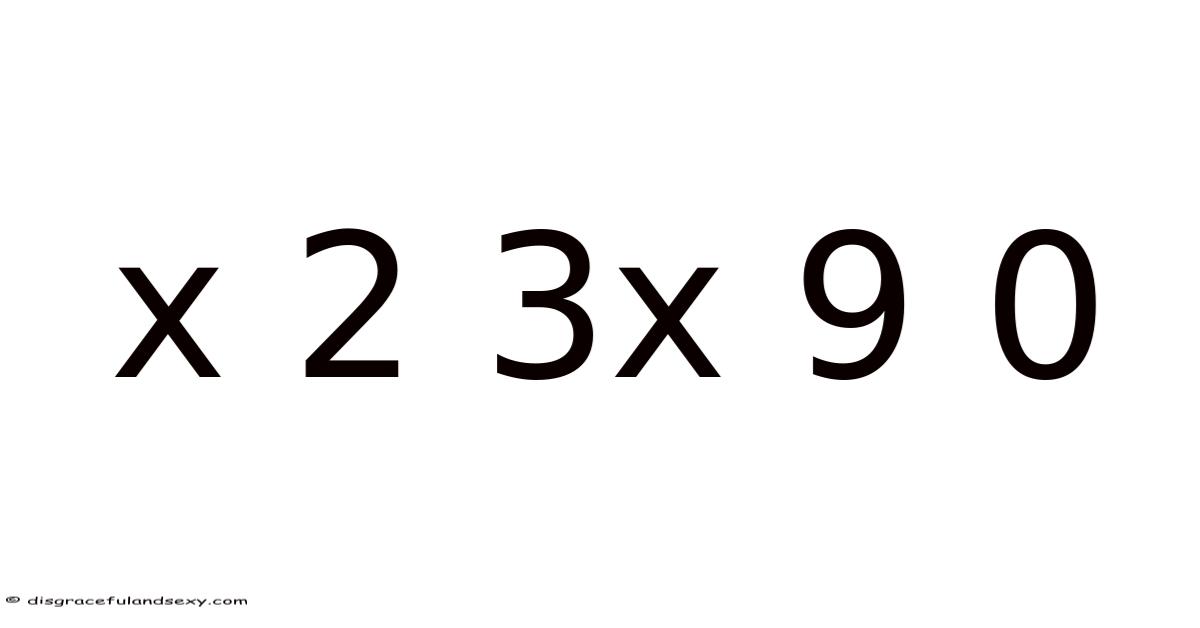
Decoding the Sequence: Exploring the Mathematical Patterns and Possibilities of "x 2 3x 9 0"
This article looks at the intriguing mathematical sequence "x 2 3x 9 0," exploring its potential interpretations, underlying patterns, and possible solutions. We'll examine various mathematical perspectives, from basic algebra to more advanced concepts, demonstrating how different approaches can lead to unique understandings of this seemingly simple sequence. The seemingly random arrangement of numbers and variables opens doors to several mathematical concepts, making it a rich field for exploration and problem-solving.
Introduction: Unveiling the Mystery
The sequence "x 2 3x 9 0" presents a captivating challenge. So this sequence can be interpreted in several ways, depending on the assumed operations and the context. At first glance, it appears to be a random collection of numbers and a variable. On the flip side, a closer examination reveals that it hints at underlying mathematical relationships. Also, we will explore these interpretations, aiming to decipher the pattern and possibly find solutions for 'x'. This seemingly simple sequence provides a springboard for understanding various mathematical principles and techniques.
Possible Interpretations and Solutions
The ambiguity of the sequence allows for different interpretations, each leading to a unique solution method. Let's consider a few:
1. A Simple Algebraic Equation:
The most straightforward interpretation treats the sequence as a simple algebraic equation. We can rearrange it to look more familiar:
x + 2 + 3x + 9 = 0
This is a linear equation. Combining like terms simplifies it to:
4x + 11 = 0
Solving for x:
4x = -11
x = -11/4 or x = -2.75
This is a direct and straightforward solution. This interpretation relies on the implicit assumption that the numbers and variables are added together to equal zero.
2. A Quadratic Equation (Introducing More Complexity):
We could interpret the sequence as representing parts of a quadratic equation. Let's assume there's an implied multiplication or exponentiation involved. While there isn't an immediately obvious quadratic structure, we can explore possibilities:
-
Scenario A: Consider the possibility of a quadratic equation where the terms are related in a more complex manner. This could involve a hidden multiplication or a different arrangement of the elements. Unfortunately, without further constraints or information, creating a meaningful quadratic equation from this sequence is difficult. We'd need additional information or context to construct a valid quadratic model.
-
Scenario B: Let’s imagine the sequence represents coefficients. To give you an idea, we might hypothesize a quadratic equation of the form: ax² + bx + c = 0, where a, b, and c are coefficients. Then, we might assign values like: a = 1, b = 2 + 3 = 5, and c = 9 + 0 = 9. This would yield the quadratic equation x² + 5x + 9 = 0. Solving this equation (using the quadratic formula) would yield complex solutions (involving imaginary numbers), indicating this interpretation might not be appropriate for a real-number solution within the given context Simple, but easy to overlook..
3. A Sequence of Operations:
Instead of an equation, we could see it as a sequence of operations. This opens a new perspective. We could, for instance, interpret it as a series of steps:
- Step 1: Start with x.
- Step 2: Add 2.
- Step 3: Multiply by 3.
- Step 4: Add 9.
- Step 5: The result equals 0.
This would translate to the following equation:
3(x + 2) + 9 = 0
Solving for x:
3x + 6 + 9 = 0
3x = -15
x = -5
This interpretation leads to a different solution than the initial linear approach. This demonstrates the importance of clearly defining the mathematical operations involved in interpreting a sequence.
4. Exploring Number Bases and Other Systems:
We could also venture beyond the standard decimal number system. Perhaps the sequence is expressed in a different base. That said, without additional context suggesting a different number base, this interpretation is speculative and requires further assumptions.
Mathematical Concepts Illustrated
The seemingly simple sequence "x 2 3x 9 0" provides a practical illustration of several fundamental mathematical concepts:
-
Algebraic manipulation: Solving for the unknown variable ('x') requires manipulating the equations through addition, subtraction, multiplication, and division. Different interpretations necessitate different algebraic techniques.
-
Order of operations (PEMDAS/BODMAS): The order in which mathematical operations are performed significantly impacts the result. This is particularly relevant when interpreting the sequence as a series of operations. Correct application of PEMDAS (Parentheses, Exponents, Multiplication and Division, Addition and Subtraction) or BODMAS (Brackets, Orders, Division and Multiplication, Addition and Subtraction) is crucial Easy to understand, harder to ignore..
-
Linear equations: The simplest interpretation leads to a straightforward linear equation, a core concept in elementary algebra.
-
Quadratic equations: The possibility of a quadratic interpretation introduces a more advanced algebraic concept, requiring the use of the quadratic formula or factoring techniques for solution No workaround needed..
-
Problem-solving strategies: The ambiguity of the sequence necessitates exploring different problem-solving strategies and approaches. It encourages creative thinking and the consideration of multiple interpretations Took long enough..
-
Different number systems: Although not directly addressed in this case, the possibility of using a different number base highlights the broader context of mathematical systems.
FAQ (Frequently Asked Questions)
-
Q: Is there only one correct answer?
A: No, the lack of clear operational signs makes the sequence ambiguous. Different interpretations, each logically sound within its own assumptions, lead to different solutions. The "correct" answer depends entirely on the intended interpretation of the sequence Simple as that..
-
Q: What if there were more numbers or variables?
A: A longer sequence would likely offer more constraints, potentially reducing the ambiguity and leading towards a more definitive solution or set of solutions. More information would naturally lead to more refined interpretations Simple as that..
-
Q: Can this sequence be used in a real-world application?
A: While this particular sequence might not have direct real-world applications in its presented form, the underlying mathematical concepts (algebraic manipulation, solving equations) are heavily used in countless real-world scenarios, including physics, engineering, finance, and computer science.
-
Q: What if the sequence had different symbols?
A: Different symbols or notations could significantly change the meaning and the interpretation, opening up completely different solution pathways and mathematical concepts Worth keeping that in mind..
Conclusion: The Power of Interpretation
The sequence "x 2 3x 9 0" serves as a valuable illustration of how a seemingly simple problem can lead to diverse mathematical explorations. So the ambiguity inherent in the sequence highlights the importance of precise mathematical notation and the significance of clearly defining the operations involved. While the specific answers vary, the journey of interpreting and solving this sequence underscores fundamental mathematical principles and enhances problem-solving skills. The exercise ultimately fosters a deeper understanding of the flexibility and power of mathematical thinking. But the multiple interpretations and solutions demonstrate the power of creative problem-solving and the need to consider alternative perspectives. It reinforces the idea that mathematics is not simply about finding the right answer, but also about the process of exploration, interpretation, and critical thinking Small thing, real impact..
Short version: it depends. Long version — keep reading Small thing, real impact..
