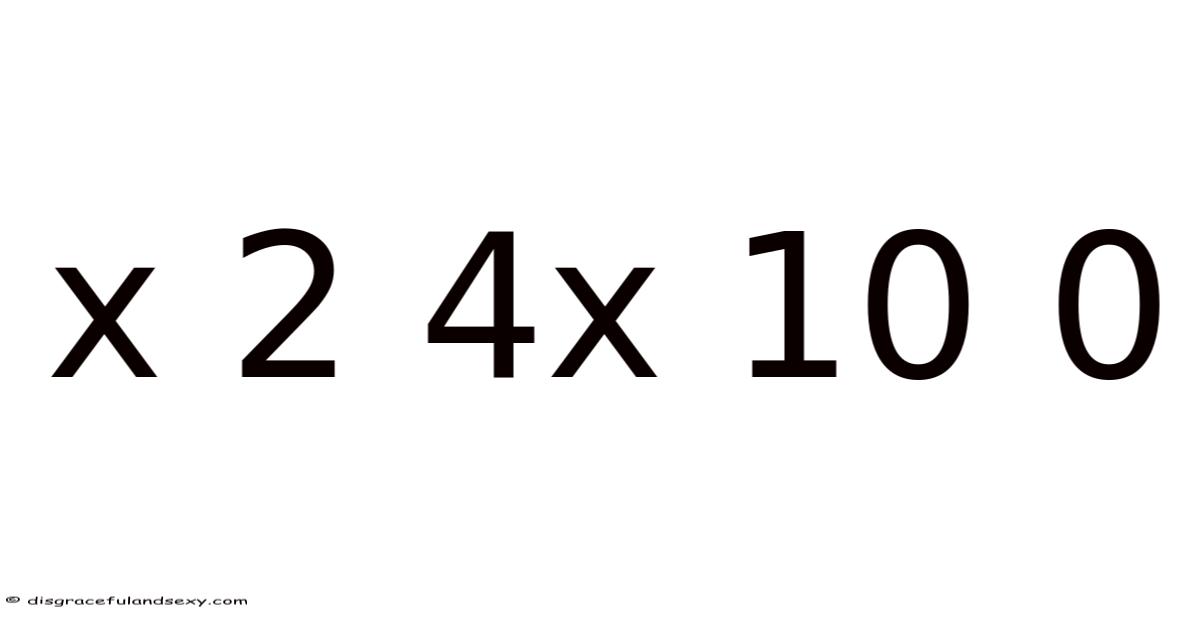
Decoding the Sequence: x 2 4x 10 0 – An Exploration of Patterns, Logic, and Problem-Solving
This article breaks down the seemingly simple sequence "x 2 4x 10 0," exploring its potential meanings, underlying patterns, and the problem-solving strategies required to decipher it. So we'll investigate various possibilities, from mathematical operations and code-breaking to logical deductions and creative interpretations. Now, understanding this sequence requires a blend of analytical thinking, pattern recognition, and a willingness to consider multiple perspectives. This exploration will enhance your problem-solving skills and highlight the importance of considering various approaches when facing seemingly ambiguous information.
Understanding the Problem: Defining the Parameters
The sequence "x 2 4x 10 0" presents an immediate challenge: what does "x" represent? Consider this: is it a variable, a placeholder for an unknown number, or something else entirely? Which means the inclusion of numbers and the symbol "x" suggests a mathematical or logical relationship, but the lack of explicit operators (like "+", "-", "*", "/") leaves room for interpretation. This ambiguity is crucial; it forces us to consider multiple possibilities and develop a systematic approach to problem-solving. The absence of context further adds to the challenge, making it a perfect exercise in deductive reasoning Less friction, more output..
Potential Interpretations and Solutions: A Multifaceted Approach
Let's examine several approaches to understanding this sequence, acknowledging that there might be multiple valid solutions depending on the underlying assumptions.
1. The Mathematical Approach: Exploring Numerical Relationships
One approach is to treat "x" as a variable and explore potential mathematical relationships between the elements.
-
Hypothesis 1: A simple arithmetic progression: This assumes a consistent mathematical operation between consecutive elements. Still, simply adding, subtracting, multiplying, or dividing does not yield a consistent pattern.
-
Hypothesis 2: A more complex mathematical relationship: We might need to consider more complex operations. Take this: could the sequence represent a function or a series? Exploring different mathematical functions (polynomial, exponential, logarithmic, etc.) might reveal a pattern. This approach would involve fitting the given numbers to different functions and testing the fit.
-
Hypothesis 3: Encoded Numbers: Consider the possibility that the "x" represents a specific digit or a set of digits. It might be part of an encoded message where "x" acts as a wildcard or stands for a particular mathematical operation. Trying various numerical substitutions for "x" could tap into a pattern, perhaps revealing a cryptographic code Worth keeping that in mind. Took long enough..
2. The Logical Approach: Identifying Patterns and Sequences
This approach focuses on identifying logical patterns rather than strictly mathematical ones Not complicated — just consistent..
-
Hypothesis 1: Alternating Patterns: Analyze the sequence for alternating patterns. The sequence could be broken down into smaller sub-sequences, which when analyzed separately, reveal a logical pattern that links them together. To give you an idea, 2 and 10 could have a pattern separate from 4 and 0, and the "x" is a placeholder for something that connects those two groups.
-
Hypothesis 2: Positional Significance: Consider the position of each element in the sequence. Is there a relationship between the position and the value? Perhaps the position in the sequence could be acting as an index for a hidden mapping No workaround needed..
-
Hypothesis 3: A code or cipher: The sequence could represent a simple substitution cipher. Each number could represent a letter or symbol, and "x" might be a key to unlocking the code That alone is useful..
3. The Creative Approach: Considering Alternative Interpretations
Beyond the mathematical and logical, we can explore more creative interpretations.
-
Hypothesis 1: A riddle or puzzle: The sequence might be part of a larger riddle or puzzle with hidden clues. The context in which this sequence was presented is vital in this instance.
-
Hypothesis 2: A symbolic representation: Each number could represent something else entirely, depending on the context or a specific system of symbols. As an example, "x" could symbolize a specific event or concept.
A Systematic Approach to Problem Solving: Strategies for Deciphering the Sequence
To effectively solve this type of problem, a structured approach is crucial:
-
Data Analysis: Carefully examine the given sequence. Note any obvious patterns, repetitions, or anomalies.
-
Hypothesis Generation: Based on the analysis, formulate multiple hypotheses about the underlying relationships. Don't be afraid to think outside the box.
-
Testing and Refinement: Systematically test each hypothesis. This might involve mathematical calculations, logical deductions, or even trial and error. Refine your hypotheses based on the results of your tests.
-
Iteration and Exploration: Be prepared to iterate through multiple hypotheses and refine your approaches. Don't get discouraged if your initial attempts fail.
-
Contextual Consideration: If the sequence was provided within a specific context (e.g., a puzzle, a code, a mathematical problem), incorporate that context into your analysis And that's really what it comes down to..
The Importance of Multiple Perspectives and Collaborative Problem Solving
Solving complex problems often requires diverse perspectives. That said, , strong mathematical skills) can complement the strengths of another (e. g.Collaboration, where individuals with different backgrounds and expertise work together, can be incredibly effective. g.The strengths of one individual (e., exceptional pattern recognition abilities) Simple, but easy to overlook..
Conclusion: The Value of Ambiguity and the Power of Deductive Reasoning
The seemingly simple sequence "x 2 4x 10 0" presents a fascinating challenge. So naturally, its ambiguity forces us to engage in critical thinking, problem-solving, and creative interpretation. Think about it: the true solution might depend heavily on the unseen context from which this sequence originates. Still, the process of attempting to solve it strengthens analytical skills and promotes a deeper understanding of problem-solving methodologies. This exploration highlights the importance of structured approaches, multiple perspectives, and iterative refinement in navigating complex, and potentially ambiguous, information. And it’s not just about finding the answer; it’s about developing the ability to approach such problems systematically and creatively. The journey of exploring potential solutions is as valuable as finding a definitive answer.
