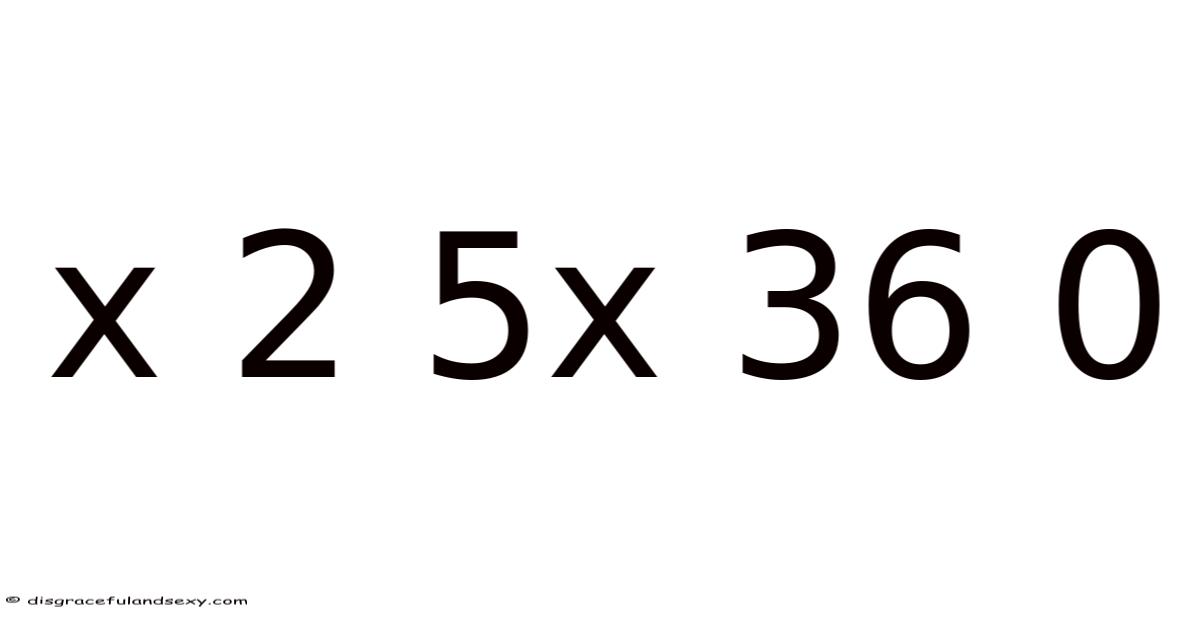
Decoding the Sequence: Exploring the Pattern in "x 2 5x 36 0"
This article looks at the fascinating world of number sequences and pattern recognition, focusing on the seemingly cryptic sequence "x 2 5x 36 0." We'll explore different approaches to decipher this sequence, examining potential mathematical relationships, logical deductions, and even considering the possibility of hidden codes or ciphers. Understanding this sequence requires a blend of mathematical reasoning, logical thinking, and a touch of creative problem-solving. This exploration will not only unravel the mystery of this specific sequence but also equip you with valuable skills in pattern recognition and analytical thinking.
Understanding the Problem: Identifying the Variables
At first glance, "x 2 5x 36 0" appears to be a random collection of numbers and a variable "x.So " Still, the presence of "x" suggests a relationship between the numbers and this unknown variable. So the challenge lies in identifying the pattern or rule that governs this relationship and ultimately determining the value of "x. " The lack of clear operators (+, -, ×, ÷) adds an extra layer of complexity, forcing us to consider more abstract relationships.
Approach 1: Algebraic Exploration
Let's assume the sequence represents a mathematical equation or expression. This approach assumes that the elements of the sequence are coefficients or terms in a polynomial expression. One approach is to treat the sequence as a polynomial equation. Take this case: we can try to fit this into a quadratic equation of the form: ax² + bx + c = 0 But it adds up..
On the flip side, directly applying this approach faces challenges. Think about it: we have "5x" which indicates a linear term alongside a possible quadratic one, complicating the straightforward use of a simple quadratic equation. On the flip side, further, we don't have a clear operator defining the relationship between the elements. To proceed using this approach, we would need to make assumptions regarding implied operators between the terms.
People argue about this. Here's where I land on it.
- x * 2 + 5x + 36 = 0
This leads to a simple quadratic equation that can be solved using the quadratic formula or factoring techniques. Solving this specific example would give a value for 'x'. That said, this is just one potential interpretation. Other interpretations involving different operators or even higher order polynomials are equally possible.
Approach 2: Geometric Progression Analysis
Another avenue to explore is whether the sequence forms a geometric progression (GP) or a modified version thereof. A geometric progression is a sequence where each term is the product of the previous term and a constant value (the common ratio). Even so, the presence of the variable "x" makes a straightforward application of GP principles difficult. We need to consider scenarios where x influences the common ratio or acts as a multiplier in some form And that's really what it comes down to..
Some disagree here. Fair enough Most people skip this — try not to..
Let's consider various possibilities:
-
Scenario 1: x as a common ratio: If x were the common ratio, the progression might look like: x, 2x, 5x², 36x³, 0. This, however, doesn’t immediately show a clear pattern or solvable equation.
-
Scenario 2: x as a multiplier: We could posit that 'x' multiplies subsets of the sequence. Here's one way to look at it: maybe 'x' multiplies the first two terms, and a different logic applies to the rest.
Approach 3: Logical Deduction and Pattern Recognition
Besides algebraic manipulation, we can approach the problem logically by looking for patterns or relationships between the numbers themselves. Let's analyze the individual numbers in the sequence: 2, 5, 36, 0. Are there any prime factorizations or other mathematical relationships we can make use of?
Short version: it depends. Long version — keep reading.
-
Prime factorization: The prime factorization of each number might reveal hidden connections:
- 2 = 2
- 5 = 5
- 36 = 2² * 3²
- 0 = 0 (The zero complicates the search for a consistent pattern)
-
Differences and ratios: We can examine the differences or ratios between consecutive numbers. Still, without a defined operation between them, drawing conclusions from differences or ratios is speculative Easy to understand, harder to ignore..
-
Number Properties: Investigating properties of each number like even/odd, perfect squares, etc., might provide some clues, especially if they correlate with the position of the number in the sequence.
Approach 4: Considering Codes or Ciphers
It's also worth considering whether the sequence represents a coded message or cipher. The inclusion of "x" might be a deliberate distraction, a red herring designed to mislead us away from a simpler solution. We could examine:
-
Substitution ciphers: Each number might represent a letter or symbol according to a substitution key. Even so, without a longer sequence, this approach is highly speculative Simple as that..
-
Numerical codes: The sequence might represent a specific numerical code used in a particular field (e.g., cryptography, encoding). Still, identifying such a code without additional context is highly improbable It's one of those things that adds up..
Addressing the '0' in the Sequence
The presence of a zero is significant. A zero often indicates a termination point, a resetting of a counter, or a significant change in the pattern. So this makes it highly unlikely that the sequence represents a straightforward arithmetic progression. The zero might signal a breakpoint in an otherwise more complex mathematical relationship Less friction, more output..
The Importance of Context
The lack of context surrounding the sequence significantly hampers our ability to decipher it. Which means where did this sequence originate? Is there additional information (a question, a puzzle, instructions) associated with it? Context provides essential clues that often hold the key to understanding complex patterns.
Conclusion: The Ongoing Search for Meaning
Unraveling the mystery behind the sequence "x 2 5x 36 0" requires a multi-faceted approach. We've explored several avenues, from algebraic manipulation and geometric progression analysis to logical deduction and the possibility of hidden codes. The ambiguity inherent in the problem highlights the critical role of context and the need for creative problem-solving. While we haven't found a definitive solution, the process of exploring various approaches provides valuable insights into pattern recognition, mathematical reasoning, and the importance of considering multiple perspectives when tackling complex problems. In real terms, more information or a clearer definition of the problem would greatly aid in finding a definitive answer. The pursuit of understanding, however, is just as valuable as finding the final answer. The sequence serves as a great exercise in critical thinking and problem-solving, demonstrating the diverse skill set required to tackle seemingly unsolvable mathematical puzzles Worth keeping that in mind. Simple as that..
