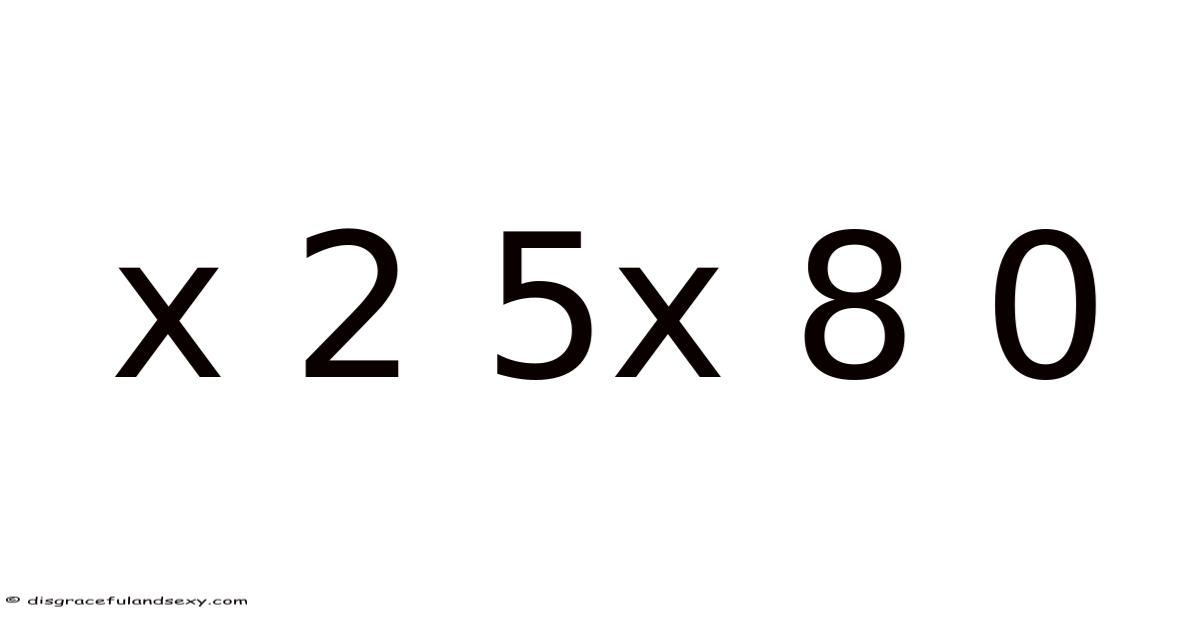
Decoding the Enigma: Exploring the Mathematical Sequence X 2 5X 8 0
This article digs into the intriguing mathematical sequence represented by "X 2 5X 8 0." We will unpack this sequence, explore potential interpretations, and investigate the underlying mathematical principles at play. Still, understanding this sequence might involve exploring various mathematical concepts like algebraic equations, number patterns, and even logic puzzles. Let's unravel the mystery behind this enigmatic expression Worth keeping that in mind. Less friction, more output..
Understanding the Components: X, 2, 5X, 8, and 0
Before we look at potential interpretations, let's dissect the individual components of the sequence: "X 2 5X 8 0". The presence of "X" immediately suggests an algebraic expression where "X" represents an unknown variable. The remaining numbers (2, 5, 8, and 0) provide the numerical context within which we need to solve for "X".
The juxtaposition of "X" and "5X" indicates a possible relationship between these two terms, hinting at a pattern or a mathematical operation. On the flip side, the inclusion of 2, 8, and 0 adds another layer of complexity, raising questions about the type of sequence or equation we are dealing with. Is it an arithmetic progression, a geometric progression, a quadratic equation, or something else entirely?
Potential Interpretations and Solutions
The sequence "X 2 5X 8 0" can be interpreted in several ways, depending on the assumed relationship between the elements. Let's explore a few possibilities:
1. As a Simple Algebraic Equation:
One approach is to treat the sequence as a simplified algebraic equation. We might interpret it as a series of related terms, potentially connected by an equals sign. For instance:
- Scenario A: X + 2 = 5X + 8 - 0
This scenario allows us to solve for X:
- Simplify the equation: X + 2 = 5X + 8
- Subtract X from both sides: 2 = 4X + 8
- Subtract 8 from both sides: -6 = 4X
- Divide both sides by 4: X = -3/2 or -1.5
- Scenario B: X + 2 + 5X + 8 = 0
This leads to a different solution:
- Combine like terms: 6X + 10 = 0
- Subtract 10 from both sides: 6X = -10
- Divide both sides by 6: X = -10/6 = -5/3 or approximately -1.67
These two scenarios illustrate that simply interpreting the sequence as a straightforward equation can yield multiple solutions, depending on how we connect the terms Small thing, real impact..
2. As a Sequence with a Pattern:
Alternatively, we could analyze the sequence as a numerical pattern, looking for relationships between consecutive elements. Even so, this approach might involve identifying arithmetic progressions, geometric progressions, or other types of sequences. We need additional information or context to determine if there is a defined pattern underlying the sequence. Even so, the presence of "X" and "5X" makes directly identifying a standard pattern challenging. We might need to define a specific pattern or rule for the sequence.
3. As a Logical Puzzle or Cryptogram:
The sequence could also represent a coded message or a logical puzzle. On top of that, in this interpretation, the numbers might represent letters, symbols, or positions in a system. This method might require additional context or clues. The "X" might be a wildcard or placeholder that requires deciphering using other information. Without further contextual details, deciphering this sequence as a cryptogram would be purely speculative Most people skip this — try not to..
Exploring More Complex Mathematical Interpretations
If we assume a more complex relationship between the elements, we could potentially model the sequence using more advanced mathematical tools. To give you an idea, we might consider the sequence as part of a larger function or equation.
1. Quadratic Equations and Polynomials:
The presence of X and 5X suggests a potential quadratic equation or a polynomial expression. Even so, the presence of the constant terms (2, 8, and 0) makes defining a specific quadratic equation challenging without further context.
To demonstrate, consider a potential quadratic equation involving the given terms:
- Example: aX² + bX + c = 0
Where a, b, and c are constants that need to be determined to fit the given sequence. Now, finding these constants would require additional information or constraints. A single sequence alone is insufficient to fully define a quadratic or higher-order equation.
2. Functional Analysis:
More advanced mathematical concepts like functional analysis could be brought to bear if the sequence represents a part of a larger mathematical function or transformation. To illustrate this, imagine a functional relationship where the output depends on the input (X). That said, without a defined function or specific rules, it remains purely hypothetical.
The Importance of Context and Additional Information
The ambiguity of the sequence "X 2 5X 8 0" highlights the crucial role of context in mathematical problem-solving. A sequence presented in isolation can often have multiple interpretations and solutions. To arrive at a definitive answer, we need additional information such as:
- The origin of the sequence: Where did this sequence come from? Was it part of a larger problem, a puzzle, a code, or an equation?
- Constraints or rules: Are there any restrictions on the possible values of X? Does X have to be an integer, a real number, or something else?
- The intended operation: What operation should be performed on these elements? Are we adding, subtracting, multiplying, or using some other mathematical operator?
Frequently Asked Questions (FAQ)
Q1: Is there only one correct solution to this sequence?
A1: No, without additional context, there isn't a single, definitively correct solution. The multiple interpretations and solutions outlined above demonstrate this ambiguity.
Q2: Can this sequence be interpreted as a geometric progression?
A2: It's unlikely to be a simple geometric progression because of the presence of the variable "X" and the non-uniform spacing between the terms. Geometric progressions have a constant ratio between consecutive terms It's one of those things that adds up..
Q3: Could this be a code or a cipher?
A3: It's possible, but we lack the key or the context to decipher it as a code. Further information is needed to determine if this is the case Took long enough..
Q4: What mathematical concepts are relevant to understanding this sequence?
A4: Depending on the interpretation, various mathematical concepts could be relevant, including algebra, number theory, sequences and series, quadratic equations, functional analysis, and even cryptography.
Conclusion: The Value of Mathematical Exploration
The exploration of the sequence "X 2 5X 8 0" showcases the beauty and complexity of mathematics. The journey to unravel the mystery, rather than simply finding the answer, is often the most rewarding aspect of mathematical problem-solving. Also, it underscores the importance of considering various interpretations and the necessity of having sufficient context to solve mathematical problems effectively. On the flip side, even seemingly simple sequences can lead to rich mathematical explorations. While we haven't arrived at a single definitive solution, the process of investigating this sequence has illustrated the importance of critical thinking, logical reasoning, and the creative application of mathematical principles. The ambiguous nature of this sequence serves as a valuable reminder of the importance of rigorous definitions and sufficient contextual information in mathematical analysis.
You'll probably want to bookmark this section.
